Equipment serial and date-code decoder: verify the format
Choose the maker of the plate being read and enter its serial or date-code field. The covered format can identify a production date, week, year or an unresolved year code.
Keep the equipment plate separate from the engine plate. Verify the interpretation with the actual model and applicable manufacturer document.
Covered formats have different precision
| Maker / scope | Covered result |
|---|---|
| Briggs separate 8-digit code | Year, month, day; final two assembly-code digits retained |
| Husqvarna professional handheld 9/11 digits | Year, week and production sequence |
| Kohler cited Command codes 49–51 | Year 2019–2021 only; no invented day or plant |
| MTD / Cub Cadet covered 11-character serial | Month/day; older numeric year code stays decade-ambiguous |
| Other application | Use its actual date label or maker lookup |
The Briggs reference explains the eight-digit date code. Applying it to 01061201 yields June 12, 2001, with assembly code 01. A month/day combination such as February 31 is rejected, as is a date in the future.
Husqvarna’s professional-product example uses 054200362, or 20054200362 in its longer form: week 42 of 2005, sequence 00362. That does not establish a universal format for robotic and battery products.
MTD does publish date fields
MTD’s own guide identifies characters two through five as month, day and year code. Its 1L080B50230 example means December 8 with an older year ending in zero; the example itself leaves 2000/2010 unresolved. The updated table also supplies letter codes M through T for 2021–2026, omitting specified letters.
The cited Kohler Command service table lists codes 49, 50 and 51 for 2019, 2020 and 2021; only that cited range is decoded here. A ten-digit length alone does not authorize decoding a day-of-year, plant or later extrapolated year.
A production date is not a purchase date, warranty decision or recall clearance. Use Equipment identification before ordering parts and the actual recall lookup for those separate tasks.
Serial number date decoder
The current tool covers the separate eight-digit Briggs code, the specified professional Husqvarna year/week format, the cited limited Kohler year table and the MTD equipment month/day/year-code convention. Other selections direct the owner to the actual date plate or manufacturer lookup. Published historical formats, including older Champion examples, are not a promise that every brand selection is decoded here.
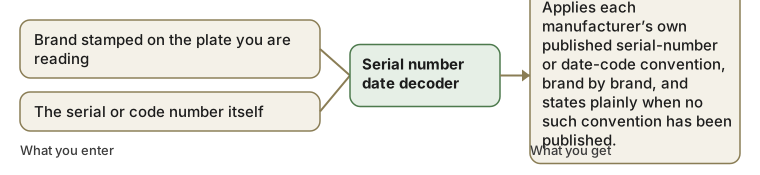
Choose the brand stamped on the plate, then type the serial or date-code number itself, not the model number. On most machines the two are printed side by side; the engine's own plate is a separate, second number from the equipment's, and each brand's convention applies to its own plate. Locate model plates and engine IDs covers finding either one when a machine has never had it recorded.
What "confidence" means in the result
| Level | What it means |
|---|---|
| Matched published format | The entered code matches a covered manufacturer convention. Verify it against the actual plate and applicable product era. |
| Supported year only | Kohler codes 49–51 report the supported year from the cited table, without decoding a production day, sequence or plant. |
| Ambiguous older decade | An older MTD numeric year code can identify month and day without settling the decade. Use the equipment model and records to establish it. |
| Lookup required | The code or brand is outside the implemented evidence. Use the manufacturer or exact model-and-serial lookup rather than guessing. |
Why three brands decode nothing
Toro and Cub Cadet/MTD solve the same problem a different way: instead of publishing one arithmetic rule, they run a lookup tool that matches your specific model number against the serial-number ranges that model shipped in, one model at a time. That is a real answer, it is simply not a formula this tool can apply without knowing your model number too, so the result links you to that brand's own tool instead.
Honda documents where its serial number is, not how to read a date from it, so a US-market Honda small engine is better dated from its federally required emission label, covered on reading the EPA emission control label, which states a model year by law regardless of brand. EGO prints its manufacture date as a separate field next to the serial rather than inside it.
And Craftsman was never one manufacturer: it was a store brand, so there was never one code for it to have.
Serial-label interpretation
What this tool checks
Each brand gets its own branch, and every branch applies only a convention that brand itself has published, cited below. Nothing here interpolates a missing year inside a documented range, and nothing here treats a widely repeated online claim as fact unless a manufacturer's own page or service document was found to confirm it.
Why some brands decode and others don't
The current tool covers the separate eight-digit Briggs code, the specified professional Husqvarna year/week format, the cited limited Kohler year table and the MTD equipment month/day/year-code convention. Other selections direct the owner to the actual date plate or manufacturer lookup. Published historical formats, including older Champion examples, are not a promise that every brand selection is decoded here.
Maker and serial formats
- Every result reads a manufacturer-published convention. None of it is inferred from the machine itself, and a plate on the actual equipment always wins over this tool.
- A brand with no verified formula is reported as such, never left blank or guessed at, per this site's no-invented-data standard.
- The current calculator declines year extrapolation, inferred day or plant fields and unsupported era guesses. Kohler results are limited to codes 49–51 in the cited Command table, meaning 2019–2021. Outside that range, consult the exact engine manual. An attractive arithmetic pattern is not manufacturer confirmation, and the tool does not promote it to a medium-confidence result.
Serial-format example
Given: A Briggs & Stratton code number of 99011556.
Work: Digits 1-2 (99) → 1999. Digits 3-4 (01) → January.
Digits 5-6 (15) → the 15th. Digits 7-8 (56) → plant/line.
Result: Made January 15, 1999. This is Briggs & Stratton’s own published example.
Given: A Kohler ten-digit serial of 3202101491. Its length alone does not establish a supported manufacture date.
Work: The segments 32, 021, 0149 and 1 do not establish a verified year, day, sequence or plant. Adding 1970 + 32 gives 2002 arithmetically, but the cited manufacturer table used here covers only year codes 49–51. That arithmetic is not a supported decoding for this serial.
Result: No supported date or production sequence is returned. Use the engine model, specification and serial with the manufacturer’s lookup; do not order era-specific parts on an inferred January 21, 2002 date.
Calculator version 1.0.0. Saved results record this version and your inputs, so a later formula change never rewrites an old result.
Serial number date decoder: questions
Which brands can the serial number decoder date?
Craftsman is a store-brand identity used by several equipment manufacturers. The current calculator requests the actual manufacturer and model lookup rather than returning an inferred MMDDYY date. Preserve the equipment model and engine identity together so the correct parts and service channel can be selected for that product and era.
Why does Briggs & Stratton decode but Honda does not?
Because Briggs & Stratton publishes an explicit 8-digit date-code formula, year, month, day, plant, on its own support pages, and this tool applies exactly that. Honda's own serial-number page shows only where the plate is fitted, not how to derive a date from it, so there is nothing published to apply. A US-market Honda small engine still carries a date of manufacture on its federally required emission label instead.
What does a "Medium" confidence result mean?
The current calculator declines year extrapolation, inferred day or plant fields and unsupported era guesses. Kohler results are limited to codes 49–51 in the cited Command table, meaning 2019–2021. Outside that range, consult the exact engine manual.
An attractive arithmetic pattern is not manufacturer confirmation, and the tool does not promote it to a medium-confidence result.
Why does Kohler show different confidence depending on the year?
The cited Kohler Command table supports year codes 49, 50 and 51 for 2019, 2020 and 2021. That evidence does not identify a production day or plant. The current result reports the supported year only and declines other eras instead of extending a formula into an unverified range.
What if the decoder's result disagrees with a date printed on the box or a warranty card?
The physical machine wins. This tool applies a manufacturer's published convention to the number you typed; it cannot see the plate, the box or the warranty card in front of you, and every result carries a standing note saying exactly that. A typo in the serial you entered, or a paperwork date that reflects when the unit was sold rather than built, are the two most common reasons for a mismatch.
Why does Craftsman get a "possibly" answer instead of a definite one?
Craftsman is a store-brand identity used by several equipment manufacturers. The current calculator requests the actual manufacturer and model lookup rather than returning an inferred MMDDYY date. Preserve the equipment model and engine identity together so the correct parts and service channel can be selected for that product and era.
What is the difference between the model number and the serial or code number the tool asks for?
The model number identifies which product it is; the serial or date-code number identifies the individual unit and, on the brands this tool decodes, encodes when it was built. Briggs & Stratton keeps these as separate numbers on the same plate, often labeled Model, Type and Code, and entering the model number where the tool wants the code returns a length mismatch rather than a wrong date.
Why does Champion's formula only cover engines built before 2011?
Because that is the entire scope of the formula Champion Power Equipment itself publishes: the first four digits, year then month. No public formula exists for current-production Champion portable generators, so entering a modern, longer serial declines outright rather than misapplying a pre-2011 rule to a unit it was never documented to cover.
Does EGO print a manufacture date anywhere on the product?
Yes, but as its own separate field, typically a month and year, printed near the serial number on the label rather than encoded inside the serial itself. EGO's own documentation shows this layout, which is why the decoder declines for EGO: there is nothing to decode from the serial, because the date is already written out in plain form beside it.
What happens if I type a serial number with dashes, spaces or lowercase letters?
The tool strips anything that is not a letter or a digit before applying any brand's formula, and treats letters case-insensitively, so "A-12 34" and "a1234" are read the same way a plain "A1234" would be. What matters is the count and pattern of the actual digits and letters, not the punctuation around them.
Why does Husqvarna's formula only apply to petrol handheld products?
Because that is the specific product category Husqvarna's own support pages document the 9- and 11-digit serial formats for, chainsaws, trimmers and blowers. Husqvarna's battery and robotic products may follow a different numbering scheme that was not found published anywhere, so the tool declines rather than assuming the same formula carries over to a different product line without evidence.