Generator cord voltage-drop calculator
Enter actual current, supply voltage, one-way cord length and a selected voltage-drop limit. The result compares six copper gauges by calculated drop only. Verify the complete cord’s marked current rating, connectors, outdoor suitability and equipment instructions before choosing a cord.
Two conductors make the voltage-drop path
For a single-phase two-wire current path, drop = 2 × one-way feet × amps × resistance per 1,000 feet ÷ 1,000. The fixed resistance assumptions are 4.99, 3.14, 1.98, 1.24, .778 and .51 ohms/1,000 feet for 16 through 6 AWG copper. They represent warm-conductor planning values, not a measurement of your assembled cord.
| Gauge | Calculated drop | Share of 120 V |
|---|---|---|
| 14 AWG | 9.42 V | 7.85% |
| 12 AWG | 5.94 V | 4.95% |
| 10 AWG | 3.72 V | 3.10% |
| 8 AWG | 2.334 V | 1.945% |
At a selected 5-percent limit, 12 AWG is the first listed drop candidate in this example. At 3 percent, the 10-AWG result still exceeds 3.6 volts and 8 AWG is the first listed candidate. These results do not establish that a particular cord assembly is approved for the load.
Use the equipment’s limit
Southwire’s voltage-drop calculator provides a manufacturer comparison tool with broader installation inputs. Temperature, material, connections, motor starting and supply behavior can change the real result. Three and five percent here are selectable screens, not universal motor/resistive-load permissions.
A longer or heavier cord does not authorize a connector adapter, parallel cords or backfeeding a building outlet. Stop for damaged insulation, missing grounds, wet connections or overheating.
CPSC’s extension-cord guidance covers cord selection and safe use. Use load planning separately from an electrical fault diagnosis.
Generator extension cord gauge
A long thin cord does two things at once and both of them matter. It drops voltage, which starves a motor of the volts it needs to start and makes it draw more current trying. The reason a pump that runs happily on a short cord will not start on a long one.
And it turns that lost voltage into heat inside the cord, which is the reason a cord that feels warm along its length is telling you something. This tool steps up through standard cord sizes and returns the first one that satisfies both tests: the voltage drop stays inside the limit you set, and the cord’s own current rating covers the load. Both have to pass, because a cord can be thick enough to hold the voltage up and still be undersized for the amps.
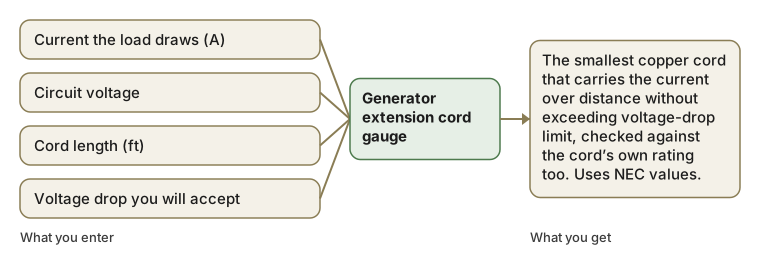
Enter the current the load draws, watts divided by volts, so an 1,800 W load on 120 V is 15 A, the circuit voltage, the full length of the run rather than the straight-line distance, and how much voltage drop you will accept.
Which drop limit to choose
Three percent is the conventional target for anything that has to start: motors, pumps, compressors, anything with a fan. Five percent is tolerable for purely resistive loads such as heaters and lights, which simply run a little cooler or dimmer rather than failing to start at all.
Where the resistance values come from
The calculation uses the DC resistance of uncoated stranded copper at 75 °C from the National Electrical Code conductor-properties table: 16 AWG 4.99, 14 AWG 3.14, 12 AWG 1.98, 10 AWG 1.24, 8 AWG 0.778 and 6 AWG 0.51 ohms per 1,000 feet. Extension cords are stranded rather than solid, which is why the stranded column applies. Those figures are for warm conductors; a cold cord has slightly lower resistance, so the answer errs toward a heavier cord rather than a lighter one.
The common cases, worked
| Load | 25 ft | 50 ft | 100 ft | 150 ft |
|---|---|---|---|---|
| 5 A (600 W) | 16 AWG | 16 AWG | 14 AWG | 12 AWG |
| 10 A (1,200 W) | 16 AWG | 14 AWG | 10 AWG | 8 AWG |
| 15 A (1,800 W) | 14 AWG | 12 AWG | 8 AWG | 8 AWG |
| 20 A (2,400 W) | 12 AWG | 10 AWG | 8 AWG | 6 AWG |
| 30 A (3,600 W) | 10 AWG | 8 AWG | 6 AWG | no cord size |
At 5%, acceptable for heaters and lights, not for motors, several of these move one size lighter. Run the calculator for your own case rather than interpolating between rows.
What this does not do
It sizes a cord. It does not size, approve or design any connection between a generator and a building’s wiring: that is a transfer switch or a listed interlock kit fitted by a licensed electrician, and it is the only correct method. Feeding a house through a cord plugged into a wall outlet energises the utility line and can kill a lineworker.
Cord voltage-drop calculation
The formula
Voltage drop over a cord is the current multiplied by the resistance of the wire: counting both conductors, because the current travels out and back:
drop (V) = 2 × length (ft) × current (A) × resistance (Ω per 1,000 ft) ÷ 1,000
The tool steps up through standard cord sizes and reports the first one whose drop is within your limit and whose current rating covers the load. Both tests have to pass: a cord can be thick enough to keep the voltage up and still be undersized for the current, or rated for the current and long enough to starve a motor.
Where the resistance figures come from
Ohms per 1,000 ft are the DC resistance of uncoated stranded copper at 75 °C from the National Electrical Code conductor-properties table: 16 AWG 4.99, 14 AWG 3.14, 12 AWG 1.98, 10 AWG 1.24, 8 AWG 0.778 and 6 AWG 0.51. Extension cords are stranded, so the stranded column applies. Resistance increases as the cord warms.
Conductor length and current
- Copper conductors. Aluminum extension cords exist and have roughly 1.6 times the resistance of copper for the same gauge.
- The current ratings used are the ordinary ratings for portable cord sets: 16 AWG 10 A, 14 AWG 15 A, 12 AWG 20 A, 10 AWG 30 A, 8 AWG 40 A, 6 AWG 55 A. A specific cord’s printed rating always wins over this table.
- A 3% limit is the conventional target for anything with a motor; 5% is tolerable for purely resistive loads.
- This sizes a cord. It does not size or approve a connection to a building’s wiring.
Extension-cord example
Given: 15 A on 120 V over 100 ft, 5% drop allowed (6.0 V).
Work: 14 AWG: 2 × 100 × 15 × 3.14 ÷ 1,000 = 9.42 V: too much. 12 AWG: 2 × 100 × 15 × 1.98 ÷ 1,000 = 5.94 V: inside the limit.
Result: 12 AWG, dropping 5.94 V (5.0%).
Given: 20 A on 120 V over 50 ft, 3% drop allowed (3.6 V).
Work: 12 AWG: 2 × 50 × 20 × 1.98 ÷ 1,000 = 3.96 V: just over. 10 AWG: 2 × 50 × 20 × 1.24 ÷ 1,000 = 2.48 V: inside.
Result: 10 AWG. The 12 AWG cord most people own misses this one by a third of a volt.
When cord ratings require an electrician
- Never feed a house through a cord plugged into a wall outlet. Backfeeding energises the utility line and can kill a lineworker; a transfer switch or interlock fitted by a licensed electrician is the only correct connection.
- A cord that is warm to the touch along its length is undersized for what it is carrying. Stop and fix the cause.
- Wet conditions, damaged insulation or a missing ground pin are stop conditions on their own, whatever the gauge says.
Generator extension cord gauge: source values
- National Electrical Code, Chapter 9, Table 8: Conductor Properties: National Fire Protection Association, NFPA 70, Chapter 9, Table 8. Retrieved 2026-09-02.
Calculator version 1.0.0. Saved results record this version and your inputs, so a later formula change never rewrites an old result.
Generator extension cord gauge: questions
What gauge extension cord do I need for my generator?
The smallest copper cord that keeps the voltage drop inside your limit over the full run length and whose own current rating covers the load: both tests have to pass. Enter the current, which is watts divided by volts, the voltage, the actual run length and your drop limit. As a rough guide at a 3% limit on 120 V, a 15-amp load wants about 14 AWG at 25 feet but 10 AWG by 100 feet.
What voltage-drop limit should I use for a generator cord?
Three percent for anything that has to start, motors, pumps, compressors, anything with a fan, because a starved motor draws more current trying to start and may not start at all. Five percent is tolerable for purely resistive loads like heaters and lights, which simply run a little cooler or dimmer. The calculator leans toward the stricter figure because that is the case that fails.
Why does a long thin cord stop my generator running an appliance?
Because it drops voltage under load, starving a motor of the volts it needs to start, and it turns that lost voltage into heat along the cord. The result is power at the generator and none at the appliance. A pump that runs on a short cord but not a long one.
Size the cord to the load and distance rather than moving the generator closer than its exhaust placement safely allows.
Can I use this calculator to connect a generator to my house?
No. This tool only sizes a cord; it does not size, approve or design any connection between a generator and a building’s wiring. That is a transfer switch or a listed interlock kit fitted by a licensed electrician, and it is the only correct method: feeding a house through a cord plugged into a wall outlet energizes the utility line and can kill a lineworker who believes it is dead.
Where do the copper conductor resistance values in this calculator come from?
The National Electrical Code's conductor-properties table (NFPA 70, Chapter 9, Table 8), specifically the DC resistance of uncoated stranded copper at 75°C: extension cords use stranded conductors, which is why the stranded column applies rather than the solid-conductor figures also in that table.
Does a cold cord need a different gauge than a warm one?
The calculator's resistance figures are for warm conductors, and a cold cord has slightly lower resistance, so the calculator's answer errs toward a heavier cord than strictly necessary in cold conditions, which is the safer direction rather than the riskier one.
How many extension cords can I safely chain together for a generator?
This calculator sizes for the full run length as a single entry, so daisy-chaining multiple cords should be entered as their combined total length, not calculated per segment: each additional connection point also adds a connection-resistance and moisture-ingress risk this tool does not model, so a single cord of the correct gauge and length is preferable to several joined together.
Does the extension cord calculator account for the cord jacket rating, like outdoor vs. indoor use?
No: it calculates gauge based on electrical current, voltage drop and length only. Whether a cord is rated for outdoor and wet-location use is a separate, equally important specification to check on the cord's own jacket markings before using it with a generator outdoors.
Why does a 30-amp load need a much heavier cord than a 15-amp load at the same distance?
Because both voltage drop and heat generation in a cord scale with current, and a 30-amp load draws twice the current of a 15-amp load: doubling the current roughly quadruples the resistive heating for the same conductor size, which is why the required gauge steps up sharply rather than proportionally as amperage rises.
Can a generator extension cord exceed an appliance’s voltage-drop limit?
It can be, if the load is borderline sensitive equipment that behaves poorly with a dimmer or slightly reduced supply: the 5% figure is a conventional tolerance for purely resistive loads generally, not a guarantee for every resistive device. When in doubt, using the stricter 3% limit costs only a heavier cord, not a failure.
Does using a shorter, better-gauge cord ever let a smaller generator run a larger load?
No: cord gauge only affects how much of the generator's available power reaches the appliance; it cannot increase the generator's own running or starting-watt capacity. A correctly sized cord prevents wasted voltage from making an adequately sized generator seem underpowered, but it does not substitute for correct generator sizing in the first place.