Chain measurement calculator: pitch, gauge and drive links
Enter the center-to-center span across three consecutive rivets, the marked gauge and a counted whole number of drive links. Pitch is half that span. The result is a measurement candidate to verify against the saw, bar and sprocket, including chain family and kickback classification.
Measure the rivets; read the family marking
Oregon’s maintenance reference explains the cutting-system measurements and compatibility checks. Both low-profile and full-size 3/8-inch chain have a 0.375-inch pitch. Pitch alone cannot distinguish them, even when measured exactly.
| Three-rivet span | Half-span / pitch |
|---|---|
| 0.500 in | 0.250 in |
| 0.650 in | 0.325 in |
| 0.750 in | 0.375 in |
| 0.808 in | 0.404 in |
For a 0.750-inch span, .050-inch marked gauge and 55 drive links, the measurement description is 3/8 inch × .050 inch × 55 DL. The low-profile/full-size family and approved application remain to be checked. The tool flags that distinction whenever it identifies 3/8-inch pitch.
A tolerance is a screening choice
The calculator compares the half-span with four listed pitches and declines a match more than 0.005 inch away. That threshold is an input-screening choice, not a manufacturer’s chain tolerance. A mismatch calls for remeasurement and reading markings, not rounding into an order.
A .050-inch and .058-inch gauge differ by .008 inch. Three-eighths inch equals 9.525 millimeters; an earlier 9.525-millimeter conversion was wrong. Nominal metric gauge labels are also not permission to substitute a neighboring size.
Isolate all starting power and wear suitable gloves before handling chain. Use chain fitment guidance and kickback precautions before returning the saw to use.
Chainsaw chain identifier
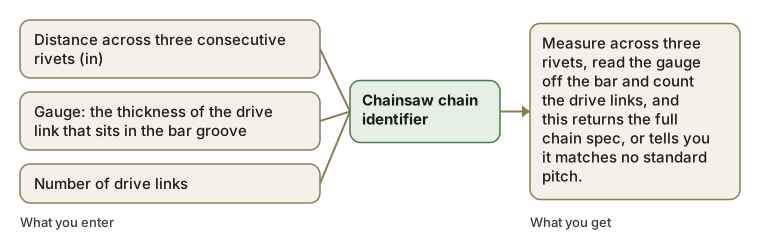
A replacement chain is ordered by three numbers, and the bar length printed on the saw gives you none of them. Pitch is the distance between drive links, taken as half the span across three consecutive rivets: three rather than two, because finding the exact center of a small rivet twice is where the error comes from. Gauge is the thickness of the drive-link tang riding in the bar groove, one of four values that cannot be told apart by eye.
Drive links is a count around the loop, and two nominally identical 18-inch bars routinely disagree about it. Enter the three and this returns the specification a counter can fill; if your rivet span is not close to any standard pitch, it says so rather than rounding to the nearest one and staying quiet.
Take the three measurements with the chain off the saw or with the saw isolated: spark plug lead removed, gloves on. A chain sharp enough to work is sharp enough to open a hand on a bench.
Taking the rivet span
Lay a rule along the chain with it pulled taut and measure from the center of one rivet to the center of the third. Halve it.
The result will land close to 0.25, 0.325, 0.375 or 0.404 inches, and those four are the pitches hand-held saws use. If it lands somewhere else, the measurement is wrong far more often than the chain is exotic.
A slack chain and a miscounted rivet are the two usual causes.
| Pitch | Pitch in decimal inches | Span across three rivets | Where you see it |
|---|---|---|---|
| 1/4 in | 0.250 | 0.500 in | Small top-handle and carving saws. |
| .325 in | 0.325 | 0.650 in | Mid-size saws; a common professional pitch. |
| 3/8 in | 0.375 | 0.750 in | The most common pitch overall, in both low-profile and full-size forms. |
| .404 in | 0.404 | 0.808 in | Large saws and harvesting equipment. |
Reading the gauge
The gauge is stamped on most bars, which is the reliable route. Measuring it needs a caliper or a gauge tool; .050 and .058 are eight thousandths of an inch apart in a place you cannot see clearly, and eyeballing it does not work.
Counting drive links
Mark one drive link with a marker and count every tang round the loop back to the mark. Being one out is the single most common ordering error in this category, and it produces a chain that cannot be tensioned rather than one that nearly fits.
The full explanation of what each number governs, and what goes wrong when each is out, is on chain: pitch, gauge and drive links.
Chain pitch and gauge arithmetic
What the three numbers are
Pitch is the distance between drive links, defined as half the
distance across three consecutive rivets. Measuring three rivets rather than two removes the
error from finding the exact center of a small rivet:
pitch = span across three rivets ÷ 2
Gauge is the thickness of the drive-link tang, which must match the width of the groove milled into the bar. Drive links is a count, not a measurement: it is how many tangs are in the loop, and it is what sets the length. A bar sold as "18 inch" does not have one drive-link count across brands.
Rounding to a standard pitch
Chain is manufactured to four common pitches. The tool takes your measurement, halves it, and reports the nearest standard value; if your measurement is more than 0.02 in from any of them, it says so rather than picking the closest one and staying quiet.
Bar and chain measurements
- Measurements are in inches. Metric equivalents are nominal: .325 in is quoted as 8.25 mm, 3/8 in as 9.525 mm.
- The four pitches covered are the ones used on hand-held saws. Harvester and specialty chain exists outside this set.
- Drive-link count is taken as given. Miscounting by one link is the single most common ordering error.
Chain-size example
Given: A three-rivet span of 0.75 in, a bar stamped .050, and 72 drive links counted.
Work: 0.75 ÷ 2 = 0.375 in, which is 3/8 in exactly.
Result: 3/8 in × .050 in × 72 DL.
Given: A three-rivet span of 0.65 in with a .063 bar and 84 drive links.
Work: 0.65 ÷ 2 = 0.325 in, matching the .325 pitch.
Result: .325 in × .063 in × 84 DL: a common combination on mid-size professional saws.
When the chain does not match the bar
- A chain that will not tension correctly, a bar with a visibly widened groove, or a sprocket with hooked teeth are wear problems, not sizing problems. Fitting a new chain to a worn sprocket wears the chain out quickly.
- Low-kickback chain is a safety feature specified in the chain-saw standard. Replacing it with a chain that does not carry that classification changes how the saw behaves in a kickback.
Chainsaw chain identifier: source values
- Outdoor Power Equipment, Internal Combustion Engine-Powered Hand-Held Chain Saws, Safety and Environmental Requirements: Outdoor Power Equipment Institute / ANSI, ANSI/OPEI B175.1-2012 (with A1-2014). Retrieved 2026-09-02.
Calculator version 1.0.0. Saved results record this version and your inputs, so a later formula change never rewrites an old result.
Chainsaw chain identifier: questions
How do I identify what chainsaw chain I need?
Take three measurements off the saw: the pitch, from half the span across three rivets; the gauge, the drive-link thickness, usually stamped on the bar; and the drive-link count around the loop. Enter them and the tool returns the specification a counter can fill. The bar length printed on the saw gives you none of the three, which is why "18-inch chain" is not an order that anyone can fill reliably.
How do I measure chainsaw chain pitch with a ruler?
Lay a rule along the taut chain and measure from the center of one rivet to the center of the third rivet, then halve it: three rivets rather than two, because finding the exact center of a small rivet twice is where error comes from. The result lands near 0.25, 0.325, 0.375 or 0.404 inch, the four pitches handheld saws use. If it lands elsewhere, the measurement is usually wrong rather than the chain exotic.
What if my chain measurement does not match a standard pitch?
The tool tells you so rather than rounding quietly to the nearest one. A rivet span that is not close to a standard pitch almost always means a measurement error, a slack chain or a miscounted rivet are the two usual causes, rather than an exotic chain, so re-measure with the chain pulled taut and the rivets counted a second time before ordering anything at all.
Why can two 18-inch bars need different chains?
Because bar length is the rounded cutting length and says nothing about the drive-link count or the pitch. Two nominally identical 18-inch bars, from different makers or the same maker in different pitches, routinely take different drive-link counts, and a chain one link out cannot be tensioned. That is why the chain is ordered on measured pitch, gauge and a counted number of drive links, not on the bar’s inch size.
How do I read chainsaw chain gauge without a caliper?
It usually can't be done reliably by eye: the gauge is stamped on most bars, which is the more reliable route than measuring. The four standard gauges are only eight thousandths of an inch apart from each other in places, which is not a difference eyeballing can distinguish; a caliper or a dedicated gauge tool is needed if the stamp is worn away.
What is the single most common chainsaw chain ordering mistake?
Being one drive link out on the count around the loop. It produces a chain that cannot be tensioned at all, rather than one that nearly fits, and it is the single most common ordering error in this category: mark one link with a marker before counting to avoid losing track partway around.
Should I take chain measurements with the chain still mounted on the saw?
Take the chain off the saw, or at minimum isolate the saw first: remove the spark-plug lead and wear gloves. A chain sharp enough to cut wood is sharp enough to open a hand on a bench, and the measurement itself does not require the saw to be running or even assembled.
Which of the four standard chainsaw chain pitches is most common?
3/8 inch (0.375 in, a three-rivet span of 0.750 in) is available on many saws, available in both low-profile and full-size forms and covering a wide range of saw sizes. 1/4 inch is reserved for small top-handle and carving saws, .325 inch is common on mid-size professional saws, and .404 inch is used on large saws and harvesting equipment.
Does this calculator tell me which brand of replacement chain to buy?
No: it returns the specification (pitch, gauge, drive-link count) that any manufacturer's chain must match to fit your saw. Which brand to buy at that specification is a separate purchasing decision this tool does not make.
Why does the chain calculator ask for three separate measurements instead of just the bar length?
Because bar length alone determines none of the three numbers a replacement chain is specified by: pitch, gauge and drive-link count. Two saws with the same bar length routinely need different chains, which is exactly why "18-inch chain" isn't a specification any supplier can reliably fill.
Do I need any special tools to measure a chainsaw chain besides a ruler?
A ruler is enough for the rivet-span measurement that gives pitch, but reading the gauge reliably needs a caliper or a dedicated bar-gauge tool, since the standard gauges are only thousandths of an inch apart: too fine a difference to judge by eye. Drive-link count needs only a marker to track your starting point around the loop.