Store outdoor equipment by its fuel, water and battery instructions
Store each machine using its own fuel, fluid, battery and attachment instructions. A treated fuel tank does not establish that the carburetor was prepared, and an engine storage routine does not protect a water-filled pump. Record the preparation performed and avoid an automatic mid-storage run that undoes it.
Complete the specified fuel procedure
Honda’s mower fuel guidance distinguishes storage durations and describes an outdoor ten-minute run after initial stabilizer addition. Other model procedures can require draining the tank or carburetor. Do not merge these into two supposedly universal choices for every gasoline machine.
For an example 30-to-90-day storage period, use the instruction for that interval and actual model. A six-month layup is longer than 90 days and needs the applicable longer-term procedure, not another dose assumed to extend the same method.
| System | Read its actual instructions |
|---|---|
| Engine fuel | Approved fuel, treatment and draining requirements |
| Engine oil | Level, due changes and model exceptions |
| Pressure-washer pump | Water removal, preservation and temperature limits |
| Starting battery | Approved charger and storage maintenance |
| Tool battery | Pack-specific temperature and charge behavior |
| Cutting equipment | Cleaning, isolation, guards and storage position |
Water protection is not an oil change
Simpson’s FAQ recommends its specified pump protection for storage beyond 30 days or expected freezing, subject to the model’s manual. Removing the hose does not prove internal water is gone. Some machines also require storage above a stated temperature despite treatment.
Two battery families have different storage behavior
Honda’s engine-family guidance calls for monthly battery recharging where applicable. EGO’s European support describes automatic discharge to 30 percent after 30 days for its named packs. Neither instruction is a universal battery-storage percentage or charger rule.
Keep damaged or leaking batteries out of use and follow the manufacturer’s handling directions. Do not improvise a charger connection or put a fuel-filled machine into living space to keep it warm.
Leave preservation intact until return to use
A routine “start every stored machine once” can refill a drained carburetor or operate a pressure-washer pump without water. Follow the exercise requirement in the applicable manual.
At return to use, follow the restart inspection and recheck recalls. A storage note documents work, not a guarantee that every control and component remains sound.
Winter storage, machine by machine
There are exactly two correct ways to store a gasoline machine, and the failure mode is doing half of one. Store it dry, which means running the tank down, shutting the fuel tap and letting the engine stop on its own so the carburetor bowl empties too, not just emptying the tank. Or store it stabilized, which means filling with correctly treated fresh fuel and then running the engine for several minutes at working speed so the treated fuel reaches the bowl and the jets, not pouring stabilizer in and switching off.
A drained tank above a full carburetor, or an untreated bowl beneath a treated tank, leaves fuel to varnish in exactly the passages that matter. Pick one approach and finish it; everything else on the list is less important than this.
Two approaches, and why you must finish one
| Approach | How it is done properly | Suits | Failure mode |
|---|---|---|---|
| Store dry | Run the tank down, shut the fuel tap, and run the engine until it stops on its own so the carburetor bowl empties too. Drain the bowl if there is a drain screw. | Machines with a fuel tap; anything stored more than about six months; two-stroke machines. | An emptied tank still holds vapor and condensation, and some machines dislike dry gaskets. It is still the more reliable of the two for long storage. |
| Store stabilized | Fill the tank nearly full with correctly stabilized fresh fuel, then run the engine several minutes at working speed so treated fuel reaches the carburetor. | Machines with no fuel tap; machines you may need at short notice, such as a generator. | Adding stabilizer and switching off immediately. The bowl then holds untreated fuel and the whole exercise achieves nothing. |
The worst outcome is the half-finished version: a tank drained but a carburetor bowl still full, or stabilizer poured in and the machine shut off. Both leave untreated fuel in the smallest passages, which is precisely where the damage happens. Decide which approach you are taking and complete it.
The common list, every machine
-
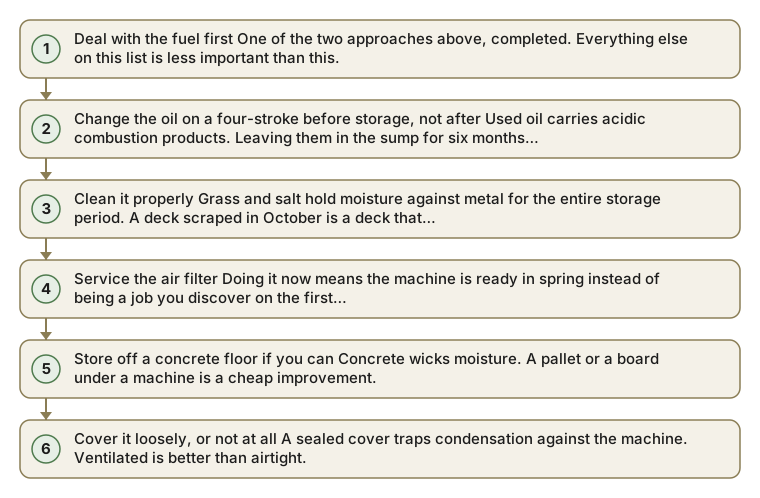
Deal with the fuel first
One of the two approaches above, completed. Everything else on this list is less important than this.
-
Change the oil on a four-stroke before storage, not after
Used oil carries acidic combustion products. Leaving them in the sump for six months is the avoidable part.
-
Clean it properly
Grass and salt hold moisture against metal for the entire storage period. A deck scraped in October is a deck that has not rusted by April.
-
Service the air filter
Doing it now means the machine is ready in spring instead of being a job you discover on the first warm Saturday.
-
Store off a concrete floor if you can
Concrete wicks moisture. A pallet or a board under a machine is a cheap improvement.
-
Cover it loosely, or not at all
A sealed cover traps condensation against the machine. Ventilated is better than airtight.
What each class needs on top of that
| Machine | The extra step |
|---|---|
| Pressure washer | Get the water out. Water left in the pump over a freeze cracks the head, and that ends more of these machines than wear does. Run a pump antifreeze or storage compound through until it comes out of the outlet. |
| Riding mower | Battery on a maintainer, or removed and stored charged and cool. Also relieve the deck belt tension if the machine has a lever for it. |
| Snow blower (in spring) | Same fuel decision, plus grease the auger shaft fittings so it does not seize into the shaft over the summer. |
| Chainsaw | Empty both tanks. Bar oil left in a warm shed can weep past the oiler; mixed fuel left in the tank is the fastest-degrading fuel you own. Fit the scabbard. |
| Generator | The one machine you may need without notice: store it stabilized rather than dry, and run it under load once during the storage period. |
| Log splitter | Retract the ram fully so the exposed rod is inside the cylinder and cannot rust or be knocked. |
| Tiller / chipper | Check the gearbox oil now rather than in spring, and clean the tines or the blade before soil and sap harden on them. |
The five minutes that changes the outcome
Whatever else you do, run each stored machine once during the storage period, under load, for long enough to reach working temperature. Five minutes of a generator carrying a heater, or a mower cutting nothing in the driveway, circulates oil, warms and dries the internals, and, most valuably, tells you now that something is wrong, while the shops are open and nothing depends on it.
That mid-storage run is exactly what a standby generator's automatic exercise cycle is doing, and the reason it exists is the reason to do it by hand for everything else.
- Standard Specification for Automotive Spark-Ignition Engine Fuel : ASTM International, ASTM D4814.
Winter storage, machine by machine: questions
What is the right way to store a gasoline machine for winter?
One of two ways, completed fully. Store it dry, run the tank down, shut the fuel tap and let the engine stop on its own so the carburetor bowl empties too, or store it stabilized, fill with correctly treated fresh fuel and run several minutes at working speed so treated fuel reaches the bowl. The failure is doing half of one: a drained tank above a full bowl, or an untreated bowl beneath a treated tank.
Should I store my machine with a full tank or empty?
Either works if you finish the method. Empty, stored dry, suits machines with a fuel tap and anything stored more than about six months, including two-strokes. A nearly full tank of stabilized fuel suits machines with no tap and ones you may need at short notice, like a generator.
What does not work is a half-done version, which leaves untreated fuel in the smallest passages, which is where the damage happens.
How do I keep a pressure washer from being ruined over winter?
Get the water out. Water left in the pump over a freeze expands and cracks the head, which ends more of these machines than wear does. Run a pump antifreeze or storage compound through until it comes out of the outlet.
This is the most expensive omission on any storage list, and the one most often skipped because the machine was already put away back in September.
Why should I run a stored machine during the off season?
Because five minutes under load, long enough to reach working temperature, circulates oil, warms and dries the internals, and, most valuably, tells you now that something is wrong, while the shops are open and nothing depends on it. That mid-storage run is exactly what a standby generator’s automatic exercise cycle does, and the reason it exists is the reason to do it by hand for everything else.
How should I cover equipment during winter storage?
Because a sealed cover traps condensation against the machine's metal surfaces, promoting rust and corrosion over the storage period. A ventilated cover, or none at all, lets moisture escape rather than accumulate. Airtight is not the same thing as protective here.
Does storing a machine off a concrete floor really make a measurable difference?
Yes: concrete wicks moisture up into whatever sits directly on it, so a machine stored on bare concrete is exposed to more sustained dampness at its base than one on a pallet or board. It is a cheap improvement relative to the rust it prevents on frames, decks and undercarriages.
Why does a chainsaw need both its fuel tank and bar-oil tank emptied for storage, not just the fuel tank?
Because bar oil left sitting in a warm shed over a storage period can weep past the oiler seal even though it isn't going through the same oxidation process as gasoline: emptying only the fuel tank addresses the faster-degrading mixed fuel but leaves the bar-oil weeping problem unaddressed.
Why does a log splitter need its ram retracted fully for storage?
So the exposed portion of the hydraulic rod sits protected inside the cylinder rather than exposed to the air, where it can rust or be accidentally knocked and damaged. A pitted or dented rod damages the cylinder's seals every time it strokes through them afterward.
Why should a snow blower's auger shaft be greased before summer storage rather than in autumn?
Because the risk being prevented is the shaft seizing into the auger housing over the long, dry summer months when the machine sits completely idle: greasing it before that idle stretch, right after the last use of the season, is what protects it, whereas greasing in autumn just before the next winter's use addresses a different, smaller concern.
Should I relieve deck belt tension on a riding mower before storing it for winter?
Yes, on machines with a lever or mechanism to do so. Leaving a belt under full running tension for months of storage can cause it to take a permanent set or develop flat spots, shortening its service life compared to storing it relaxed.
Is checking a tiller's gearbox oil something to do before storage or in spring?
Before storage, according to the guide's guidance, along with cleaning the tines or blade before soil and sap can harden onto them. Doing both while the machine is already out and being serviced for winter avoids discovering a caked-on mess or an oil issue on the first day you need the machine again in spring.