Read a maintenance schedule by hours, dates and operating conditions
Use the actual model’s maintenance table and individual procedures together. Record hours and calendar dates, applying the earlier limit and any severe-service requirement.
Keep initial service separate from recurring tasks. A generic annual tune-up list cannot establish every machine’s oil, filter, plug or grease schedule.
The procedure may add a calendar limit
The cited TimeCutter SW manual gives initial oil service at five hours or the first month and recurring oil/filter service at 100 hours or yearly. Its summary hour table is not a reason to omit the calendar wording in the procedure.
For a 100-hour/yearly task with 90 hours since service, ten hours remain by the meter. If 13 months have passed, the task is already due by the calendar. “Ten hours left” would be an incomplete answer.
| Record | Reason |
|---|---|
| Machine / engine identity | Keep the applicable manual attached |
| Task and actual specification | Separate oil, filter, plug and component work |
| Last completed date and meter | Use both clocks |
| Initial / recurring interval | Do not repeat or skip break-in incorrectly |
| Conditions and defects | Track severe use and work still needed |
Do not impose an oil change on an exception
Briggs’ schedule guidance distinguishes Check & Add EXi engines from engines requiring oil changes. Other manuals can also separate inspection from replacement. Identify the engine and feature before applying a familiar rule.
A spark-plug inspection is not necessarily a replacement instruction. Likewise, greasing a fitting is not the same task as changing a gearbox lubricant. Record what was done instead of marking a whole “tune-up” complete without details.
Unknown history stays visible
For a used machine without receipts, note that service history is unverified and obtain an appropriate inspection. A new date on a log cannot establish what fluid or parts a prior owner used.
Use the engine-service directory for model-specific examples and your equipment record to keep identifiers together. Stop for faults that make continued operation unsafe instead of waiting for the next routine interval.
A small engine maintenance schedule: what is due, and by which clock
A service schedule looks like one list, but it runs on three clocks. Oil, air filter, spark plug and blade wear with hours of use. Fuel, oil age and battery charge run on the calendar whatever the hours.
The rest follow the seasons. A homeowner who runs a mower thirty times a year meets the calendar clock first, which is why a yearly oil change is right for most domestic machines even though the hour count is small. A tune-up on a small engine is four wear items done together, oil, filter, plug and fuel, plus the cutting edge, and the manual for the machine sets the actual figures.
The manual for your machine sets the intervals, and its figures win over anything here. This page shows how the intervals are built and which jobs move with hours, with the calendar, or with the season, so that the manual’s table is easy to read and easy to keep.
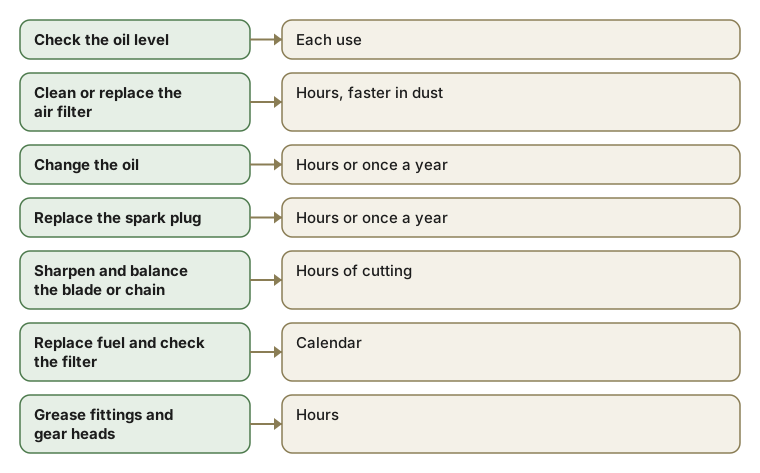
Three clocks run at once
A service schedule looks like one list, but it is three. Some jobs are due by hours run: the oil, the air filter, the plug and the blade all wear with use. Some are due by the calendar whatever the hours: fuel goes off, oil ages in the sump, and a battery discharges on the shelf.
The rest are due by season, and they belong to the storage and start-up pages. A homeowner who cuts a lawn thirty times a year will meet the calendar clock long before the hours clock, and that is why so many mowers get an oil change that the hour meter would never have asked for.
| Job | Clock | Typical interval | What skipping it costs |
|---|---|---|---|
| Check the oil level | Each use | Before every start | A low sump can seize an engine, or trip an oil-level shutdown. |
| Clean or replace the air filter | Hours, faster in dust | Inspect every few hours; replace when dirty | A rich mixture, sooting and a hard-starting engine. |
| Change the oil | Hours or once a year | Commonly every 25 to 50 hours, or each season | Sludge and wear, slowly and without warning. |
| Replace the spark plug | Hours or once a year | Commonly yearly or every 100 hours | Hard starting and a weak, misfiring run. |
| Sharpen and balance the blade or chain | Hours of cutting | When the cut degrades; a chain often at each refuel | A ragged cut, more load on the engine, more vibration. |
| Replace fuel and check the filter | Calendar | Fresh fuel each season; filter yearly | Varnish in the carburetor and a starved engine. |
| Grease fittings and gear heads | Hours | Per the manual, often every 25 hours | Worn bearings, spindles and gears. |
| Check belts, blades and fasteners | Hours and season | Each season, and after any strike | A slipping drive, an out-of-balance blade or a loose part. |
A sensible year, in the order the machine needs it
Before the first use
Spring tune-up
- Oil change while the engine is warm
- New plug at the specified gap
- Air filter checked or replaced
- Blade sharpened and balanced
- Fresh fuel in the tank
During the season
Every few uses
- Oil level before each start
- Deck cleaned after wet grass
- Filter shaken out or replaced in dust
- Belts and tires looked at
- Grease where the manual says
End of season
Before it is put away
- Fuel used up or stabilized
- Oil changed while it is warm
- Deck scraped
- Battery on a maintainer
- Notes on what wore
Two of those jobs move around. The oil change belongs at the end of the season for a machine that will sit, because used oil holds acids, and in spring for a machine you forgot; either is better than neither. The plug and the filter are the cheapest parts on the machine and the most often left too long, so changing them together once a year costs little and removes two causes of a hard start at once.
Keep a record, because the interval is measured, not remembered
Most domestic machines have no hour meter, so the calendar and a note stand in for one. Write the date and the job on a strip of tape inside the deck, or on a card kept with the machine. A walk-behind mower that is used once a week for thirty weeks has run perhaps twenty to thirty hours, so a yearly oil change is right for it; a machine run daily on a contract runs that in a month.
When a job has been missed, do it now and start the clock again, since nothing is gained by waiting for the “right” date.
Oil
The job with the most effect
Cheap, quick, and the one whose neglect ends an engine.
Air
The filter beside it
A choked filter mimics a dozen faults and costs a few coins.
Spark
The plug, once a year
Replace it whether or not it looks worn; a plug cannot be judged by eye.
What a tune-up is not
A small engine has no computer to adjust and no timing to set on most machines. A tune-up is the four wear items above, done together: oil, filter, plug and fuel, plus the cutting edge on a mower or a saw. A shop that quotes a long list beyond those is either adding checks the machine needs, such as a valve clearance on an overhead-valve engine, or adding labor.
Ask which. The full symptom pages on this site name the jobs that a real fault needs.
A small engine maintenance schedule: questions
How often should a small engine be serviced?
The manual sets it, and the common pattern is a yearly service for a domestic machine: oil, spark plug, air filter and fresh fuel, plus a sharp blade or chain. A machine run daily on a contract needs the same jobs by hours, often every 25 to 50 hours for the oil, so heavy use moves the schedule forward.
How often should I change the oil in a lawn mower?
Commonly every 25 to 50 hours of use, or once a year if the mower does fewer hours than that. Most homeowners reach the yearly limit first, since a mower used weekly for a season runs perhaps twenty to thirty hours. Change it while the engine is warm, because warm oil drains more completely and carries the contaminants out.
How often should I replace a spark plug?
Commonly once a year or about every 100 hours, whichever comes first. A plug cannot be judged by eye, since a plug that looks fine can misfire under load, so replacing it on a schedule costs little and removes a frequent cause of hard starting. Set the gap to the figure in the manual.
What does a small engine tune-up include?
Four wear items, done together: fresh oil, a new spark plug, a clean or new air filter and fresh fuel, plus a sharpened and balanced blade or chain. Most small engines have no computer or timing to adjust. A quote for a long list beyond those is worth asking about, since some items, such as valve clearance, apply only to certain engines.
Do I need to service a machine I barely use?
Yes, on the calendar. Fuel goes off, used oil holds acids, and a battery discharges whether or not the machine runs, so a low-hours machine still needs fresh fuel each season and a yearly oil change. A machine that sits ages faster than a machine that works, which is why the calendar clock matters more than the hour count for most homeowners.
How do I keep track of hours on a machine with no hour meter?
Write the date and the job on a strip of tape inside the deck, or on a card kept with the machine, and count uses. A walk-behind mower used weekly for thirty weeks has run perhaps twenty to thirty hours. If you are unsure, service it on the calendar date, and if a job has been missed, do it now and start the clock again.
Which maintenance job matters most?
The oil, because a low or worn sump is the neglect that ends an engine, and it is a quick, cheap job. The air filter is next, since a choked filter mimics a dozen other faults. Both cost a few coins, and skipping them is far more expensive than the parts.
How often should I sharpen a mower blade?
When the cut degrades, commonly once or twice a season for a home lawn, and after any strike on a stone or stump. Balance the blade after sharpening, since an unbalanced blade vibrates and loosens fasteners. A dull blade tears grass and adds load to the engine.
How often should a chainsaw chain be sharpened?
When it stops pulling itself into the wood or makes dust instead of chips, and often at each refuel for a saw in steady use. Hitting dirt dulls a chain at once. The bar, the chain tension and the bar oil supply each need a look at the same time.
When should the fuel filter and fuel lines be checked?
The filter yearly, and the lines at the same time, looking for cracks, hardening or a stiff primer bulb. Ethanol fuel hardens rubber over time, and a blocked filter starves the engine at load, which shows up as surging or a stall. Both are cheap parts.
Is a professional tune-up worth it?
For a machine you are not comfortable working on, yes, and for a low-value machine the visit can cost about as much as a new one. The four jobs are within reach of a beginner with a manual, and doing them yourself also gets you a look at the machine. A shop earns its fee on valves, carburetors and fault-finding.