Generator break-in and readiness tests: use the actual schedule
Follow the generator’s exact first-hours and periodic-test instructions. Break-in, routine exercise and an outage load test are different tasks. A universal monthly 20-minute run cannot replace the manual, and starting the engine alone does not prove correct electrical output, transfer or fuel delivery under load.
Two break-in examples that cannot share one rule
The cited Champion 100522 manual uses five hours of break-in at no more than half running load with varied loading, then an oil change. The Predator 57509 manual instead describes about 30 hours at no more than 75 percent of its running rating, followed by the oil service.
| Machine | Break-in figure | Load ceiling |
|---|---|---|
| Champion 100522 | 5 hours | 50 percent of running rating |
| Predator 57509 | About 30 hours | 75 percent of running rating |
For the cited Predator’s 3,500 running watts, 75 percent is 2,625 watts. Its 4,400 starting-watt headline is not the basis: 75 percent of that would be 3,300 watts, 675 watts higher than the running-rating calculation.
Plan the test before connecting a load
Use approved cords, outlets and loads within their ratings. Follow startup, warm-up, load application and shutdown instructions. Do not connect unknown 240V equipment or open a live panel to prove an outlet works.
For installed transfer equipment, use the installer’s operating/test procedure. A generator test switch or engine exercise may not apply the building load. Record what the test established and any fault, without assuming that one successful start clears every system.
Weather protection must be approved
CPSC’s 2026 guidance retains outdoor 20-foot separation and exhaust-direction requirements. Use only a weather arrangement permitted for the actual generator; an improvised tarp or enclosed shed is unsafe.
Stop and cool before refueling. If a test finds leakage, unstable output or a failed safety control, stop and obtain the required repair before relying on the machine. Keep run hours and completed service dates with the model record.
Generator exercise, break-in and running in wet weather
A generator that has not run for months can fail the first time it is asked to carry a load, and that is usually a bad night. Exercising it means running it to full temperature with a real load on a schedule, commonly monthly for twenty to thirty minutes for a portable and weekly by self-test for a standby unit. A new machine may need a light first run and an early oil change, and the manual is the whole answer there.
In wet weather the unit needs a dry, open-sided cover made for the purpose and must be run outdoors, away from the building, with a carbon monoxide alarm inside.
A generator makes carbon monoxide. Run it outdoors, well away from doors, windows and vents, never in a garage, a shed or a porch that closes in, and use a working carbon monoxide alarm inside the building. Rain and snow are also a shock and fire risk, so a running generator needs a dry, open-sided cover made for the purpose, not a tarp over it.
Exercise is running it under a real load, on a schedule
A generator that has not run for months starts hard and can fail the first time it is asked to carry a load, which is usually a bad night. Exercising it means starting it and running it long enough to reach full operating temperature, with a load connected, on a set schedule. The point is not to burn fuel.
It moves fresh fuel through the carburetor, recharges the start battery on an electric-start model, and lets you find a fault on a calm day. A portable is commonly exercised monthly for about twenty to thirty minutes, and a standby unit is often set to run itself weekly. The manual gives the interval for the model.
-
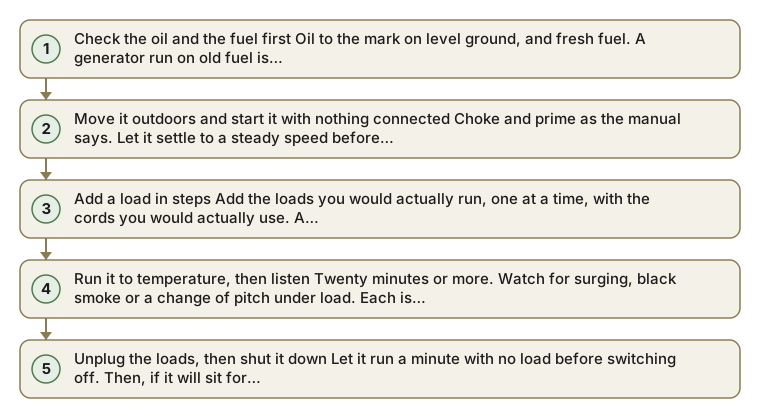
Check the oil and the fuel first
Oil to the mark on level ground, and fresh fuel. A generator run on old fuel is being tested against a fault it does not have.
-
Move it outdoors and start it with nothing connected
Choke and prime as the manual says. Let it settle to a steady speed before anything is plugged in.
-
Add a load in steps
Add the loads you would run, one at a time, with the cords you would use. A steady heavy load is a better test than a single light one.
-
Run it to temperature, then listen
Twenty minutes or more. Watch for surging, black smoke or a change of pitch under load. Each is a fault to fix while nothing depends on it.
-
Unplug the loads, then shut it down
Let it run a minute with no load before switching off. Then, if it will sit for a month or more, use the fuel-off valve or a treated fuel plan.
Break-in for a new machine
A new engine has surfaces that are machined smooth but not yet worn to fit one another. Many makers ask for a short first run at light load, followed by an early oil change, commonly within the first several hours of use, to remove the fine metal that a new engine sheds.
The figures differ by model and some makers list no break-in at all, so this is one of the few places where the manual is the whole answer. After that first oil change, follow the ordinary schedule on the maintenance page.
Wet weather, and keeping a running generator dry
Water and a generator do not mix, and a generator often has to run in the weather that is knocking the power out. The safe arrangement is a cover with open sides, sited on level ground, clear of the building, with the exhaust pointing away. A generator tent or canopy made for the job keeps rain off the unit and the outlets while leaving the air moving.
Cord ends and adapters should stay off wet ground, and hands and floor should be dry when plugging in. Never fuel a running or hot unit, and let it cool before you top up.
| Situation | What it needs | What to avoid |
|---|---|---|
| Monthly exercise | A steady load for twenty minutes or more, and fresh fuel. | Running it idle with no load, which glazes the engine and proves little. |
| First hours on a new unit | A light first run and an early oil change per the manual. | A heavy load at once, and skipping the first oil change. |
| Running in rain or snow | A dry open-sided cover, level ground and distance from the building. | A tarp draped over a running unit, or running it inside to keep it dry. |
Load
Not idling
Running with nothing connected is a weak test of a machine built to carry a load.
Cover
Open sides
A canopy that keeps rain off and lets air and exhaust move.
Alarm
Carbon monoxide, indoors
A working alarm is the last safeguard, not the first.
Generator exercise, break-in and running in wet weather: questions
How often should I exercise a portable generator?
Commonly once a month, for about twenty to thirty minutes with a real load connected. That moves fresh fuel through the carburetor, recharges the start battery, and shows a fault on a calm day. The manual for the model sets its own interval, so follow that where it differs.
Does a generator need a load when it is exercised?
Yes. A generator run with nothing connected is a weak test of a machine built to carry a load, and long idling can glaze the engine. Plug in the loads you would run, in steps, using the cords you would use, and run to full temperature.
How often does a standby generator run its own test?
Commonly once a week for a short period, set from its controller. The unit starts and runs without a load transfer, and some models will also run under load on a longer schedule. A standby unit still needs its oil and battery checked on the maker’s interval.
What is break-in for a new generator?
A short first run at light load and often an early oil change, commonly within the first several hours of use, to remove the fine metal that a new engine sheds. Some makers list no break-in at all. It differs by model, so the manual is the whole answer.
Can I run a generator in the rain?
Only under a dry, open-sided cover made for the purpose, on level ground and away from the building. Rain on a running unit is a shock and fire risk. A tarp draped over it traps heat and exhaust, so use a generator canopy or tent that keeps air moving.
Can I run a generator in the garage or on the porch?
No. A generator makes carbon monoxide, which has no smell, and it collects in a garage, a shed or an enclosed porch even with a door open. Run it outdoors, well away from doors, windows and vents, and keep a working carbon monoxide alarm inside.
How far from the house should a generator be?
Well clear of doors, windows and vents, with the exhaust pointing away from the building. Manufacturers and safety agencies give a minimum distance, commonly about twenty feet, and the manual for the unit gives its own figure. Distance is a protection, and the alarm inside is the second.
Should I let a generator run out of fuel before storing it?
For a long store, running the carburetor dry or closing the fuel valve and letting the engine run until it stops keeps fuel from gumming the carburetor. Follow the manual. For a machine exercised monthly, fresh treated fuel in the tank is the more practical plan.
Is it safe to refuel a generator while it is running?
No. Let it cool first, since spilled fuel on a hot engine or exhaust can ignite. Turn it off, wait, and refill from an approved can on the ground clear of the unit.
Keep the fuel stored away from the generator and outside the living space.
Why does my generator surge or stall when it is exercised?
Surging usually points to old fuel, a partly blocked carburetor or a dirty air filter, and it often shows only under load, which is why exercising finds it. Try fresh fuel and a clean filter first. The surging and hunting page lists the rest in order.
How do I know how big a generator I need?
Add the running watts of what you will run together, then allow for the starting surge of motors such as a fridge or a pump. The calculator does the sum from your own figures. A unit that is too small trips or stalls, and one that is far too large wastes fuel.
Do I need a transfer switch?
To power a house circuit from a portable unit safely, yes. Feeding a house from a generator through an ordinary outlet can send power back onto the lines and injure utility workers. A licensed electrician fits a transfer switch or an interlock, and the local code sets the rule.