Engine starts then dies: record the stop without guessing the part
Record whether the engine stops when the choke changes, a load engages, or engine temperature rises. Those observations guide the next check but do not identify a part by themselves.
Return the machine to a safe, cool condition before inspecting fuel components. Do not open a hot fuel cap as a running experiment.
Match the stop to a repeatable event
| Event | What it leaves unresolved |
|---|---|
| Choke moved toward run | Mixture, air restriction, starting procedure and fuel delivery |
| Blade or other load engaged | Engine output, load obstruction and control operation |
| Several minutes of running | Fuel delivery, heat, ignition and shutdown controls |
| Oil warning or fault indication | The actual model’s warning and shutdown logic |
A hypothetical machine that runs for 90 seconds and stops twice has a repeatable symptom. That timing does not prove a plugged tank vent, and a ten-minute run does not prove that a coil is good. Record fuel condition, settings, load and warning indications with the time.
A fuel cap is not always the whole tank vent
Briggs’ fuel-tank guidance distinguishes older vented-cap arrangements from systems using separate venting and charcoal components. Looking for a hole in every cap is therefore not a reliable test. Fit the specified cap and inspect only the components allowed by the equipment procedure.
Keep hoses attached during operation. Never run with a loosened cap or disconnected fuel line to see whether the engine improves. Leaking fuel creates a fire hazard.
Separate a hot-running fault from its cause
Briggs’ ignition-testing guidance calls for an appropriate tester and procedure. A technician may need to compare tests under the conditions that produce the stop. A cold spark observation alone cannot establish hot ignition performance.
Check accessible cooling areas, correct oil level and required controls before another operating trial. Do not bypass a low-oil shutdown or seat switch. See hot-running diagnosis for heat-related observations and carburetor repair choices when testing has established a fuel-metering fault.
TS-02 · Troubleshooting
Starts, runs briefly, then dies
This is the most informative symptom on the site, because an engine that starts at all has already proved two of the three things it needs: there is spark and there is compression. What is left is fuel delivery, air, or an ignition component that fails once it gets warm, and those four causes are distinguishable purely by how the machine dies, before you pick up a tool. A few seconds and then dead means the carburetor bowl emptied and nothing refilled it.
Several minutes and then dead, restarting after it stands, is a blocked tank vent pulling a vacuum. Running only with the choke closed means the normal fuel circuit is restricted. Dying after ten minutes of good running and refusing to restart until cool is a coil breaking down as it heats.
Before anything else: pull the spark plug lead off and tuck it away from the plug, and on a battery machine take the key out. Every step assumes the engine cannot start while your hands are near it. On a machine with a blade, an auger or a chain, that is not a formality.
Why this symptom is worth more than a no-start
An engine that starts has already proved it has spark and compression. That eliminates most of the diagnostic tree in one observation, and what remains is a fuel delivery problem, an air problem, or an ignition component failing as it heats up. There are only four common causes, and they are distinguishable by exactly how it dies.
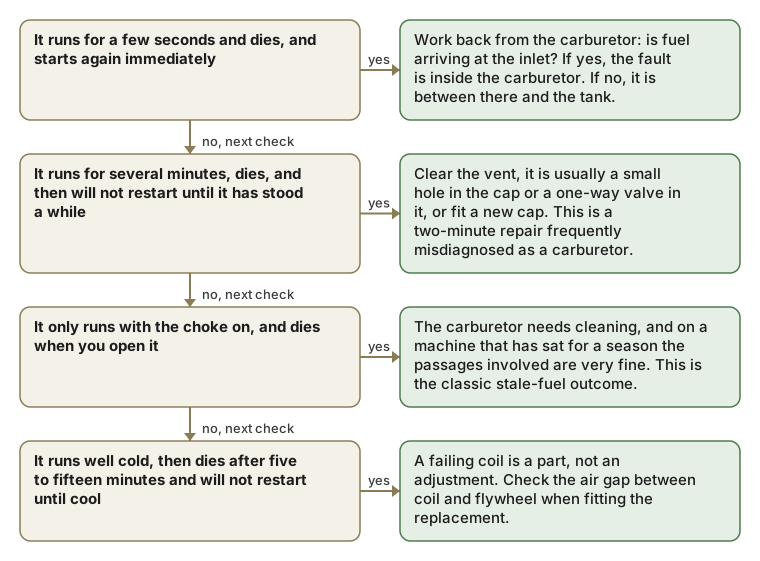
It runs for a few seconds and dies, and starts again immediately
The carburetor bowl held enough fuel for those few seconds and nothing refilled it. That is a blocked fuel path: the tap, the in-line filter, the needle valve, or on a handheld two-stroke the pickup filter inside the tank.
If that is it: Work back from the carburetor: is fuel arriving at the inlet? If yes, the fault is inside the carburetor. If no, it is between there and the tank.
It runs for several minutes, dies, and then will not restart until it has stood a while
A vacuum is building in the tank because the vent is blocked, and it eventually becomes strong enough to stop fuel flowing. Standing lets air leak past and equalize. Confirm it in ten seconds: when it dies, loosen the fuel cap.
If you hear a hiss and it restarts, that is the fault.
If that is it: Clear the vent, it is usually a small hole in the cap or a one-way valve in it, or fit a new cap. This is a two-minute repair frequently misdiagnosed as a carburetor.
It only runs with the choke on, and dies when you open it
Choking enriches the mixture. If the engine will only run rich, the normal fuel circuit is restricted. The main jet or an idle passage is partly blocked, usually with varnish from stored fuel.
Every remedy that is not cleaning the carburetor is a workaround.
If that is it: The carburetor needs cleaning, and on a machine that has sat for a season the passages involved are very fine. This is the classic stale-fuel outcome.
It runs well cold, then dies after five to fifteen minutes and will not restart until cool
This is the pattern of an ignition coil breaking down as it warms. It is temperature dependent, repeatable, and it fools people for weeks because the machine works perfectly from cold every time. Confirm by fitting an in-line spark tester and running it until it dies: the spark will disappear.
If that is it: A failing coil is a part, not an adjustment. Check the air gap between coil and flywheel when fitting the replacement.
The overlooked causes
| Cause | How it presents | Check |
|---|---|---|
| Low-oil shutdown | Four-stroke engines with a sensor cut ignition when oil is low or when the machine is on a slope. | Check oil on level ground. A machine that dies only on a bank is telling you something specific. |
| Blocked spark arrestor | Runs, loses power progressively, then dies as back pressure builds. | The mesh screen at the muffler outlet. Common on chainsaws and trimmers. |
| Water in the fuel | Runs, stumbles, dies. Often after a machine has been stored outdoors or a fuel can was left open. | Drain into a clear container and let it settle; water separates below the gasoline. |
| Air leak at an intake gasket | Erratic idle, dies at idle, sometimes runs fast then quits. | A perished intake boot on a handheld two-stroke is the usual version of this. |
| Safety interlock | Dies when a lever is released or when a bag is removed, which is what it is supposed to do. | Read the machine: interlocks are a feature, not a fault. Never defeat one. |
The order to work it
Do the free tests first, in this order: loosen the fuel cap when it dies; look at whether it will only run choked; note whether the failure is time-dependent and heat-related. Those three observations separate the four main causes from each other without a single tool.
Only then start removing things. If the answer points at the carburetor, be aware that a machine which sat with fuel in it usually needs the carburetor cleaned through its internal passages rather than sprayed externally: see what happens to stored gasoline for why the deposits are where they are.
Starts, runs briefly, then dies: questions
Why does my engine start and then die after a few seconds?
The carburetor bowl held enough fuel for those few seconds and nothing refilled it: a blocked fuel path. Work back from the carburetor: if fuel is arriving at the inlet, the restriction is inside the carburetor; if not, it is between there and the tank, in the tap, the in-line filter, the line, or on a handheld two-stroke the pickup filter inside the tank itself.
My engine runs a few minutes then dies and restarts after standing: why?
That is the signature of a blocked tank vent. A vacuum builds in the tank as fuel is used until it becomes strong enough to stop the flow, and letting the machine stand allows air to leak past and equalize it. Confirm it in ten seconds: when it dies, loosen the fuel cap, and if you hear a hiss and it restarts, the vent is the fault rather than the carburetor.
Why does my engine only run with the choke on?
Because choking enriches the mixture, and an engine that will only run rich has a restricted normal fuel circuit. The main jet or an idle passage is partly blocked, almost always with varnish from stored fuel. Every fix that is not cleaning the carburetor is a workaround; on a machine that has sat a season, the affected passages are very fine and need the carburetor taken apart, not sprayed through the throat.
My engine runs fine cold then dies when warm. What causes that?
That is the classic pattern of an ignition coil breaking down as it heats up. It is temperature-dependent and repeatable, and it fools people for weeks because the machine starts perfectly from cold every time. Confirm it by fitting an in-line spark tester and running the engine until it dies: the spark will disappear as it warms.
Replace an ignition coil only after confirming it fails the specified test.
How do I work backward from the carburetor to find a blocked fuel path?
Disconnect the fuel line at the carburetor inlet and check whether fuel flows out when you open the tap, if it does, the restriction is inside the carburetor itself; if it doesn't, the blockage is upstream, in the tap, the in-line filter, the line, or on a handheld two-stroke, the pickup filter sitting inside the tank on the end of the fuel line.
Is the ten-second fuel-cap test reliable, or can a blocked vent cause a false negative?
The test is reliable for what it checks, if loosening the cap produces an audible hiss and the engine restarts, a blocked vent is confirmed. A false negative (no hiss, no restart) simply means the vent isn't the fault, not that the vent is definitely fine; a vent that's only partially restricted could still contribute to symptoms without producing an obvious hiss.
Does starts-then-dies always mean the same thing regardless of how quickly it dies?
No: dying within a few seconds usually points at the carburetor bowl running dry with nothing refilling it (a blocked fuel path), while dying after several minutes and restarting once the machine has sat is the more specific signature of a blocked tank vent building vacuum over that longer running period. Timing the die-off narrows which of the two mechanisms is more likely before testing either.
Can a partially clogged air filter cause an engine to start and then die, the way a fuel problem does?
It's possible but less common than a fuel-path cause for this specific symptom: a fuel restriction typically produces the classic run-briefly-then-die pattern the guide describes, while an airflow restriction more often produces rough running or stalling under load rather than dying shortly after a clean start. Still worth ruling out if the fuel-path checks come back clear.
Why does an engine that only runs with the choke closed eventually die even with the choke held on?
Because the choke enriches the mixture as a workaround for a restricted normal fuel circuit, but it doesn't fully replace that circuit's function: as the engine warms and demands change, or as the choke is gradually opened, the underlying restriction reasserts itself and the engine dies once the enrichment can no longer compensate for the blocked passage.
Is a coil that fails only when warm dangerous to keep using, or just inconvenient?
It's primarily inconvenient rather than dangerous to the operator, but it's worth replacing rather than living with, since repeated cranking attempts on a hot, non-firing engine waste fuel, can flood the cylinder, and put unnecessary wear on the starting system for a fault that a straightforward coil replacement resolves permanently.
Can moisture in the fuel cause an engine to start then die, the same way a physical blockage does?
Yes: water that has separated out of ethanol-blended gasoline (phase separation) can be drawn into the fuel path intermittently, causing the engine to run briefly on the gasoline layer then stumble or die when the corrosive water-ethanol layer reaches the carburetor, a chemically different cause producing a similar symptom to a physical blockage.
Should I replace the fuel filter as a precaution if my engine starts and dies, even before confirming it's the actual cause?
It's a cheap, low-effort check worth doing early in the sequence rather than a precaution to skip straight to: a clogged in-line filter is a common and inexpensive cause of exactly this symptom, so inspecting or replacing it early can resolve the fault before moving on to more involved checks like the tank vent or carburetor.