Engine overheats or stops hot: check cooling, oil and operating load
Stop an engine showing overheating, smoke, abnormal noise or a hot-running shutdown. Let it cool before inspection.
Check its oil-level procedure, accessible cooling areas and permitted operating load. A restart after cooldown establishes a temperature-related pattern, not a proven ignition-coil failure.
Cooling parts belong to the actual engine
Many small engines use air cooling, but equipment in this category also includes other cooling arrangements. Identify the model before looking for a radiator, coolant, oil cooler or a particular shutdown sensor. Do not assume every engine has an over-temperature shutdown.
The cited Toro TimeCutter SW manual calls for cooling-area inspection and cleaning and gives model-specific service intervals. Debris behind a cover may need a prescribed service procedure. Removing a shroud and running without it can disrupt cooling as well as expose moving parts.
Record the load and the warning
| Detail | Why it matters |
|---|---|
| Model and cooling system | Determines permitted inspection and fluids |
| Oil-level result | Use its actual level-check position and method |
| Load and operating conditions | Separate overload or obstruction from no-load behavior |
| Warning or shutdown indication | Read the model-specific meaning |
| Restart after cooldown | Record the pattern without naming a failed part |
For a hypothetical machine that stops after 12 minutes under load and restarts after 20 minutes cooling, both times help service reproduce the condition. Neither time identifies the coil. Fuel delivery, ventilation, cooling, control circuits and other faults remain possible.
Oil color is not an oil-level test
Use the dipstick or level procedure for that model and the specified oil. Dark color alone does not establish that changing oil will cure a hot stall. Overfilling can create another operating problem.
Briggs’ problem-solving guidance covers several engine systems rather than a single timed-stall diagnosis. A qualified technician can compare ignition and other tests under the fault conditions.
Never loosen a hot fuel cap, disconnect a running fuel hose or make an exposed-spark test beside fuel. For a generator, maintain its required outdoor placement during any test. See carbon-monoxide precautions and stall-event checks before further operation.
TS-24 · Troubleshooting
Engine overheating, and an engine that dies when hot
A small air-cooled engine has no radiator, so when it runs hot the cause is almost always air, oil or mixture. Blocked cooling fins and a clogged flywheel screen come first, then the oil level and its condition, then a lean mixture that burns hotter than the engine was built for, then load. An engine that stalls after twenty minutes and restarts once cool is a slightly different fault with a short list of suspects: fuel vapour in a hot line or bowl, a tank vent that has clogged, or an ignition coil that fails as it warms.
Each is checked with the engine stopped, and the last three with a simple test done while it is still hot.
Stop the engine and let it cool before you touch anything. A muffler, a cylinder and a cooling shroud on a machine that has been overheating can burn skin long after the engine stops. Pull the spark plug lead before you reach near the flywheel, and keep fuel and the hot exhaust apart: a fuel line that has softened against a hot muffler is a fire risk, not a nuisance.
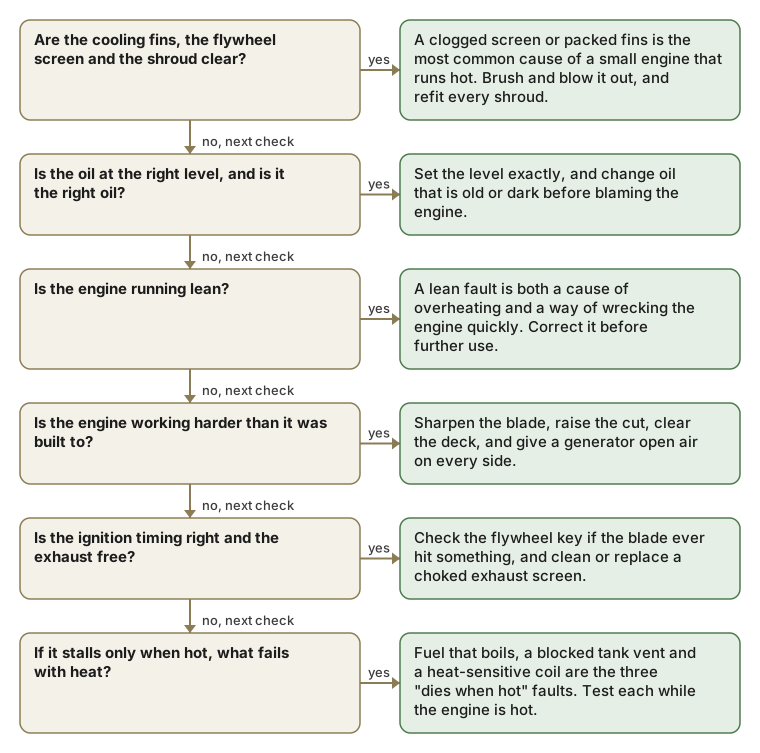
Two symptoms that share one cause: heat the engine cannot get rid of
A small air-cooled engine has no radiator, no coolant and no thermostat. It throws heat away with a fan built into the flywheel that blows air over cast fins on the cylinder and head, guided by a sheet-metal shroud, and with the oil that splashes inside. Anything that stops that air, or thins the oil, or makes the engine burn hotter than it was built to, lets the temperature climb.
It shows up in two ways. Some engines run rough, lose power, smoke and smell hot. Others run well for twenty minutes, stall, and will not restart until they have cooled.
The second pattern feels like a different fault. Usually it is the same one, or a part that only fails when it is hot.
The order below is cheapest and most likely first. Most of it needs nothing but eyes, a brush and the oil dipstick.
1. Are the cooling fins, the flywheel screen and the shroud clear?
With the engine cold and the plug lead off, look at the cylinder and the head. Grass clippings, chaff, dust and oily grime pack between the fins and act as a blanket. The fan draws its air through a screen or grille over the flywheel, and that screen clogs first.
The shroud that directs the air also has to be there: an engine run with a shroud left off, a cooling plate bent aside or a fin-cover lost after a repair cools far worse, because the air goes past the cylinder instead of across it.
If that is it: A clogged screen or packed fins is the most common cause of a small engine that runs hot. Brush and blow it out, and refit every shroud.
2. Is the oil at the right level, and is it the right oil?
Oil carries a share of the heat away from the piston and the bearings. Check the level with the machine on flat ground, engine off and settled. Low oil runs hot, and many engines have a low-oil sensor that shuts them down for that reason.
Very old, thin or burnt-smelling oil, or the wrong weight for the season the engine is being used in, does the job worse. Overfilling is a fault as well: it churns to foam and heats up.
If that is it: Set the level exactly, and change oil that is old or dark before blaming the engine.
3. Is the engine running lean?
A lean mixture burns hotter. Air can leak in past a cracked intake boot, a loose carburetor mount or a worn gasket, or a partly blocked main jet can pass too little fuel. The signs are a white or blistered spark plug, surging, and popping when the throttle closes.
A lean engine runs hot fast and can damage the piston, so it is one to fix before the engine is run again. The carburetor page covers cleaning and the choice between a rebuild and a replacement.
If that is it: A lean fault is both a cause of overheating and a way of wrecking the engine quickly. Correct it before further use.
4. Is the engine working harder than it was built to?
Heat follows load. A dull or bent mower blade, a deck packed with wet grass, cutting far too low, a chipper fed larger stock than it wants, a splitter or a pump run against a blockage: each keeps the engine at full throttle on the edge of its rating. Extended running in still, hot air, or in an enclosure with no airflow around a generator, adds to it.
If the engine only overheats on the hardest work, the engine may be sound and the job may be too big for the setting.
If that is it: Sharpen the blade, raise the cut, clear the deck, and give a generator open air on every side.
5. Is the ignition timing right and the exhaust free?
A sheared flywheel key after a blade strike puts the spark early or late, and both run hot. A muffler or spark arrestor clogged with carbon holds the exhaust in, so the engine loses power and its temperature rises. Heavy carbon in the combustion chamber does the same over years.
A previous blade strike on the machine's history is a strong clue.
If that is it: Check the flywheel key if the blade ever hit something, and clean or replace a choked exhaust screen.
6. If it stalls only when hot, what fails with heat?
Two parts commonly do. The first is fuel: petrol vaporises in a hot carburetor or a fuel line lying against the muffler, the pump or the bowl passes vapour instead of liquid, and the engine starves. That is vapour lock, and it clears when things cool.
Ethanol blends, which boil at a lower temperature, make it more likely. A blocked fuel-cap vent starves the tank in the same way. The second is the ignition coil: its insulation can break down with heat, so the engine runs, dies hot, and restarts once the coil cools.
If that is it: Fuel that boils, a blocked tank vent and a heat-sensitive coil are the three "dies when hot" faults. Test each while the engine is hot.
A quick test for a hot-stall: fuel or spark?
When the engine stalls hot, do not wait for it to cool. Pull the plug lead, put a known-good plug in the lead and lay its threads against bare metal on the engine, then pull the cord or turn it over. A strong blue spark means the ignition is working and the fault is fuel or air.
No spark, or a weak orange one, points at the coil. Then loosen the fuel cap a turn and try again: an engine that revives has a blocked tank vent. If the spark is good and the cap is not the cause, take the bowl or the fuel line and look for vapour or an empty carburetor bowl.
Hot-engine symptoms and cooling faults
| What you observe | What it points to | Fix |
|---|---|---|
| Fins packed, flywheel screen matted, hot to the touch soon after starting | Blocked cooling air | Clean the fins and screen; refit every shroud and cooling plate. |
| Low oil, or black, thin oil, and hot running | Oil carrying too little heat | Set the level on flat ground; change old oil. |
| White or blistered plug, surging, pop when the throttle closes | A lean mixture from an air leak or a partial jet blockage | Find the leak; clean the carburetor; stop running it meanwhile. |
| Overheats only on heavy work | Load, from a dull blade, a packed deck, or a restricted airflow | Sharpen, raise the cut, clear the deck, give a generator open air. |
| Loss of power after a blade strike, or a choked muffler screen | Ignition timing shifted, or exhaust restricted | Check the flywheel key; clean or replace the spark arrestor screen. |
| Runs, stalls hot, restarts when cool | Fuel vapour, a blocked tank vent, or a heat-sensitive coil | Test spark while hot; loosen the cap; move the line away from the muffler. |
Engine overheating, and an engine that dies when hot: questions
Why is my small engine running hot?
An air-cooled engine sheds heat through fins and a fan, so the usual causes are blocked cooling air, low or old oil, a lean mixture, or a load beyond what it was built for. Check the flywheel screen and the fins first, then the oil level on flat ground. Both take a few minutes with the engine off and the plug lead pulled, and they explain most cases.
Where are the cooling fins on a small engine, and how do I clean them?
They are the thin cast ribs around the cylinder and the head, under a sheet-metal shroud, with the fan in the flywheel drawing air in through a screen. With the engine cold and the plug lead off, remove the shroud, brush out the packed grass and grime with a stiff brush and blow it clear, then refit the shroud exactly. A shroud left off makes the engine run hotter, not cooler.
Can low oil make an engine overheat?
Yes. Oil carries part of the heat away from the piston and bearings, and an engine run low runs hot and wears quickly. Many engines shut down through a low-oil sensor before damage occurs.
Overfilling causes trouble too, because the crankshaft whips the oil to foam. Check the level on flat ground with the engine off and settled, and change oil that is dark, thin or smells burnt.
Can a lean mixture cause overheating?
Yes, and it is one of the faster ways to ruin an engine. A lean mixture burns hotter, from an air leak at the intake or the carburetor mount or a partly blocked jet. The signs are a white or blistered spark plug, surging and popping when the throttle closes.
Stop running the engine, find the leak or clean the carburetor, and check the plug color again afterwards.
Why does my mower engine stall after twenty minutes and restart when it cools?
Something is failing with heat. The likely suspects are fuel vapour in a hot carburetor or a line lying against the muffler, a fuel-cap vent that has clogged and slowly starves the tank, and an ignition coil whose insulation breaks down as it warms. A spark test done straight after the stall, then a loosened fuel cap, tells you which one is at fault.
What is vapour lock in a small engine?
Fuel boiling to vapour in a hot carburetor bowl or fuel line, so the engine gets vapour instead of liquid and starves. It clears as things cool, which is why the engine restarts after a wait. Fuel blends containing ethanol boil at a lower temperature and make it more likely.
Moving a fuel line away from the muffler and using fresh fuel are the usual first remedies.
How do I tell a failing coil from a fuel problem on a hot stall?
Do a spark test while the engine is still hot. Pull the plug lead, fit a known-good plug in the lead and hold its threads against bare metal while you turn the engine over. A strong blue spark means the ignition is working and the fault lies in fuel or air.
No spark, or a weak orange one, points at the coil. Do it straight away, because a coil that recovers on cooling hides the fault.
Can a blocked fuel cap stop an engine?
Yes. The tank has to breathe as fuel leaves it, through a small vent in the cap or a separate line. When that clogs, a vacuum builds, fuel stops flowing and the engine dies, often after some minutes of running.
Loosening the cap a turn and seeing the engine revive confirms it. Clear the vent or replace the cap.
Does a dull mower blade make the engine overheat?
It can. A dull or bent blade needs more power to cut the same grass, so the engine sits nearer its limit for longer, and a deck packed with wet clippings adds to it. If the engine only overheats on the heaviest work, sharpen the blade, raise the cutting height, clear the deck and mow in dry conditions before suspecting the engine.
Can a generator overheat if it is run in a shed or garage?
Yes, and running one in an enclosure is dangerous for a second reason, carbon monoxide. A generator needs open air on every side so its fan can pull cool air across the engine and the heat can leave. Keep it outdoors, well away from windows and doors, with the exhaust pointing away from any building, and never run it in a shed, a garage or under cover that blocks airflow.
Could a clogged muffler or spark arrestor make an engine run hot?
Yes. A muffler or spark arrestor screen choked with carbon holds exhaust in the cylinder, so the engine loses power and its temperature rises. Heavy carbon inside the combustion chamber does the same over years.
Cleaning or replacing the screen is a simple job when the muffler is cold, and it is worth doing if the engine lost power gradually as well as running hot.
When should I stop using the machine altogether?
Stop at once if the engine smells of burning oil, smokes heavily, loses power fast or seizes, if a fuel line is touching the muffler, or if it overheats again after the cooling air and the oil have been put right. Continuing risks a seized piston, a fire or a wrecked cylinder. Have a compression test and the mixture checked before running it on.