Engine popping: distinguish intake backfire from exhaust afterfire
Record whether the pop comes through the intake, occurs in the exhaust while running, or follows shutdown. The timing and location matter more than the sound’s loudness.
Stop for flame, leaking fuel, recoil kickback or a recent blade impact. Do not keep restarting an engine to reproduce a hazardous event.
During operation versus after shutdown
Briggs distinguishes backfire and afterfire and explains that fuel can reach a hot muffler during shutdown. Its guidance includes following the correct stopping procedure. That is not a universal instruction to idle every engine for the same number of seconds or to close a fuel valve on every machine.
| Observation | Question to resolve |
|---|---|
| Intake pop while starting | Starting settings, mixture, valve sealing or timing |
| Exhaust pop while running | Ignition, mixture, load and exhaust condition |
| Pop after stopping | Shutdown procedure and fuel-control operation |
| Kickback after blade impact | Stop and inspect for damage under the actual service procedure |
For example, a pop two seconds after switching an otherwise running engine off is an after-shutdown observation. It does not establish low compression, a sheared flywheel key or a required carburetor replacement. Those conclusions need their own tests.
Impact damage needs more than a new key
After a mower blade strike, follow the equipment’s stop-and-inspect instructions. A damaged blade, shaft, mounting or flywheel system can require qualified service. Automatically removing the flywheel and replacing its key does not establish that the rest of the machine is safe.
A compression reading also needs the correct engine procedure and interpretation of any compression-release system. A single gauge value cannot identify every valve or ignition-timing problem.
Do not treat popping with an adjustment guess
Check accessible intake and exhaust parts only after the engine cools and starting power is isolated. Keep required guards in place. Do not enlarge jets, bypass an anti-afterfire solenoid or change governed speed to suppress a noise.
Use compression diagnosis for a tested sealing concern and ignition diagnosis for a verified spark fault. Give the technician the exact engine identifier and event sequence.
TS-22 · Troubleshooting
Engine backfires, pops or sputters
A bang at the air filter and a pop at the muffler are different faults. The first is flame going backward through the intake, from a lean mixture, a spark that fires too early or a leaking valve. The second is unburned fuel lighting in the hot exhaust, from a misfire, a rich mixture or air leaking in at the exhaust joint.
Find which end the noise comes from, and whether it happens at starting, under load or when the throttle closes, and the list of causes halves. Then work them in order: fuel and filter, ignition timing and the flywheel key, the valves, and the exhaust joint.
A backfire through the carburetor can ignite fuel vapor at the air filter. Do not keep cranking an engine that is leaking fuel, keep the machine outdoors and away from ignition sources, and never pour fuel into the carburetor to test it. Pull the spark plug lead before touching the flywheel, the blade or the muffler.
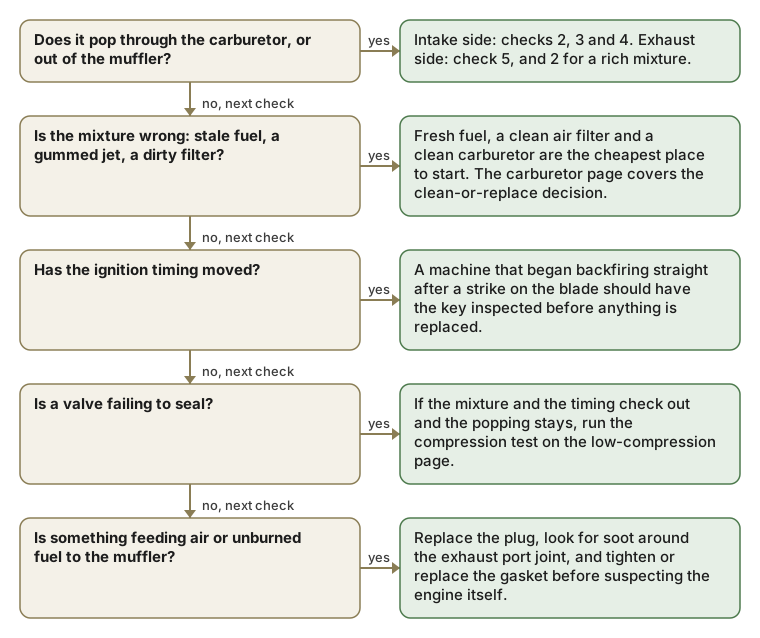
Where the bang comes from tells you what to check
A backfire is combustion happening where or when it should not. A bang or pop from the carburetor and air filter side means the flame went backward through the intake, which needs an open intake valve and a mixture that is still burning, or a spark that fired too early. A bang or pop from the muffler means unburned fuel reached the hot exhaust and lit there.
Those are different families of cause, so the first job is to find out which end the noise comes from, and whether it happens at starting, under load, or when the throttle is released.
1. Does it pop through the carburetor, or out of the muffler?
A cough or bang at the air filter, sometimes with the pull cord snatching back at starting, is an intake backfire: look at the mixture, the ignition timing and the valves. A pop or a flash at the muffler, worst when the throttle is released, is an exhaust afterfire: look at a misfire, a rich mixture, or air leaking into the exhaust.
If that is it: Intake side: checks 2, 3 and 4. Exhaust side: check 5, and 2 for a rich mixture.
2. Is the mixture wrong: stale fuel, a gummed jet, a dirty filter?
A lean mixture burns slowly enough that flame is still present when the intake valve opens, and lights the fresh charge in the intake. Stale fuel, a partly blocked carburetor jet, a loose or cracked intake joint, or a fuel path that is not passing enough fuel all lean the mixture out. A rich mixture, from a choke left on or a filter that is choked with dirt, sends unburned fuel down the exhaust instead.
If that is it: Fresh fuel, a clean air filter and a clean carburetor are the cheapest place to start. The carburetor page covers the clean-or-replace decision.
3. Has the ignition timing moved?
A flywheel is located on the crankshaft by a small soft key, and hitting a root, a stump or a rock with the blade can shear it. The flywheel then sits a little out of position, and the spark arrives at the wrong point in the stroke, which shows as a backfire at starting, a pull cord that kicks, and a loss of power. The key is checked by removing the flywheel, which needs the right puller and the plug lead off.
If that is it: A machine that began backfiring straight after a strike on the blade should have the key inspected before anything is replaced.
4. Is a valve failing to seal?
An intake valve that sticks, or that is burnt or set with too little clearance, lets flame reach the intake on the compression stroke. An exhaust valve that leaks pops through the muffler. Either shows up as weak compression and a rough idle, and the compression test separates a valve problem from a mixture or timing problem.
If that is it: If the mixture and the timing check out and the popping stays, run the compression test on the low-compression page.
5. Is something feeding air or unburned fuel to the muffler?
A gasket that has failed at the exhaust port, or a muffler joint that is loose, draws air in behind each exhaust pulse and lights whatever fuel is left. A fouled spark plug or a weak coil that misfires sends unburned mixture the same way. The effect is often strongest when the throttle is closed suddenly, when unburned fuel briefly reaches the exhaust.
If that is it: Replace the plug, look for soot around the exhaust port joint, and tighten or replace the gasket before suspecting the engine itself.
Where the noise is, what it points to, and the fix
| What you observe | What it points to | Fix |
|---|---|---|
| Cough or bang at the air filter; recoil kicks back | A lean mixture, or a spark that fires too early | Fresh fuel and a clean carburetor; check the flywheel key if the blade has struck something. |
| Pops at the muffler when the throttle closes | Unburned fuel lighting in the hot exhaust | New plug, clean air filter, check the exhaust joint gasket. |
| Began straight after the blade hit something solid | A sheared flywheel key and shifted timing | Remove the flywheel and inspect or replace the key. |
| Weak compression along with the popping | A sticking, burnt or poorly seated valve | Compression test, then valve inspection. |
| Soot or a black streak at the exhaust port joint | A failed exhaust gasket letting air in | Replace the gasket and tighten the muffler. |
Engine backfires, pops or sputters: questions
What is the difference between a backfire and an afterfire?
A backfire is flame going backward through the intake, heard at the carburetor and air filter. An afterfire is unburned fuel lighting in the exhaust, heard at the muffler. The distinction matters because they have different causes: intake backfires come from a lean mixture, early spark or a leaking intake valve, and afterfires from a misfire, a rich mixture or air leaking into the exhaust.
Can stale gasoline make an engine backfire?
Yes. Stale fuel and the varnish it leaves in the carburetor jets starve the engine of fuel and lean the mixture out. A lean mixture burns slowly, so flame can still be present when the intake valve opens and lights the fresh charge in the intake.
Fresh fuel and a clean carburetor are the cheapest first step for a machine that has sat.
Can a sheared flywheel key cause backfiring?
Yes. The key locates the flywheel on the crankshaft, and if it shears the flywheel sits out of position, so the spark arrives at the wrong point in the stroke. That shows as a backfire at starting, a pull cord that snatches back, and a loss of power.
It is most likely if the backfiring began straight after the blade struck a stump, root or rock.
How do I check the flywheel key?
The flywheel has to come off. With the plug lead off, remove the blower housing, hold the flywheel, take off its nut, and pull it with the correct puller, not by levering under it. A sound key is intact and square; a sheared one is cracked, twisted or visibly deformed.
The keyway in the flywheel should not be damaged either. Refit to the torque the manual gives.
Why does my engine pop when I let off the throttle?
Popping at the muffler when the throttle closes is an afterfire. Closing the throttle briefly sends unburned fuel into the hot exhaust, where it can light. It is worse with a rich mixture, a misfiring spark plug, or a failed gasket at the exhaust port that lets air in behind the exhaust pulse.
A new plug, a clean filter and a sound exhaust joint usually settle it.
Will spraying starting fluid cause a backfire?
It can. Starting fluid is highly flammable, and spraying it into an engine that then catches on the first compression stroke can produce a backfire through the carburetor. It is also a poor way to diagnose a fault, because it can mask a fuel-delivery problem by making the engine fire once.
Fresh fuel and a clean carburetor test the same thing without the risk.
Can a dirty air filter cause a backfire?
Indirectly. A badly choked filter restricts air and enriches the mixture, which sends unburned fuel toward the exhaust and can produce popping at the muffler. It is not a typical cause of intake backfires, which point to a lean mixture or timing.
Checking the filter is worth doing early because it costs nothing and is often overlooked.
Can valve trouble make an engine backfire?
Yes. A valve that sticks, is burnt or is set with too little clearance can fail to seal, letting flame reach the intake on the compression stroke or pop through the muffler on the exhaust side. It usually comes with weak compression and a rough idle, and a compression test separates a valve fault from a mixture or timing fault.
Is backfiring harmful to the engine?
It can be. An intake backfire is a flame at the air filter and carburetor, which is a fire risk with fuel around, and hard backfires can damage the carburetor, the filter housing and the flywheel key. Repeated afterfires are less damaging but signal a fault worth fixing.
Neither is something to keep running through, and it is the reason for the fuel-and-flame warning at the top of the page.
Why does the pull cord snatch back when I start the engine?
A pull cord that kicks back means the piston is being driven backward before top dead center, because the spark fires too early. A shifted flywheel from a sheared key is the classic cause. Stop pulling and do not keep trying: the recoil can hurt a wrist.
Have the ignition timing and the key checked before starting again.
Does it matter whether the popping is at starting or under load?
Yes, it narrows the cause. Popping only at starting points at the choke, a flooded engine, or a timing or valve problem. Popping under load with a loss of power points at a lean mixture or a misfire.
Popping only when the throttle closes is the afterfire pattern. Note which of the three it is before starting any work.
Should I keep running the engine until I can fix it?
No. A machine that backfires is either lean, mistimed or leaking through a valve, and running it on risks a fire, a damaged carburetor or a bent flywheel key. Stop, let it cool, and work through the causes in order: mixture first, then the flywheel key if the blade struck something, then valves and the exhaust joint.