No spark: verify the test before replacing the ignition coil
Confirm missing ignition with the engine’s specified spark tester and procedure before replacing a coil. Check the correct plug, connection and visible wiring condition with starting power isolated. Do not rank parts by an invented failure rate or disconnect a safety circuit to make the engine run.
A removed plug is not the prescribed tester
Briggs’ ignition guide specifies a tester connected according to its instructions and warns against connecting the test arrangement to the spark plug where the engine could start. Keep fuel contained and required guards in place. An exposed plug beside an open cylinder is not an acceptable substitute.
| Question | What the answer does not establish |
|---|---|
| Is there a tester spark? | Correct combustion, fuel delivery or valve sealing |
| Is the plug the specified part? | Condition of every ignition component |
| Does the fault appear hot? | A coil diagnosis without a hot-condition test |
| Did a blade impact occur? | A flywheel-key diagnosis without inspection |
Record the exact conditions
For example, one passing cold test and one hot no-start are two observations, not a complete coil test. Give the technician the engine model and code, tester used, operating load and temperature-related sequence. Resistance figures from a different ignition design cannot establish whether this module is sound.
A stop switch, interlock or damaged wire can affect ignition, but the circuit arrangement varies. Leave interlocks functional and use the equipment wiring diagram. A machine that starts after an unauthorized bypass has not been repaired.
Plug condition and timing are separate
NGK’s installation guidance explains that correct installation affects heat transfer. Correct thread, reach, seat and torque matter as well as gap; use the engine’s approved application. A plug can physically screw in and still be wrong.
A flywheel or timing concern after impact belongs to an appropriate damage inspection. See backfire and kickback observations rather than replacing a key automatically. See plug selection before buying a substitute.
TS-25 · Troubleshooting
No spark on a small engine: plug, lead, kill switch, key and coil
When a small engine has no spark, the coil is the last suspect, not the first. The spark plug fails more often than any other part, then the boot and lead, then the stop switch or its wire, which grounds the coil and can mimic a dead one. After those come the gap between the coil and the flywheel, which a repair can leave too wide, and the flywheel key, which a blade strike can shear so that the spark fires at the wrong moment.
Only when all of those check out does the coil deserve a resistance test against the manual, and it can fail outright or only when warm. Each of the first five checks costs little or nothing and needs no test equipment beyond a plug and a feeler gauge.
A spark test means turning the engine over with the plug lead in your hand or near the engine, so keep fuel away first: no spilled petrol, no open fuel line, nothing that gives off vapour within reach. Use a plug in the lead or an inline tester, never a bare lead held near the plug hole where fuel vapour comes out. A spark fires with the ignition primed for a fraction of a second, and it also lands on whoever is holding the wire.
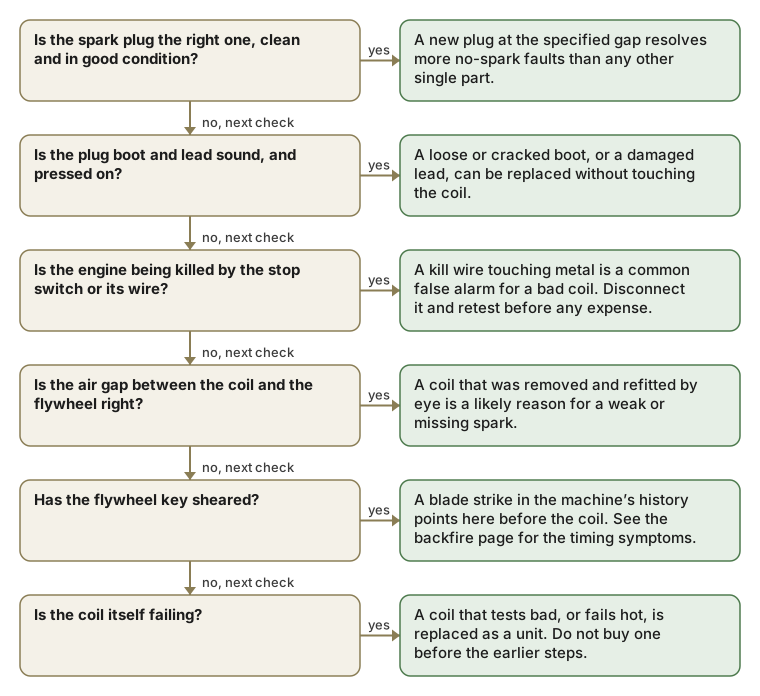
No spark is a short list, and the cheap parts come first
A small engine gets its spark from a coil, often called a magneto, fixed beside the flywheel. Magnets in the flywheel sweep past the coil as it turns and generate the high voltage that jumps the plug gap. There is no battery in that loop on most push mowers, trimmers, chainsaws and generators, so the parts that can fail are few: the plug, its boot and lead, the stop switch or wire that grounds the coil to kill the engine, the gap between coil and flywheel, the key that locates the flywheel, and the coil itself.
The coil is the least likely of these, and the most expensive, so it comes last. The steps are in order of cost.
1. Is the spark plug the right one, clean and in good condition?
Remove the plug and look. A plug fouled with black carbon or wet with fuel or oil, with a cracked porcelain, a burnt-away electrode, or the wrong gap will not fire. It is cheap to test by fitting a new plug of the type in the manual and setting the gap it gives with a feeler gauge.
Do this before condemning any other part, because it is the one fault that a spark tester alone does not always show.
If that is it: A new plug at the specified gap resolves more no-spark faults than any other single part.
2. Is the plug boot and lead sound, and pressed on?
The boot is the cap that grips the plug. If it is loose, cracked or corroded inside, the voltage escapes or never arrives. On some machines the boot holds a resistor, and the lead can be cracked or chafed where it passes the shroud.
Push the boot on until it clicks and look along the lead for cracks, burns or a rubbed-through patch.
If that is it: A loose or cracked boot, or a damaged lead, can be replaced without touching the coil.
3. Is the engine being killed by the stop switch or its wire?
The stop switch works by grounding the coil, so a switch that has stuck on, a wire that has rubbed through and is touching metal, or a safety interlock that is holding the ignition grounded will all look like a dead coil. Disconnect the kill wire from the coil terminal and test again: if a spark returns, the fault is in the switch, the wire or an interlock. On riding mowers the seat, PTO and brake switches sit in the same circuit.
If that is it: A kill wire touching metal is a common false alarm for a bad coil. Disconnect it and retest before any expense.
4. Is the air gap between the coil and the flywheel right?
The coil has to sit close to the magnets, at a gap the manual specifies, set with a feeler gauge or a spacer. Too wide a gap after a repair, or a loose coil bolt, weakens the spark or kills it. Loosen the coil bolts, set the gap, and tighten them with the spacer in place.
If that is it: A coil that was removed and refitted by eye is a likely reason for a weak or missing spark.
5. Has the flywheel key sheared?
The key is a small soft-metal wedge that locks the flywheel to the crankshaft in the right position. A blade striking a stump or a rock can shear it, shifting the flywheel so the magnets pass the coil at the wrong moment. The engine then kicks back, runs badly, or has spark at the wrong time.
Removing the flywheel nut and the flywheel and looking at the key settles it, and a new key is inexpensive.
If that is it: A blade strike in the machine’s history points here before the coil. See the backfire page for the timing symptoms.
6. Is the coil itself failing?
Once the plug, boot, switch, gap and key are ruled out, the coil is the last suspect. It can fail outright, or fail as it warms, which gives the engine that runs and dies hot. A multimeter set to resistance, used against the values in the manual, checks the primary and secondary windings.
A reading outside the range, or an open circuit, condemns it.
If that is it: A coil that tests bad, or fails hot, is replaced as a unit. Do not buy one before the earlier steps.
Spark-test results and ignition faults
| What you observe | What it points to | Fix |
|---|---|---|
| Plug black, wet, cracked or gapped wrongly | A plug that cannot fire | Fit the specified plug and set its gap. |
| Spark that comes and goes as you move the lead | A cracked boot or a damaged lead | Seat the boot; replace a damaged boot or lead. |
| No spark, but spark returns with the kill wire disconnected | A stuck switch, a grounded wire or an interlock | Repair or replace the switch or wire; check the interlocks. |
| Weak spark after the coil was removed | Air gap too wide, or a loose coil | Reset the gap with a gauge and tighten the coil. |
| Kickback, or a spark at the wrong moment after a blade strike | A sheared flywheel key | Remove the flywheel and fit a new key. |
| Everything else passes, or it fails only when hot | A failing coil | Meter it against the manual; replace as a unit. |
No spark on a small engine: questions
How do I test a small engine for spark?
Pull the plug lead, fit a spare plug of the right type into it, lay its threads against bare metal on the engine and turn the engine over. A strong blue spark across the gap is good. No spark or a weak orange one is not.
Keep fuel and vapour away, and do not hold the lead bare near the plug hole. An inline spark tester is a safer way to do the same thing.
What is the most common reason for no spark?
The spark plug. A plug fouled with carbon, fuel or oil, cracked, worn out or set to the wrong gap will not fire, and it costs very little to replace. Fit the plug the manual specifies, set its gap with a feeler gauge, and test again before suspecting the boot, the switch or the coil, all of which cost more.
Can a stop switch stop a spark?
Yes. The stop switch grounds the coil to kill the engine, so a switch that has stuck in the stop position, or a wire that has rubbed through and is touching metal, holds the ignition dead. Disconnect the kill wire from the coil terminal and test for spark again: if it returns, the fault is the switch, the wire or an interlock, not the coil.
Why does a riding mower have no spark when I sit off the seat?
On many riding mowers the seat, brake and PTO switches ground the ignition when their conditions are not met, so the engine cannot start or stops when the seat is left. That is a safety feature working, not a failed coil. Check that each switch is closing as its circuit requires and that no wire to one of them has come loose before testing the coil.
What is the air gap on an ignition coil, and does it matter?
It is the small space between the coil and the magnets in the flywheel, and it matters a great deal. Too wide and the coil sees a weak field and the spark weakens or fails. The manual gives the gap; set it with a feeler gauge or a spacer with the coil bolts loose, then tighten them.
A coil refitted by eye is a common cause of weak spark.
What does a sheared flywheel key do?
It lets the flywheel shift on the crankshaft, so the magnets pass the coil at the wrong moment and the spark fires early or late. The engine may kick back on the pull cord, backfire, run badly or fail to start. It usually follows a blade striking a stump or a rock.
Removing the flywheel and inspecting the key confirms it, and a replacement key is cheap.
How do I test an ignition coil with a multimeter?
Set the meter to resistance, measure across the primary winding and the secondary winding as the manual shows, and compare with the values it gives. A reading far outside the range, or no reading, means the coil has failed. The test is only meaningful with the manual's figures.
A coil can also pass a cold test and fail as it warms, so a hot stall is a reason to suspect it.
Can a coil work when cold and fail when hot?
Yes. Heat can open up a break in the coil's insulation or windings, so the engine starts, runs for a while and then loses its spark, then works again once cooled. The clue is that spark is good cold and gone hot.
Test for spark right after the stall, before it cools, and if it is missing then, replace the coil.
Should I buy a new coil before checking anything else?
No. The coil is the least likely cause and among the dearest parts. Check the plug and its gap, the boot and lead, the kill wire and the air gap first, and the flywheel key if the blade ever hit something.
Most no-spark faults end at one of those. Buy a coil only when they check out and a resistance test condemns the old one.
How should I diagnose a weak spark at the spark plug?
A weak or orange spark suggests too little energy is reaching the plug: a fouled or wrongly gapped plug, a damaged boot or lead, a coil gap that is too wide or a coil that is failing. Change the plug first, then check the boot and gap. A weak spark can fire in the open air and still fail under compression, so do not stop at the first flash.
Is it safe to test for spark myself?
It is, with care. Keep petrol and vapour away, use a plug or an inline tester, hold the plug by its insulated boot with a dry glove, and stay clear of the blade or any moving part. The voltage is high but the current is small.
Never test for spark near a spilled fuel puddle or an open fuel line.
What else stops an engine that has good spark?
Fuel, air and compression. If a strong spark is present and the engine still will not run, work through the fuel first: stale fuel, a blocked jet or a shut valve. Then the air filter and the exhaust, then a compression test.
The engine-will-not-start page walks through that order.