Low compression: use the correct test and interpret its limits
Use the exact engine’s service procedure before interpreting a compression number. A compression-release mechanism, test speed, temperature and adapter can change the result. Easy recoil pulling does not prove worn rings, and one wet test does not uniquely separate every ring, valve and head-gasket fault.
Record the compression-test conditions
| Record | Reason |
|---|---|
| Engine identifier | Selects the applicable procedure and limits |
| Temperature and cranking method | Makes the result reproducible |
| Adapter and instrument | Avoids comparing unlike setups |
| Release system / valve condition | Can affect cranking compression |
| Specified limit and interpretation | Avoids an unrelated internet PSI threshold |
Briggs’ problem-solving guidance identifies valve clearance and sealing as possible compression-related issues and recommends appropriate leak-down testing or dealer service. Its tool listing includes a dedicated tester for compression-component sealing. These are different measurements from judging how hard a rope feels.
Percent leakage is not cylinder pressure
For a hypothetical pair of test reports, 70 PSI on a cranking gauge and 15 percent on a leak-down instrument are not competing versions of the same reading. One reports pressure during cranking; the other reports leakage under its test conditions. Neither is a pass or fail without the applicable procedure and specification.
A leak-down test uses compressed air and can turn the engine unexpectedly. Correct piston position, restraint and isolation require the actual service instructions and suitable equipment. Do not improvise a generic compressed-air connection or add an arbitrary teaspoon of oil to a small cylinder.
Request a diagnosis before an economic verdict
A quote should identify the suspected defect, supporting tests, included parts and labor, and unresolved damage. Worn rings do not automatically make every machine uneconomic to repair, and a head gasket is not automatically a cheap repair.
Use repair versus replacement after obtaining that scope. For an engine that will not rotate, first use locked-engine checks; forcing a seized or liquid-filled cylinder is not a compression test.
TS-17 · Troubleshooting
Low compression, diagnosed
Fuel and spark are cheap to fix regardless of the result; low compression is the one outcome in the will-not-start sequence where the engine’s internals, not a part bolted to them, are the problem, which is why "the cord pulls easy" is worth turning into an actual gauge reading rather than acted on as an impression. Warm the engine if it will run, crank it through several full revolutions, and read the peak rather than the first pull. If the number is low, a teaspoon of oil through the plug hole and a second reading separates worn rings, where compression rises noticeably with the oil, from a valve or head gasket, where it does not change.
Rings and a worn bore are where the repair math usually favors replacement; a head gasket is often the inexpensive exception.
Before anything else: pull the spark plug lead off and tuck it away from the plug, and on a battery machine take the key out. Every step assumes the engine cannot start while your hands are near it. On a machine with a blade, an auger or a chain, that is not a formality.
Why this is the one result that changes the economics
The will-not-start sequence tests fuel and spark before compression for a reason: both of those are inexpensive to fix regardless of the result, while low compression is the one outcome on that whole page where the engine's internals, not a part bolted to them, are the problem. That is the point where repair-versus-replace stops being a feeling and starts being arithmetic; see repair or replace old equipment for that decision once you have a number.
"The cord pulls easy" is an impression. A gauge is a number.
A cord that pulls with little resistance is a real and useful sign, but it is not a measurement. It tells you compression is low relative to what that engine normally feels like, not how low, and not whether it is low enough to matter. A compression gauge with the correct small-engine adapter thread turns that impression into a number you can compare against a healthy reading from the same engine, or against a specification if the engine's documentation states one.
-
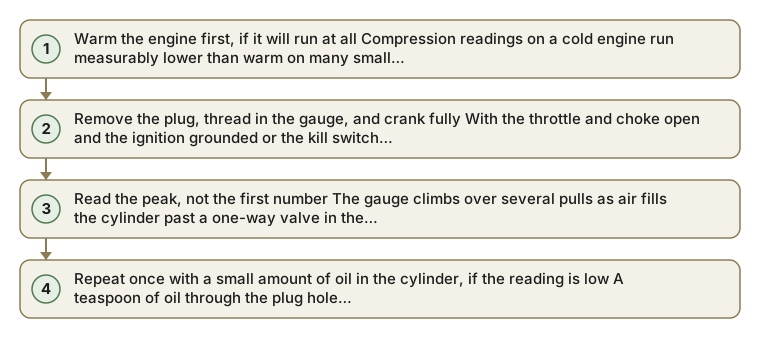
Warm the engine first, if it will run at all
Compression readings on a cold engine run measurably lower than warm on many small engines because ring seal improves once the cylinder and piston reach operating temperature: a cold reading can look worse than the engine is.
-
Remove the plug, thread in the gauge, and crank fully
With the throttle and choke open and the ignition grounded or the kill switch engaged for safety, crank the engine through several full revolutions with the starter cord or electric starter until the gauge needle stops climbing.
-
Read the peak, not the first number
The gauge climbs over several pulls as air fills the cylinder past a one-way valve in the gauge itself; the number that matters is where it stops rising, not the first pull’s reading.
-
Repeat once with a small amount of oil in the cylinder, if the reading is low
A teaspoon of oil through the plug hole temporarily seals worn rings. If compression rises noticeably with the oil added, the rings are the likely cause; if it does not change, the leak is more likely a valve or a head gasket instead.
What the wet test separates
| What happens with oil added | What it points to |
|---|---|
| Compression rises noticeably | Worn piston rings or a worn cylinder bore: the oil temporarily restores the seal. |
| Compression stays about the same, still low | A valve not seating fully, or a head gasket leaking: oil in the cylinder does not seal either of those. |
| Compression is normal on both tests | Compression was not the fault. Look again at fuel and spark. |
Where the economics land
Rings and a bore are a genuine engine rebuild or replacement on almost every small engine in this size class: the labor to access them costs more than a low-hour replacement engine on most machines, which is why this result is where repair-versus-replace usually resolves in favor of replacement. A head gasket, by contrast, is often a straightforward and inexpensive repair by comparison, because the head comes off without splitting the crankcase. The wet test above is what tells the two apart before you spend on either.
Low compression, diagnosed: questions
How do I test compression on a small engine?
Warm the engine if it will run at all, remove the plug, thread in a compression gauge with the correct small-engine adapter, and crank through several full revolutions with the throttle and choke open. Read the peak the gauge reaches, not the first pull: it climbs over several strokes as air fills the cylinder past the gauge’s own check valve.
What does a low compression reading mean?
That the cylinder cannot hold pressure the way it should, from worn piston rings, a worn cylinder bore, a valve not seating fully, or a leaking head gasket. A wet test, adding a small amount of oil through the plug hole and retesting, tells rings and bore (compression rises) apart from a valve or gasket (compression stays about the same).
Is low compression worth repairing, or should I replace the machine?
Rings and a worn bore are a genuine engine rebuild on most small engines in this size class, and the labor to access them often costs more than a low-hour replacement engine. This is usually where the repair math favors replacement. A head gasket, by contrast, is often a comparatively inexpensive repair, since the head comes off without splitting the crankcase.
Why does the will-not-start sequence test fuel and spark before compression?
Because fuel and spark faults are inexpensive to fix regardless of the result, while low compression is the one outcome where the engine's internals themselves, not a part bolted to them, are the problem. Testing the cheap possibilities first means compression is only tested once the less expensive explanations are already ruled out.
Why is "the cord pulls easy" not a reliable substitute for an actual compression reading?
Because it tells you compression is low relative to what that engine normally feels like, not how low, and not whether it's low enough to matter: a gauge reading turns that vague impression into a number that can be compared against a known-healthy reading from the same engine or against a published specification.
Why should I warm the engine before testing compression, if it can run at all?
Because compression readings on a cold engine run measurably lower than warm on many small engines, as ring seal improves once the cylinder and piston reach operating temperature: testing cold can make a healthy engine look worse than it is, leading to an incorrect low-compression conclusion.
Why does the compression gauge reading climb over several cranks rather than showing the true number on the first pull?
The gauge itself contains a one-way check valve that holds the peak pressure reached across multiple compression strokes, and it takes several revolutions for air to fill the cylinder and register the engine's actual peak compression: reading the first pull's number instead of where the needle stops rising gives an artificially low, misleading result.
What is the wet compression test, and why does adding oil help distinguish the cause?
A teaspoon of oil through the plug hole temporarily seals worn piston rings against the cylinder wall, so if compression rises noticeably with that oil added, worn rings or a worn bore are the likely cause. If compression stays about the same, the leak is more likely a valve not seating fully or a head gasket, since oil in the cylinder doesn't help seal either of those.
Can an engine test normal on both a dry and a wet compression test?
Yes: a normal reading on both tests means compression was never the actual fault, and the diagnosis should return to fuel and spark rather than continuing to suspect the engine's internals. This is a useful negative result, not a dead end.
Does a low compression reading always mean the same repair regardless of engine size or class?
The diagnostic method (warm the engine, test dry, retest wet) applies universally, but the economics differ by engine size and cost: a small handheld two-stroke engine's low-hour replacement cost differs enough from a larger four-stroke riding-mower engine's that the repair-versus-replace threshold the guide describes can land differently depending on which specific engine is being diagnosed.