Low-oil shutdown and hydrolock are different no-start problems
Check oil by the actual engine’s level procedure, but do not assume every no-start has a low-oil sensor. An engine that rotates without firing differs from one that physically will not turn. Stop cranking a locked engine; a sensor bypass or a harder pull cannot safely resolve liquid in a cylinder or internal damage.
Oil Alert is a model feature
The Honda GX120/GX160/GX200 manual describes Oil Alert where equipped. It still requires checking oil before use. A protection feature is not a guarantee against every form of low-oil damage, and it is not present on every engine carrying the Honda name.
| Observation | Decision |
|---|---|
| Rotates but does not fire | Check oil, settings and the actual warning/shutdown system |
| Stops hard or will not rotate | Stop; inspect for obstruction, liquid or internal damage |
| Fuel smell or rising oil level | Keep out of use pending fuel-system and oil inspection |
| Recently tipped machine | Follow the approved tilt and recovery instructions |
Capacity is not the amount to add
The GCV160/GCV190 manual distinguishes a 0.50-liter dry capacity from approximately 0.35–0.41 liters for an oil change. Adding the entire dry capacity after an ordinary drain can exceed the intended refill by 0.09–0.15 liter. The level procedure controls the final fill.
Clearing liquid is not the whole repair
Hydrolock describes liquid preventing the piston from completing its stroke. A locked engine can also have another cause. Removing a plug and spraying liquid out with the starter can create a fuel and ignition hazard without resolving the leak, contamination or damage that caused it.
Use qualified service when a liquid-filled cylinder is suspected. Inspection can require correcting a carburetor leak, contaminated crankcase oil or transport damage before a restart. Smoke after an improvised recovery is not proof that the machine is safe.
See carburetor repair choices for a diagnosed fuel leak, and recoil problems when the starting assembly itself needs inspection.
TS-18 · Troubleshooting
Oil level, low-oil shutdown and hydrolock
Two opposite oil-related problems both present as "it will not start," and treating one as the other causes real damage. An engine that cranks normally, sounds fine, and simply will not fire has its dipstick checked first: many four-stroke engines cut spark or fuel below a minimum oil level on purpose, to make running low-on-oil impossible rather than merely unlikely, and topping up resolves it in minutes. An engine that will not turn over at all, the starter strains, or the pull cord will not move, after being tipped is a different problem: liquid sitting above the piston, which physically cannot be compressed.
Forcing that engine over is how a connecting rod bends; the fix is pulling the plug and clearing the liquid, not applying more force.
Before anything else: pull the spark plug lead off and tuck it away from the plug, and on a battery machine take the key out. Every step assumes the engine cannot start while your hands are near it. On a machine with a blade, an auger or a chain, that is not a formality.
Two completely different problems that both look like "it won't start"
Many four-stroke engines refuse to start, or start and die within a second, specifically because of oil, but in two opposite ways that need opposite responses. Confusing them is how a five-minute check turns into a damaged engine.
| What you observe | Actual cause | What to do |
|---|---|---|
| Cranks freely, sounds normal, simply will not fire | Low-oil shutdown can interrupt ignition or fuel. Confirm the oil level before diagnosing a failed component. | Check the dipstick with the machine level before anything else. Top up and retry. |
| Will not turn over at all. Starter strains or the pull cord will not move | Hydrolock: liquid (oil or fuel) has entered the cylinder and the piston physically cannot compress it. | Stop. Do not force it. See the removal procedure below. |
The low-oil shutdown, and why it is not a fault
Many walk-behind and generator engines include an oil-level sensor that cuts spark or fuel below a minimum level specifically to prevent the engine from running itself into a crankshaft-bearing failure: running a four-stroke meaningfully low on oil for even a short period causes real, expensive damage, and the sensor exists to make that mistake impossible rather than merely unlikely. A machine that cranks normally and simply will not fire, with no other symptom, has the oil level checked first, before spark or fuel are touched at all.
Hydrolock: what happened, and what not to do next
An engine hydrolocks when liquid, oil that has run into the cylinder because the machine was tipped or stored the wrong way up, or raw fuel from a flooded carburetor, sits above the piston at top dead center. Liquid does not compress the way an air-fuel mixture does, so the piston simply cannot complete its stroke, and the engine will not turn over at all, by hand or by starter.
Do not force a hydrolocked engine over with a starter motor, an impact wrench, or by leaning on the pull cord: that is how a connecting rod bends or a piston cracks. Clear the liquid by the engine’s service procedure before trying to turn the engine again.
-
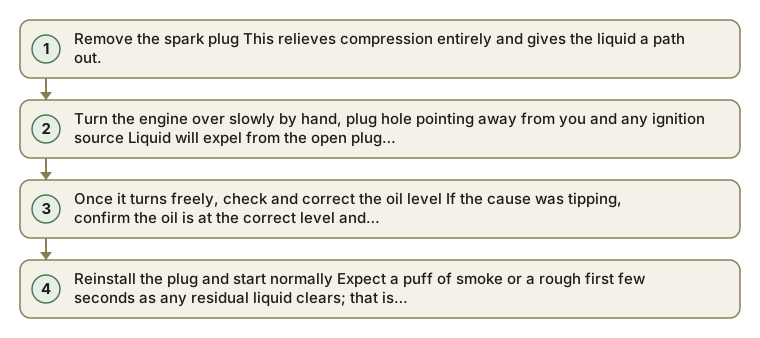
Remove the spark plug
This relieves compression entirely and gives the liquid a path out.
-
Turn the engine over slowly by hand, plug hole pointing away from you and any ignition source
Liquid will expel from the open plug hole as the piston moves. Do this outdoors or in a well-ventilated area if fuel is involved.
-
Once it turns freely, check and correct the oil level
If the cause was tipping, confirm the oil is at the correct level and not overfull. An overfilled crankcase can itself blow past the rings into the cylinder under some orientations.
-
Reinstall the plug and start normally
Expect a puff of smoke or a rough first few seconds as any residual liquid clears; that is normal after a proper hydrolock recovery.
The tip direction matters on some engines: check the machine's manual for which way it may safely be tilted for cleaning or transport, since some small engines specify a side that keeps the carburetor and breather above the oil level and one that does not.
Oil level, low-oil shutdown and hydrolock: questions
Why does my mower crank but not start, even though it sounds fine?
Check the oil level first. Many four-stroke engines cut spark or fuel below a minimum oil level on purpose, to prevent running low on oil, which causes real bearing damage, rather than merely warn about it. A machine that cranks normally and simply will not fire, with no other symptom, is checked here before spark or fuel are touched.
My mower won’t turn over at all after I tipped it: what happened?
Likely hydrolock: oil ran into the cylinder while the machine was tipped and now sits above the piston, which cannot compress a liquid the way it compresses an air-fuel mixture. Do not force it with a starter, an impact wrench, or by leaning on the pull cord: that bends a connecting rod. Remove the spark plug and turn the engine over slowly by hand to clear the liquid.
Is it safe to run a small engine low on oil for a short time?
No: running a four-stroke engine meaningfully low on oil for even a short period causes real, expensive bearing damage, which is exactly why many engines include a low-oil shutdown that cuts ignition or fuel rather than allowing it to run at all.
How do I know which way I can safely tip my mower for cleaning?
Check the machine’s own manual: some small engines specify a permitted tip direction that keeps the carburetor and crankcase breather above the oil level, and one that does not. Tipping the wrong way is one of the more common causes of hydrolock on walk-behind machines.
How do I tell the difference between a low-oil shutdown and a genuine hydrolock?
By whether the engine turns over at all. A low-oil shutdown lets the engine crank freely and sound normal, it simply won't fire, while a hydrolocked engine physically will not turn over, with the starter straining or the pull cord refusing to move, because liquid sitting above the piston cannot be compressed the way an air-fuel mixture can.
What is the correct first step after removing the spark plug from a suspected hydrolocked engine?
Turn the engine over slowly by hand, with the plug hole pointing away from yourself and any ignition source: this relieves the compression entirely and gives the trapped liquid a path out through the open plug hole as the piston moves, which is the actual fix rather than forcing the engine against the trapped liquid.
Can raw fuel from a flooded carburetor cause hydrolock, not just oil from tipping?
Yes: either oil that has run into the cylinder from tipping or storage orientation, or raw fuel from a flooded carburetor (such as one recently reassembled with an incorrect float level), can sit above the piston and produce the identical can't-turn-over hydrolock symptom, which is why the guide cross-references the carburetor rebuild page's warning about testing float level before the first start.
Is it normal to see smoke or rough running immediately after recovering from a hydrolock?
Yes: a puff of smoke or a rough first few seconds as any residual liquid clears is expected and normal after a proper hydrolock recovery procedure, not a sign that something else is now wrong. It should smooth out quickly once the residual liquid has fully burned off or drained.
Should I check the oil level even if I have no specific reason to suspect a low-oil shutdown?
Yes, as a routine first check on any four-stroke that cranks normally but won't fire: since checking the dipstick costs nothing and takes under a minute, doing it before touching spark or fuel components rules out the single most common cause of this specific symptom pattern immediately.
Can an overfilled crankcase cause similar problems to a hydrolock?
Yes, in some orientations: an overfilled crankcase can blow oil past the rings into the cylinder under certain tilts or vibration, producing a similar liquid-in-the-cylinder problem to hydrolock from tipping. This is why the recovery steps explicitly include confirming the oil level is correct, not just topped up, once the engine turns freely again.
Does every small engine have a low-oil shutdown sensor, or is it only on certain models?
Not universally: many, but not all, walk-behind and generator engines include this protection, so a machine that cranks normally and won't fire on a model without a low-oil sensor points the diagnosis elsewhere (fuel, spark) rather than to oil level, which is why confirming whether your specific engine has this feature is worth doing before ruling other causes out.
Can a machine hydrolock from being stored on a slope or an uneven surface, without ever being deliberately tipped?
It's possible in principle if the slope is steep enough and sustained long enough for oil to migrate past a seal into a cylinder over time, though this is far less common than hydrolock from an active tipping event during use, cleaning, or transport: storing equipment on a level surface avoids this small additional risk on top of its other benefits.