Carburetor repair: choose cleaning, correct parts or replacement
Diagnose the fuel-metering fault before choosing carburetor cleaning, a repair kit or replacement. Identify the engine and carburetor code, then check the approved service procedure and parts. Cleaning cannot repair a cracked body or worn fit, and a kit is not proof that every internal component is included.
Choose the job from the defect
| Finding | Decision to verify |
|---|---|
| Accessible contamination | Whether approved cleaning can reach the affected passage |
| Seal, needle or diaphragm fault | Correct replacement parts and test procedure |
| Damaged casting or worn fit | Repairability and exact replacement assembly |
| Unknown cause of rough running | Finish diagnosis before ordering a carburetor |
Briggs’ carburetor-cleaning guidance describes cleaning in the context of its procedures. It does not establish that one spray or one soaking chemical is safe for every diaphragm, coating, plastic part or solenoid. Do not drill jets or remove limiter features to make a replacement behave differently.
A diaphragm system is not a float bowl
ZAMA’s service tips use carburetor-specific pressure testing and distinguish it from a pop-off test. A generic float-level instruction cannot apply to a diaphragm carburetor that has no float. Use the correct exploded drawing, parts revision and test equipment.
Compare complete quotes
For a hypothetical repair, $35 in parts plus $90 labor totals $125. A $70 replacement plus $60 labor totals $130. The difference is $5, not the $35 difference between the parts alone.
Add required diagnosis, shipping and warranty terms before choosing.
These example prices are arithmetic, not a quote or a claim about current labor rates. A replacement listing also needs the correct fuel connections, controls and emissions application; appearance alone is not fitment.
Leakage must be resolved before starting
Fuel leakage or fuel-contaminated crankcase oil requires correction before a test run. Do not regard the absence of an external drip as proof of a sealed internal needle valve. Use a qualified repairer when the required leak test or adjustment is outside the operator procedure.
Continue with fuel-path identification or liquid-lock concerns according to the observed fault.
TS-15 · Troubleshooting
Carburetor: clean, rebuild or replace
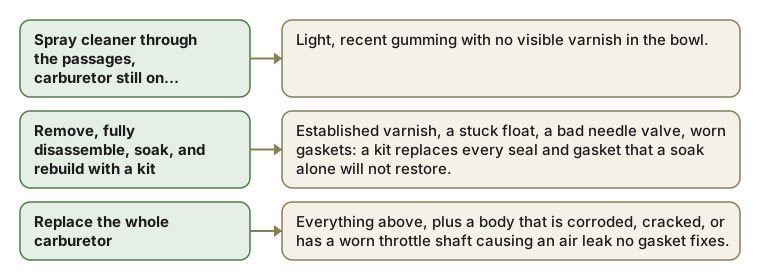
Several symptom pages narrow a fault down to "it is the carburetor" and stop there, because diagnosis and repair are different jobs. Ethanol-blended fuel left standing oxidizes into a shellac-like varnish that blocks passages measured in fractions of a millimeter, most visibly in the float bowl. A light spray-clean fixes recent, minor gumming with the carburetor still on the machine; established varnish, a stuck float or a bad needle valve need a full disassembly and a rebuild kit; a worn throttle shaft or a cracked body is the one case that justifies full replacement.
The costliest mistake is not the rebuild itself. It is test-starting a reassembled carburetor before confirming the float level, which floods the crankcase and can hydrolock the engine on the very next crank.
Before anything else: pull the spark plug lead off and tuck it away from the plug, and on a battery machine take the key out. Every step assumes the engine cannot start while your hands are near it. On a machine with a blade, an auger or a chain, that is not a formality.
Every symptom page on this site eventually points here
A brief start followed by stalling, surging and hunting, or running only with the choke closed can make the fuel path worth investigating. Those symptoms do not uniquely identify a carburetor fault; check the tank, valve, filter and line before opening the carburetor. This guide then explains what varnish looks like inside and how condition, available parts and the diagnosis affect the choice between cleaning, rebuilding and replacement.
What "gummed" means
Ethanol-blended gasoline left standing in a carburetor oxidizes and leaves a shellac-like varnish behind as it evaporates, and that varnish is thick enough to block passages measured in fractions of a millimeter: the main jet, the idle jet, and the tiny emulsion tube passages in particular. The float bowl is usually where it is most visible: a discolored, sticky residue on the bottom and walls, sometimes with a stuck float or a gummed needle valve that no longer seals. See ethanol, stabilizer and what happens to stored gasoline for the chemistry; this page picks up after the damage is already done.
Clean, rebuild or replace: the actual decision
| Option | Fixes | Does not fix |
|---|---|---|
| Spray cleaner through the passages, carburetor still on the engine | Light, recent gumming with no visible varnish in the bowl. | Anything the spray cannot reach with the carburetor assembled, usually not enough for fuel left over a full winter. |
| Remove, fully disassemble, soak, and rebuild with a kit | Established varnish, a stuck float, a bad needle valve, worn gaskets: a kit replaces every seal and gasket that a soak alone will not restore. | A warped bowl gasket surface, a stripped adjustment screw, or a diaphragm carburetor whose metering diaphragm has hardened. Those need parts a basic kit may not include. |
| Replace the whole carburetor | Everything above, plus a body that is corroded, cracked, or has a worn throttle shaft causing an air leak no gasket fixes. | Nothing: but it is the most expensive option and unnecessary for most gumming cases. |
For most seasonal no-start machines, a soak-and-rebuild is the right level of effort: the parts are inexpensive relative to the labor either way, and a full rebuild resets everything a partial clean cannot reach. Reach for a full replacement mainly when the throttle shaft has visible play. An air leak there causes exactly the same surging and hunting symptoms as a fueling problem, and no amount of cleaning fixes worn metal.
The mistake that turns a cheap repair into a new engine
Reassembling a carburetor with a gasket misaligned, a jet cross-threaded, or a spring left out is common and usually just means doing it again correctly. The mistake that costs money is running the engine to "test" a reassembled carburetor before confirming the float level and the choke linkage are correct: a stuck-open needle valve floods the crankcase with raw fuel through the intake, and cranking a flooded four-stroke repeatedly is exactly how you hydrolock one. See oil level, low-oil shutdown and hydrolock before the first test start.
Two-stroke carburetors: the same problem, a smaller part
A two-stroke's carburetor is mechanically simpler, usually a diaphragm design with no float, but the diaphragm itself hardens with age and heat exposure independent of fuel quality, which is why a two-stroke that has always run fresh fuel can still eventually need the same kit-and-rebuild treatment. The fuel mix calculator at least removes one variable going back into it.
Carburetor: questions
How do I know if my carburetor needs cleaning?
Brief starting followed by stalling, surging or choke-dependent running can justify a fuel-system inspection; none proves the carburetor is the only cause. Inspect the normal supply path before disassembly. A sticky, discolored varnish deposit found in the float bowl is physical evidence to consider alongside passage condition and the manufacturer’s service instructions.
Can I just spray carburetor cleaner without taking it apart?
It works for light, recent gumming, but a spray cleaner cannot reach every passage with the carburetor still assembled: for anything that sat over a full winter, a full disassembly and rebuild kit reaches the passages a spray cannot and resets every seal and gasket at once.
How much does a carburetor rebuild kit cost compared to a new carburetor?
A rebuild kit is typically a small fraction of a replacement carburetor’s cost, which is why a soak-and-rebuild is the right level of effort for most gumming cases. Full replacement is worth the extra cost mainly when the throttle shaft has visible play, which causes an air leak no gasket or cleaning fixes.
Why did my engine flood after I rebuilt the carburetor?
Almost always a float level or needle valve that was not confirmed correct before the first test start: a stuck-open needle valve floods the crankcase with raw fuel through the intake. Confirm the float and choke linkage before cranking, and never crank a suspected-flooded four-stroke repeatedly, which risks hydrolocking it.
How do I choose a carburetor, and what size or carburetor do I need for my engine?
By the engine currently in front of you, not a generic size: match the engine’s model and type number (see finding model and serial numbers) to the exact carburetor it shipped with, since even engines of similar displacement from the same maker can use different carburetors across production years. A rebuild kit for the existing carburetor is usually the right first choice over a full aftermarket replacement; see the rebuild-versus-replace question above for when replacement is worth it.
What does "gummed" look like inside a carburetor?
Ethanol-blended gasoline left standing oxidizes and leaves a shellac-like varnish behind as it evaporates, thick enough to block passages measured in fractions of a millimeter: the main jet, idle jet, and emulsion tube passages especially. The float bowl usually shows it most visibly, as a discolored, sticky residue on the bottom and walls, sometimes with a stuck float or a gummed needle valve that no longer seals.
Why is a two-stroke's carburetor described as "simpler" but still needing eventual rebuilds?
A two-stroke carburetor is usually a diaphragm design with no float, which is mechanically simpler than a float-bowl design, but its diaphragm hardens with age and heat exposure independent of fuel quality, meaning even a two-stroke that has always run fresh fuel can eventually need the same kit-and-rebuild treatment for a different underlying reason than fuel-caused gumming.
Is it ever appropriate to skip the diagnosis pages and go straight to rebuilding the carburetor?
It's better to confirm the carburetor is the fault first, using the relevant symptom page's diagnostic sequence, since a carburetor rebuild is real labor and cost that's wasted if the actual fault turns out to be a blocked tank vent, a fuel line issue, or an ignition problem that only resembles a carburetor symptom.
Does a carburetor rebuild kit typically include everything needed, or are some parts sold separately?
Most kits include the seals and gaskets a soak alone won't restore, but the guide notes specific exceptions: a warped bowl gasket surface, a stripped adjustment screw, or a diaphragm carburetor's hardened metering diaphragm may need parts a basic kit doesn't include, which is worth checking against the specific kit's contents before assuming full coverage.
How do I know if a worn throttle shaft, rather than gumming, is my carburetor's problem?
Visible play in the throttle shaft when wiggled by hand is the tell: this creates an air leak that produces the same surging and hunting symptoms as a fueling problem, but no amount of cleaning or a standard rebuild kit fixes worn metal at the shaft bore, which is specifically why the guide recommends full replacement rather than a rebuild in that one case.
Does a carburetor ever need attention even on a machine that has never sat with old fuel in it?
Yes, in two specific ways the guide notes: a two-stroke diaphragm hardens with age and heat exposure independent of fuel quality, and a throttle shaft can develop wear-related play from ordinary years of use, both of which affect a machine regardless of whether its fuel has been stored and replaced on schedule.