Pull-cord problems: distinguish a stuck rope, slipping drive and kickback
Stop pulling when the rope locks abruptly or kicks back. A rope that does not retract, a rope that pulls without turning the engine, and an engine that will not rotate need different checks. Identify the model and recoil assembly before ordering a spring, pawl or complete starter.
Describe what the rope and engine do separately
| Symptom | What it does not prove |
|---|---|
| Rope remains extended | A spring fault rather than binding or rope damage |
| Rope moves, engine does not | Which engagement component has failed |
| Rope stops hard | A seized engine rather than another obstruction |
| Forceful reverse pull | A routine cord-replacement job |
A broken engagement pawl can leave a rope pulling without cranking; it is not a universal explanation for a rope that cannot move. A bind in the housing, rope routing, equipment load or engine needs the applicable inspection. Do not reach under a mower or turn a cutting attachment to test it.
Check the kickback campaign first
Honda’s 2023 recall identifies certain HRN216, HRX217K6 and GCV170/GCV200 G5B applications with a camshaft defect and recoil injury hazard. Model and serial coverage matter. Replacing the pull cord does not complete that recall remedy.
One dimension cannot select a cord
Suppose a replacement listing gives only a 4-millimeter rope diameter. Even if the old rope measures 4 millimeters, length, material, handle and attachment compatibility remain unresolved. Select the assembly or rope specification through the equipment parts listing, not diameter alone.
A recoil spring stores energy and can unwind forcefully. A generic instruction to open the housing and rewind a fixed number of turns cannot establish the correct preload or safe containment for every design.
Briggs’ starter guidance also separates engine rotation from starter faults. Having both electric and recoil start does not prove that both share a failed pulley. Use electric no-crank checks for that observation and stop for suspected liquid or internal lockup.
TS-16 · Troubleshooting
Recoil starter and pull cord problems
A recoil starter is a spring-loaded pulley, and almost every complaint about one is a fault in a different part of that same assembly rather than in the engine underneath it. A cord that will not pull at all can mean the engine itself is seized, or that the recoil’s own catch pawls are not engaging the pulley. The two feel identical from the handle and have to be told apart by hand-turning the flywheel with the spark lead disconnected.
A cord that pulls but will not retract cleanly is a fatigued or displaced spring. A snapped cord is the simplest repair of the three. And a cord that pulls hard every time on an otherwise normal engine usually is not the recoil at all.
That is a compression question.
Before anything else: pull the spark plug lead off and tuck it away from the plug, and on a battery machine take the key out. Every step assumes the engine cannot start while your hands are near it. On a machine with a blade, an auger or a chain, that is not a formality.
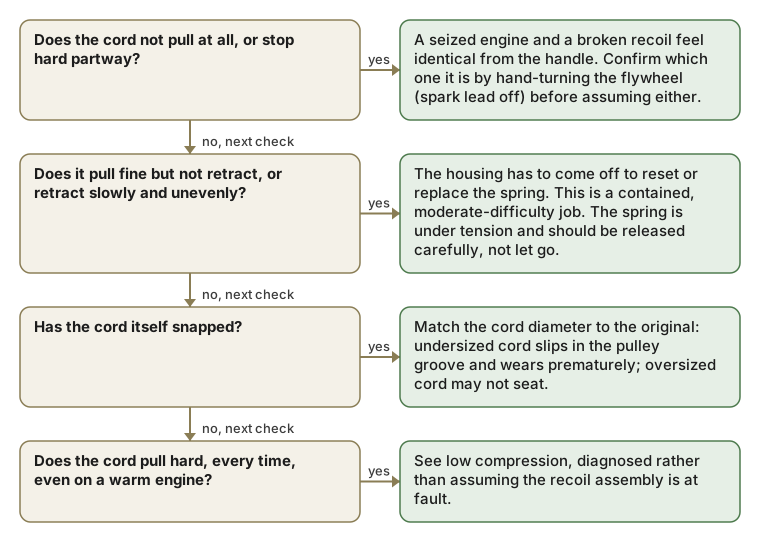
Three complaints, three different parts of the same assembly
A recoil starter is a spring-loaded pulley: pulling the cord unwinds it against the spring and spins the engine; releasing the handle lets the spring rewind the cord. Almost every complaint about it is one of three faults, and each points at a different part of that assembly rather than at the engine underneath.
1. Does the cord not pull at all, or stop hard partway?
If the engine itself will not rotate, the fault is not the recoil: see oil level, low-oil shutdown and hydrolock and check for a jammed blade, auger or chain first, with the spark plug lead disconnected. If the engine turns freely by hand but the cord will not pull, the recoil's own pawls, the small catches that grip the pulley only while pulling, may be stuck or broken and not engaging the pulley at all.
If that is it: A seized engine and a broken recoil feel identical from the handle. Confirm which one it is by hand-turning the flywheel (spark lead off) before assuming either.
2. Does it pull fine but not retract, or retract slowly and unevenly?
This is the recoil spring losing tension. Either it has slipped off its anchor point inside the housing, or repeated full-length yanks have fatigued it over years of use. A cord that hangs part-out after every pull, rather than snapping back cleanly, is the characteristic sign.
If that is it: The housing has to come off to reset or replace the spring. This is a contained, moderate-difficulty job. Control the recoil spring during release and follow the service procedure; it can unwind forcefully.
3. Has the cord itself snapped?
Cord replacement is the simplest of the three repairs and the one most owners can do without disassembling the spring housing at all on most designs: the recoil is unwound, the new cord is threaded and knotted at the pulley and the handle, and the assembly is rewound by hand before reinstalling.
If that is it: Match the cord diameter to the original: undersized cord slips in the pulley groove and wears prematurely; oversized cord may not seat.
4. Does the cord pull hard, every time, even on a warm engine?
Persistent hard pulling on an otherwise normal engine is more often compression or a flooded cylinder than the recoil itself: a recoil fault changes how the cord feels through the pull, not how much resistance the engine gives.
If that is it: See low compression, diagnosed rather than assuming the recoil assembly is at fault.
Yanking harder at a cord that has stopped hard is how a repairable recoil spring or pawl becomes a broken one, and on an engine that is seized it accomplishes nothing except risking a hand injury if the cord suddenly gives. Stop and diagnose which of the four situations above you have before pulling again.
Electric-start machines are not exempt
A machine with both electric and recoil start still relies on the recoil mechanically being free to spin when the electric starter engages: a seized recoil pulley can prevent an otherwise healthy starter motor from turning the engine at all. If electric start clicks or strains without turning the engine over, and the recoil pull cord is also stiff or will not move, the fault is the shared pulley assembly, not the starter motor or the battery.
| Symptom | Likely part | Fix |
|---|---|---|
| Cord will not pull; flywheel turns freely by hand | Recoil pawls | Recoil housing service |
| Cord will not pull; flywheel will not turn either | The engine, not the recoil | See a jammed blade/auger, oil shutdown or hydrolock |
| Pulls fine, will not retract or retracts unevenly | Recoil spring | Reset or replace the spring |
| Cord has snapped | The cord itself | Rethread a matched-diameter cord |
| Pulls hard every time, engine otherwise normal | Not the recoil | Check compression instead |
Recoil starter and pull cord problems: questions
Why won’t my pull cord pull at all?
Two very different causes feel identical from the handle: the engine itself may be seized, or the recoil’s own catch pawls may not be engaging the pulley. Disconnect the spark plug lead and try turning the flywheel by hand, if it turns freely, the recoil assembly is at fault, not the engine.
How do I fix a pull cord that won’t retract?
This is a recoil spring that has slipped its anchor or fatigued from repeated full-length pulls over years of use. The starter housing has to come off to reset or replace the spring, which is a contained job but the spring is under real tension and should be released according to the specified unwinding procedure.
Can I replace a snapped pull cord myself?
Yes: on most designs it does not require disassembling the spring housing at all. The recoil is unwound, the new cord threaded and knotted at the pulley and handle, and the assembly rewound by hand. Match the replacement cord’s diameter to the original.
Why does my pull cord feel hard to pull even though the recoil seems fine?
A consistently hard pull on an otherwise normal-feeling recoil is more often a compression or flooding issue than a recoil fault. A recoil problem changes how the cord feels through the pull, not how much resistance the engine itself gives. Check compression before assuming the starter assembly is at fault.
What is the actual mechanism of a recoil starter, and why does understanding it help diagnose faults?
A recoil starter is a spring-loaded pulley: pulling the cord unwinds it against the spring and spins the engine, and releasing the handle lets the spring rewind the cord. Understanding this splits almost every complaint cleanly into one of three parts of that assembly (the pawls, the spring, or the cord itself), which is exactly why the guide organizes its diagnosis around those three components rather than treating "the recoil is broken" as one undifferentiated fault.
Why does yanking harder on a stuck cord make things worse rather than better?
Yanking harder at a cord that has stopped hard is how a repairable recoil spring or pawl becomes a broken one, and if the engine itself is seized, extra force accomplishes nothing except risking a hand injury if the cord suddenly gives way. Stopping to diagnose which specific fault is present, rather than pulling harder, is what the guide recommends instead.
Does a machine with both electric start and a recoil pull cord ever have a shared point of failure?
Yes: a seized recoil pulley can prevent an otherwise healthy electric starter motor from turning the engine at all, since the electric starter still has to spin the same shared pulley assembly the pull cord uses. If electric start clicks or strains without turning the engine, and the pull cord is also stiff, the fault is the shared pulley assembly rather than the starter motor or battery.
How do I release spring tension safely when servicing a recoil starter housing?
Follow the manufacturer's specific unwinding procedure rather than simply prying the housing open: the spring is under real tension when compressed inside the housing, and releasing it uncontrolled can cause it to spring out forcefully, a genuine hand and eye hazard during what is otherwise a contained, moderate-difficulty repair.
What happens if I install a replacement pull cord with the wrong diameter?
An undersized cord slips in the pulley groove and wears prematurely, while an oversized cord may not seat correctly in the groove at all: matching the replacement cord's diameter to the original, rather than using whatever cord is on hand, avoids both of these failure modes.
Can a jammed blade, auger, or chain be mistaken for a recoil starter fault?
Yes: if the engine itself cannot rotate because an attached blade, auger, or chain is jammed, the cord will not pull at all, which feels identical from the handle to a broken recoil assembly. Disconnecting the spark plug lead and confirming whether the flywheel turns freely by hand is what separates these two very different faults.
Is a recoil starter repair something a homeowner can typically do, or does it need a professional?
Cord replacement is simple on most designs and doesn't require disassembling the spring housing at all, making it accessible to most owners. A spring reset or replacement is more involved, a contained job, but one requiring care around the spring's stored tension, while pawl repair varies by design; the complexity generally increases in that order across the three fault types the guide describes.
Does recoil starter wear happen faster on machines started frequently versus occasionally?
Generally yes: more starting cycles mean more full-length pulls placing repeated stress on the spring and pawls, so a commercial machine started many times a day accumulates recoil wear faster in absolute terms than a homeowner machine started a handful of times per season, even though both eventually experience the same wear mechanisms.