Starter clicks without cranking: test the battery and circuit under load
A click without cranking does not prove a bad battery, solenoid or starter. Check required start settings and the battery’s correct specification, then use the service procedure for a load test and circuit voltage-drop tests. Keep the drive and blades disengaged and never bridge starter terminals or bypass interlocks.
Resting voltage and loaded voltage answer different questions
A battery can show voltage at rest and still fail to deliver required starting current. A voltage decline during cranking can also involve excessive load or a faulty connection. It is not an automatic replacement verdict.
For a hypothetical circuit carrying 100 amps through 0.02 ohm of unwanted resistance, voltage loss is I × R = 2 volts. That is substantial in a nominal 12-volt system. These example numbers explain voltage drop; they are not a test current, resistance limit or pass/fail specification for your mower.
Use a circuit diagram, not the click’s sound
| Evidence | Purpose |
|---|---|
| Battery condition / load result | Separate stored charge from current capability |
| Voltage drop in positive and return paths | Locate resistance under the prescribed load |
| Control-circuit result | Check commands and required interlocks |
| Engine and starter-drive inspection | Check binding or damage before replacing a motor |
Briggs’ starter guide lists battery and connection faults as well as additional load, oil viscosity, starter wear and valve-related issues. Its guidance limits starting cycles to five seconds, with a minute between cycles. Follow a more specific equipment instruction where provided.
Three five-second attempts already total 15 seconds of starter operation. Continuous cranking for that entire period ignores the required pauses and may damage the starting system without adding diagnostic information.
Stop when the engine is locked
Do not use a socket, impact tool or stronger battery to force a locked engine. Follow the prescribed isolation and rotation inspection or obtain service. Fuel or liquid in a cylinder requires its own recovery and cause investigation.
See starting-battery selection for case and terminal fit, and locked-engine diagnosis when rotation is obstructed.
TS-21 · Troubleshooting
Starter clicks but the engine will not crank
A click and no crank on an electric-start mower or tractor is almost always current failing to reach the starter: a weak battery, a poor cable end or ground, or a failed solenoid contact. The click only proves that the small current that closes the solenoid arrived; cranking takes far more. Work it in order of cost: how the click sounds, then the battery under load rather than at rest, then both cable ends and the ground, then whether the solenoid passes current, and last whether the engine will turn by hand at all.
A key that produces no click is a different fault, upstream of the solenoid, and belongs to the safety-interlock chain instead.
Set the parking brake, put the drive in neutral, disengage the blades and pull the spark plug lead off before working near the starter or the flywheel. A battery can deliver enough current to heat a dropped wrench red-hot across the terminals: disconnect the negative cable first when you work on the solenoid or the starter, and reconnect it last.
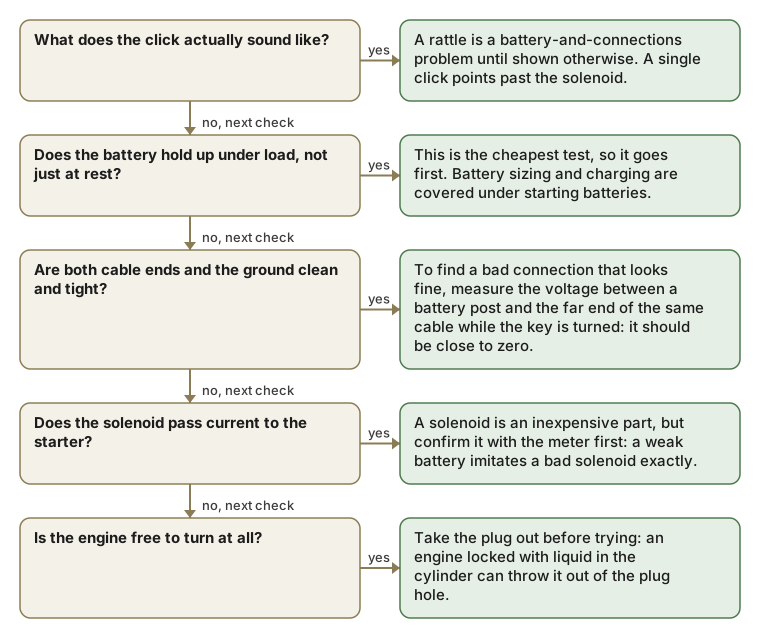
The click is the easy part; the crank is what takes the current
On an electric-start mower or tractor, turning the key sends a small current to the starter solenoid, which is a relay. It closes a heavy contact that connects the battery straight to the starter. The click you hear is that contact closing, and it takes very little current to make it.
The starter, once connected, takes a great deal. So a battery that is too weak, a cable end that has corroded, or a ground strap that has lost its grip can all let the solenoid click perfectly while the starter gets almost nothing.
A click without cranking therefore points at current delivery, not at fuel, spark or compression. The checks below run from free to a part, and the sound of the click already narrows the first one.
1. What does the click sound like?
A fast rattle of clicks, one firm click, and no sound at all are three different faults. A rattle means the solenoid closes, the battery voltage collapses the instant the starter draws current, the solenoid drops out, and it closes again, over and over: the battery or its connections. One firm click means the solenoid closed and stayed closed, so the fault is past it, or the engine is not free to turn.
No sound at all is a fault upstream of the solenoid, in the key switch, a fuse or a safety interlock, which is a different page.
If that is it: A rattle is a battery-and-connections problem until shown otherwise. A single click points past the solenoid.
2. Does the battery hold up under load, not just at rest?
Put a multimeter across the battery posts while a helper turns the key. A battery can read healthy at rest and still fall away the moment the starter draws current, and that is the classic click. If the reading sinks while the key is turned, charge the battery fully and test again.
If it still sinks, the battery is finished. A borrowed, fully charged battery connected in its place settles it in one attempt.
If that is it: This is the cheapest test, so it goes first. Battery sizing and charging are covered under starting batteries.
3. Are both cable ends and the ground clean and tight?
Starter current returns to the battery through the frame or the engine block, so the far end of the negative cable matters as much as the positive. Corrosion under a clamp, a cable end that looks clean but has lost its grip on the post, or a ground lug bolted over paint or rust all add resistance where the current is highest. Remove each clamp, clean the post and the clamp to bright metal, refit both tight, and check where the negative cable and the ground strap meet the frame.
If that is it: To find a bad connection that looks fine, measure the voltage between a battery post and the far end of the same cable while the key is turned: it should be close to zero.
4. Does the solenoid pass current to the starter?
With the key held at start, the small terminal on the solenoid should show battery voltage, because that is the key asking, and so should the large terminal on the starter side, because that is the contact having closed. Voltage on the small terminal and none on the starter side means the solenoid’s contact has failed. Voltage on both and no cranking means the trouble is at the starter or its ground.
Bridging the two large terminals with a screwdriver gives a similar answer, but it bypasses every safety interlock, throws a large spark and can start the engine with the blades or the drive engaged, so it is not a test to recommend.
If that is it: A solenoid is an inexpensive part, but confirm it with the meter first: a weak battery imitates a bad solenoid exactly.
5. Is the engine free to turn at all?
If the battery, the cables and the solenoid all pass, the starter may be fine and the engine simply locked. With the plug lead off and the spark plug or plugs out, turn the engine over by hand at the flywheel with a socket. An engine that will not turn by hand is seized, or is hydrolocked with liquid in the cylinder, which a plug hole will show.
A starter that draws current and does not turn, on an engine that turns freely by hand, has failed.
If that is it: Take the plug out before trying: an engine locked with liquid in the cylinder can throw it out of the plug hole.
Starter clicks but the engine will not crank: symptoms and repairs
| What you observe | What it points to | Fix |
|---|---|---|
| A fast rattle of clicks when the key is turned | A weak battery, or resistance in a cable end or ground | Charge and load-test the battery; clean and tighten both cable ends and the ground. |
| One firm click; battery voltage sinks when the key is turned | A battery that fails under load | Replace it, or borrow a charged one to confirm first. |
| One firm click; battery holds up; no voltage on the starter side of the solenoid | A failed solenoid contact | Replace the solenoid. |
| Voltage reaches the starter and the starter does not turn | The starter, or its ground | Clean the ground; service or replace the starter. |
| The engine will not turn by hand with the plug out | A seized or hydrolocked engine | Stop cranking. See the hydrolock page. |
| No click and no crank at all | The key switch, a fuse or a safety interlock, upstream of the solenoid | Work the interlock chain before any electrical part. |
Starter clicks but the engine will not crank: questions
Why does my mower click when I turn the key but not crank?
The click is the starter solenoid closing, and that takes very little current. Cranking takes a great deal more. So the usual cause is current failing to reach the starter: a battery that collapses under load, a corroded cable end or ground, or a solenoid whose heavy contact has failed.
It is a current-delivery fault, not a fuel or spark fault, which is why replacing the carburetor or the plug does nothing for it.
What is the difference between one click and a fast rattle of clicks?
A fast rattle means the solenoid closes, the battery voltage collapses as soon as the starter draws current, the solenoid drops out and closes again, repeatedly. That points at the battery or its connections. One firm click means the solenoid closed and stayed closed, so the fault is past it: the contact inside, the starter, its ground, or an engine that cannot turn.
Can a battery that tests fine with a multimeter still be too weak to crank?
Yes. A reading taken with nothing connected only shows the resting voltage. A tired battery can show a healthy figure at rest and then fall away the instant the starter loads it.
The meaningful test is to watch the reading across the posts while someone turns the key: if it sinks sharply, the battery is the fault regardless of what it read a minute earlier.
Do I need to check the ground cable as well as the positive cable?
Yes, and it is missed more often. Starter current returns to the battery through the frame or engine block, so a ground lug bolted over paint or rust, or a negative clamp that has lost its bite, carries the same current as the positive side and can stop a starter just as well. Clean the lug and the surface it bolts to down to bright metal and refit it tight.
How do I tell a bad solenoid from a bad starter?
Measure, with the key held at start. Battery voltage on the solenoid’s small terminal and none on the large terminal that leads to the starter means the solenoid’s contact has failed. Voltage on both, and a starter that does not turn, means the fault is the starter or its ground.
Replacing the solenoid without measuring is a common mistake, because a weak battery imitates it exactly.
Is it safe to jump the solenoid posts with a screwdriver?
It is not a test to recommend. Bridging the two large terminals bypasses the safety interlocks that stop the engine cranking with the blades engaged or the drive in gear, so the machine can start and move. It also throws a large spark next to a battery.
A multimeter on the terminals gives the same answer without those risks.
Can I jump-start a riding mower from a car to test the battery?
Yes, as a test, with the usual precautions: engine and key off on both machines, positive to positive, then the last connection on bare unpainted metal away from the battery rather than the negative post. If the mower cranks with the help and will not without it, the battery or its connections are the problem. Do not leave the car running at high speed while cranking.
Why does the engine crank slowly and then click?
Slow cranking that ends in clicking is the same battery-under-load failure arriving gradually: the battery, or a cable end, cannot keep up the current, so the turning slows and the solenoid finally drops out. Cold makes it worse, because a cold battery delivers less and cold oil is harder to turn. A slow crank that starts in warm weather with a healthy battery is worth an oil-level check.
Why does an engine starter click intermittently?
An intermittent fault is nearly always a connection rather than a failed part. A clamp with corrosion under it, a ground lug that grips only when the metal is warm, or solenoid contacts that are worn and only sometimes close all behave this way. Wiggle each cable end with the key on and watch the result, then clean and tighten every connection before buying anything.
Could a safety interlock cause a click without cranking?
Rarely. The interlocks, the seat switch, the brake and the neutral or blade position, normally sit in the circuit that feeds the solenoid’s coil, so when one is open the solenoid does not click at all. A click means the coil received current, which means the interlocks passed.
Silence, rather than a click, is the sign to work through the interlock chain instead.
Should I replace the battery or the solenoid first?
Neither until they have been tested. Clean and tighten every connection first, because it is free. Then load-test the battery, since a weak battery is the most common cause of this exact symptom and mimics a bad solenoid.
Only if the battery holds up and the meter shows no voltage reaching the starter side should the solenoid be replaced, and the starter last.
The starter draws current but the engine will not turn: what is wrong?
The engine may be locked. Take the plug lead off, remove the spark plug or plugs, and try turning the engine by hand at the flywheel with a socket. If it will not turn, it is seized or hydrolocked with liquid in the cylinder, and cranking it further risks bending a rod.
If it turns freely by hand, the starter itself has failed.