Muffler and spark-arrester service: identify the approved assembly
Keep the machine’s approved muffler and any required spark arrester intact. A muffler reduces sound but is not automatically a qualified spark arrester. Identify the actual exhaust assembly and applicable land-use restrictions before cleaning or replacement; lost power alone does not prove that the screen is blocked.
Qualification is more than finding a screen
The Forest Service Spark Arrester Guide helps identify qualified devices and describes screen-type openings of 0.023 inch or smaller. It does not authorize installing homemade mesh or modifying an exhaust to meet a guessed dimension.
Converting 0.023 inch by 25.4 millimeters per inch gives 0.5842 mm. A visible hole that appears small is not evidence of compliance, especially with damaged or distorted mesh. Use the specified replacement and qualification information.
| Observation | Next check |
|---|---|
| Power loss | Follow fuel, intake and exhaust diagnosis; not screen-only guessing |
| Cracked or loose muffler | Stop and obtain approved repair |
| Damaged arrester | Replace under the actual instructions |
| Proposed substitute | Confirm approved application and qualification |
| Work on restricted land | Check current land-manager/fire rules |
Cool and isolate before inspection
Follow the model’s screen-removal and cleaning procedure. Some tasks belong with a dealer, and retention methods differ. Do not assume every exhaust can be opened or cleaned with the same brush, solvent or flame treatment.
A clean screen does not prove an entire muffler, catalyst or exhaust port is clear. Conversely, oily residue alone does not establish a rich carburetor or worn rings. Diagnose using the actual engine’s procedure.
Exhaust direction does not make an enclosure safe
CPSC warns against running engine-driven tools indoors or in enclosed spaces. A replacement muffler or improvised extension does not make a garage or shed safe for a generator.
Keep hot exhaust away from people and combustible material as the manual directs. Do not remove a muffler to continue work, defeat a catalyst or bypass a required arrester. Correct the fault before returning the equipment to service.
PT-07 · Parts
Mufflers, exhaust and spark arrestors
A small-engine muffler does three jobs at once: it lets the exhaust out with as little resistance as it can, it takes the harsh edge off the noise, and on many machines it carries a spark arrestor, a fine screen that stops glowing carbon leaving the outlet. Those aims pull against each other, because a screen fine enough to catch sparks is a screen that clogs with carbon, and a blocked exhaust leaves an engine tired: it runs, but it bogs under load, runs hot and starts hard. Two-stroke engines carbon up sooner than four-strokes.
The remedy is usually a cool engine, a wire brush and a new screen, and it should never involve running without a muffler.
A muffler and the pipe leading to it stay hot enough to burn skin and light dry grass long after the engine stops. Let the machine cool before you handle any exhaust part, and never leave a hot machine parked over dry leaves or grass. Wear gloves and eye protection when you scrape or brush carbon from a screen, because the dust is fine and gritty.
What the exhaust parts do, and why a blocked one costs power
The muffler does three jobs at once. It lets the engine breathe out with as little resistance as its makers could manage, it takes the harshest part of the noise out of that exhaust, and on many machines it carries a spark arrestor, a fine screen that stops glowing carbon particles leaving the outlet. The three jobs pull against each other.
A screen fine enough to catch sparks is also a screen that fills with carbon, and once it is part blocked the engine cannot empty its cylinder. It loses power, runs hot, and can be hard to start.
That is the pattern behind most complaints about a muffler. The part itself rarely fails by breaking. It fails by filling up, or by rusting through where condensation sits.
Muffler
The silencer body
Baffles or a chamber that absorb noise. Rusts from the inside on machines that are stored damp.
Screen
The spark arrestor
A fine mesh in or on the outlet. It clogs with carbon, which is the usual reason for lost power.
Pipe
The exhaust pipe or header
Carries the gas from the cylinder. A leak at the joint is heard as a tick and seen as a black streak.
Symptoms of a blocked or failing exhaust
A blocked muffler does not announce itself. The engine simply feels tired: it runs, but it bogs under load, will not rev cleanly, and starts hard because the exhaust gas has nowhere to go. Two-stroke engines, which burn oil in the fuel, carbon up faster than four-strokes, and the screen and the exhaust port clog sooner.
A chainsaw or a trimmer that has lost power without a fuel or air fault is the classic case.
| What you observe | What it points to | What to do |
|---|---|---|
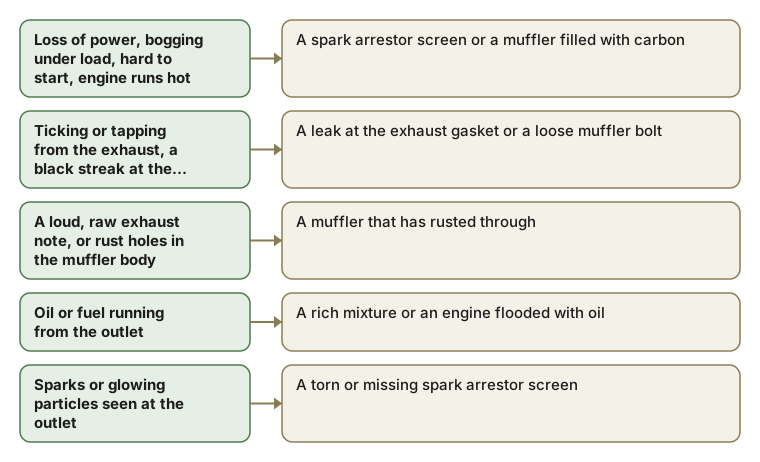
| Loss of power, bogging under load, hard to start, engine runs hot | A spark arrestor screen or a muffler filled with carbon | Cool the muffler, remove the screen, brush it clean, and replace it if it is damaged or will not clear. |
| Ticking or tapping from the exhaust, a black streak at the joint | A leak at the exhaust gasket or a loose muffler bolt | Replace the gasket and tighten the bolts to the manual’s figure. |
| A loud, raw exhaust note, or rust holes in the muffler body | A muffler that has rusted through | Replace the muffler. Do not run the machine without one. |
| Oil or fuel running from the outlet | A rich mixture or an engine flooded with oil | Look at the carburetor, the air filter and the oil level before the muffler. |
| Sparks or glowing particles seen at the outlet | A torn or missing spark arrestor screen | Fit a new screen before the machine is used near dry vegetation. |
Why the spark arrestor matters more than it looks
A small engine's exhaust can throw glowing carbon out into dry grass or brush, which is why many rules for public and forest land require an approved spark arrestor on any engine used there, and why some jurisdictions require them on equipment working near vegetation at all. An arrestor that is torn, missing or clogged does not do the job. Check the rules that apply where you work, because they differ by state and by land manager, and keep the screen intact.
Running a machine without its muffler is not a repair, a test or a saving. It is louder than the engine was designed to be, it risks hearing damage, it points hot gas at the operator's legs, and it removes the arrestor. Replace the part before further use.
Cleaning the screen, step by step
Cool the engine and pull the plug lead. Find how the screen is retained, usually by a small screw or a clip on the outlet, and take it out. Look at it against the light: if it is blocked, brush it with a stiff wire brush until light shows through evenly.
A screen that has holes, a bent frame or mesh that has gone brittle is replaced rather than cleaned, because a screen that cannot catch a spark is worse than none in the eyes of the rule it was fitted for. Refit it so it sits fully seated and cannot rattle loose.
On a machine that has lost power over time, look inside the muffler outlet with a torch at the same time. A muffler packed solid with carbon is replaced. A muffler with a clear passage and a clean screen means the fault lies elsewhere, and the troubleshooting pages take over.
Choosing a replacement without a fitment table
A muffler is shaped for one machine, so a general-purpose one rarely fits. Identify it by the machine's model and serial plate, then compare the new part against the old one before it is fitted: the mounting holes, the outlet size, the shape and the gasket face have to match. Buy from a supplier that will take the part back if it does not, and do not drill or bend a muffler to make it fit, since that changes its flow and its noise.
Generators deserve one extra warning. Their exhaust carries carbon monoxide, and a replacement or an extension has to keep the gas pointing away from every building, window and door. A generator run in a shed or a garage is a danger to life, whatever its muffler.
Mufflers, exhaust and spark arrestors: questions
What does a spark arrestor do?
It is a fine metal screen in or on the muffler outlet that stops glowing carbon particles leaving the exhaust and landing in dry grass or brush. Many rules for public and forest land require an approved one on any engine used there. A torn, missing or clogged screen does not do the job, so keep it intact and check the rules that apply where you work.
Why has my engine lost power when nothing else has changed?
A muffler or spark arrestor filled with carbon is a common reason. The engine cannot empty its cylinder, so it bogs under load, runs hot and starts hard. Two-stroke engines, which burn oil in the fuel, carbon up sooner.
With the engine cool and the plug lead pulled, remove the screen and look through it: if little light shows, it is blocked.
How do I clean a spark arrestor screen?
Let the muffler cool, pull the plug lead, remove the screen from its retaining screw or clip, and brush it with a stiff wire brush until light shows evenly through the mesh. Wear gloves and eye protection because the carbon dust is fine and gritty. Refit it fully seated.
A screen that is torn, bent or brittle is replaced rather than cleaned.
Can I run a machine without its muffler?
You should not. It is much louder than the engine was designed to be, it risks hearing damage, it points hot gas at the operator's legs and it removes the spark arrestor. A muffler that has rusted through is replaced before further use, not removed or left with a hole in it.
Why is my two-stroke muffler clogging so quickly?
A two-stroke engine burns lubricating oil mixed into the fuel, and part of that oil leaves as carbon that collects in the exhaust port and the muffler screen. A mixture with too much oil, poor-quality oil or a lot of idling makes it worse. Use the ratio in the manual, clean the screen on a regular schedule and replace a muffler packed solid.
What does a ticking sound from the exhaust mean?
Usually a leak at the exhaust gasket or a loose muffler bolt, where hot gas escapes with each pulse. A black soot streak at the joint confirms it. Replace the gasket and tighten the bolts to the figure in the manual.
A leak also lets air into the exhaust, which can cause popping and, on some engines, a change in how it runs.
How do I choose a replacement muffler?
Identify the part from the machine's model and serial plate, then hold the new one against the old before fitting it: the mounting holes, the outlet size, the shape and the gasket face must match. Do not drill or bend a muffler to make it fit, because that changes its flow and its noise. Buy from a supplier that will accept a return.
Can a blocked muffler damage the engine?
It can. Exhaust that cannot leave raises the cylinder temperature and loads the valves and piston, and the extra heat shortens the life of the engine. A machine that has lost power gradually and runs hot deserves an exhaust check before a hard or long job.
It is one of the cheapest faults to fix.
Why does my generator's exhaust matter for safety?
Generator exhaust carries carbon monoxide, a gas that cannot be seen or smelled and can kill within minutes indoors. Run the generator outdoors, well away from windows, doors and vents, with the exhaust pointing away from every building. A replacement muffler or an extension has to keep the gas moving that way.
Never run one in a shed, a garage or under cover.
Is a spark arrestor the same as a catalytic converter?
No. A spark arrestor is a screen that catches carbon particles. A catalytic converter is a chemical device that cleans certain gases from the exhaust, and a few machines fit one inside the muffler to meet emissions rules.
If yours has one, it should not be removed, and it may make the muffler hotter, so keep it clear of anything that burns.
What is the black streak or wet oil at my muffler?
A black streak at a joint is a leak. Wet oil or fuel at the outlet points elsewhere: a rich mixture, a flooded engine or too much oil in the crankcase. Check the carburetor, the air filter and the oil level before blaming the muffler, since the muffler is only showing what the engine is sending it.
When should I replace the muffler and not clean it?
Replace it when the body is rusted through, when the baffles or the chamber inside are packed solid with carbon and will not clear, when the screen cannot be cleaned or is torn, or when a leaking joint will not seal. A muffler with a clear passage and a clean screen is not the fault, and the troubleshooting pages take over.