Choose a leaf vacuum by collection task and claim definitions
Choose a leaf vacuum for the area, collection volume, access and material the manual permits. A handheld blower-vac, walk-behind vacuum and tow-behind collector have different carrying and storage requirements. Read shredding claims precisely: particle size and reduction in bag volume are not the same measurement.
Do not turn a particle-size claim into fewer bags
Toro’s UltraPlus 51621 page and manufacturer demonstration describe up to 97 percent of mulched debris below half an inch under the stated material conditions. That does not say 97 percent less volume.
For a hypothetical ten cubic feet of loose leaves, “97 percent of particles below half an inch” gives no final cubic-foot quantity. A claimed 10:1 volume reduction would instead imply one cubic foot under its own test conditions. Do not substitute one claim for the other.
| Machine | Main limitation to check |
|---|---|
| Handheld blower-vac | Carried bag weight and repeated emptying |
| Walk-behind vacuum | Width, slopes, intake and storage |
| Tow-behind collector | Approved mower connection, turning and transport |
| Chipper-vac | Separate chute limits and infeed hazards |
Look at the complete pickup cycle
Include sweeping or blowing leaves into reachable areas, setup, emptying and disposal. A larger bag may reduce stops but be difficult to lift when full. Wet leaves, stones and sticks must be assessed against the actual material instructions, not a generic metal-impeller claim.
Isolate power before clearing anything
The 51621 manual gives electrical, conversion and vacuum-use instructions for its serial range. Use the approved extension cord and assembled tubes/bag; a power-off switch is not a substitute for unplugging before service.
For gasoline or battery machines, follow their own isolation procedure and wait for the impeller to stop. Do not reach into an intake, chute or housing to push through a clog. A torn bag or damaged guard needs replacement before operation.
For a modest leaf layer, compare a compatible mulching mower or hand collection before buying another machine. If material must leave the property, include the hauling and disposal cost as well as vacuum performance.
Leaf vacuums, blower-vacs and mulching
A leaf vacuum pulls leaves in, shreds them and blows them into a bag, and the term covers four different machines: a handheld blower-vac, a walk-behind vacuum, a tow-behind lawn vacuum and a chipper-vac. They differ in bag size, intake width, impeller material and how much stick and acorn they will take. The reduction ratio a maker quotes describes dry leaf, and wet leaf packs and clogs.
A mulching mower is often enough for a moderate fall of leaf, and a vacuum earns its cost where the leaf is deep or must leave the property. Most trouble is a clog, and a clog is cleared only with the machine off and the plug lead pulled.
Never put a hand or a tool into the intake, the chute or the impeller housing while the engine or motor is running or connected, and never with a plug wire attached or a battery in. A clog is cleared with the machine off, the spark plug lead pulled or the battery removed, and the moving parts stopped. An impeller can turn for some seconds after power is cut.
Four machines that all get called a leaf vacuum
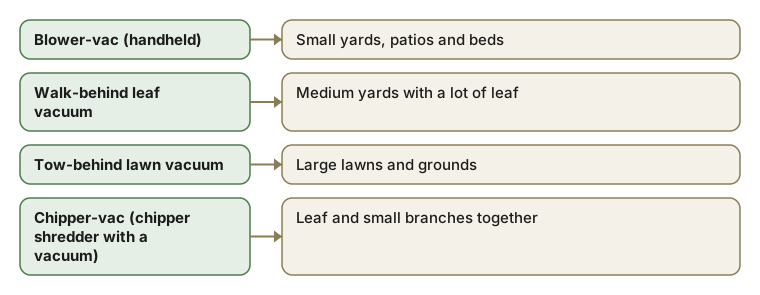
A leaf vacuum pulls leaves in through a hose or an intake, shreds them and blows them into a bag. The word covers four different machines, and buying the wrong one is the usual mistake. They differ in how much they can hold, how much leaf they can reduce, and how much stick and acorn they will take before they choke.
| Machine | Best for | What to know |
|---|---|---|
| Blower-vac (handheld) | Small yards, patios and beds | A leaf blower that switches to a vacuum tube and a bag. Light, but the bag fills fast and thick, wet leaf clogs the tube. |
| Walk-behind leaf vacuum | Medium yards with a lot of leaf | A wheeled engine, a hose and a large bag. Handles more debris and shreds it, but is heavy and needs storing. |
| Tow-behind lawn vacuum | Large lawns and grounds | Pulled by a tractor or ride-on mower, with a big hopper. Fast on open ground, poor in tight spaces. |
| Chipper-vac (chipper shredder with a vacuum) | Leaf and small branches together | A shredder that also takes a vacuum hose. Heaviest and most costly, and it must be treated as a chipper for safety. |
Reduction ratio, and what shredding does for you
A leaf vacuum reduces leaves to fragments, so a bag holds far more than the same leaves raked. Makers quote a reduction ratio, such as ten or more to one, and it is a claim about ideal dry leaves, not a promise. Wet leaves pack and clog, and green material reduces less.
The shredded leaf is a useful mulch or compost material, and a fine shred breaks down faster than whole leaves, which mat and shade the lawn.
Impeller
Metal or plastic, fan or flail
A metal impeller takes twigs and lasts; a plastic one is quieter and cracks on stones.
Bag
Size and how it empties
A big bag saves stops, but one that is hard to lift or zip is a chore.
Intake
Width and hose
A wide intake is faster and clogs less. A narrow hose is better for beds and corners.
Mulching, and the difference from vacuuming
A mulching mower cuts leaves fine enough to drop into the turf, and it is often the cheapest answer for a moderate fall of leaf. It works on a dry layer thin enough to see the grass through, in several light passes, and it fails on a deep wet layer. A vacuum earns its cost where the leaf is deep, where it must leave the property, or where the leaf is wanted as compost.
Many owners use both: the mower for the routine fall and a blower-vac for the beds.
Keeping one working, and clog-free
Most trouble is a clog, and most clogs are wet leaf, too much at once, a stick or a stone. Feed it at a steady rate, do not push it through wet material, and check the intake for stones before you start.
A worn impeller loses its shredding, a slipping belt loses its speed, and a torn bag loses its airflow. The engine is the same small engine as the rest of the garage, with the same fuel, oil and plug needs, so the schedule applies.
Store it with the fuel drained or treated, and the bag dry, since a damp bag mildews.
Leaf vacuums, blower-vacs and mulching: questions
What is the difference between a leaf blower and a leaf vacuum?
A blower pushes leaves with a stream of air, and a vacuum pulls them in through an intake, shreds them and collects them in a bag. A blower-vac does both by switching the tube. The vacuum leaves nothing to rake up, but it costs more and clogs when fed wet or bulky material.
What are the main types of leaf vacuum?
Four: a handheld blower-vac, a walk-behind leaf vacuum with a wheeled engine, a tow-behind lawn vacuum pulled by a tractor or ride-on mower, and a chipper-vac, which is a shredder that also takes a vacuum hose. They differ in bag size, intake width, and how much stick and acorn they take.
What does the reduction ratio mean?
It is how much the shredding shrinks the leaf, so a ratio of ten to one means ten bags of raked leaf fit in one. It is a figure for ideal dry leaves. Wet leaves pack and clog, and green material reduces less, so treat it as a comparison between machines, not a promise.
Is a leaf vacuum better than a mulching mower?
For a moderate fall of dry leaf, a mulching mower is often enough, since it cuts the leaf fine enough to drop into the turf. A vacuum earns its cost where the leaf is deep, where it must leave the property, or where you want it as compost. Many owners use both.
Can I vacuum wet leaves?
With difficulty. Wet leaves pack in the tube and the impeller and clog it, and they mat in the bag. Wait for a dry day where you can, feed the machine at a steady rate, and do not push wet material through.
A wide intake and a metal impeller cope with damp leaf better.
Why does my leaf vacuum keep clogging?
Too much fed at once, wet or green material, a stick or stone wedged at the intake, or a worn impeller that has lost its shredding. Feed at a steady rate, check for stones first, and keep the hose straight. A slipping belt also reduces the airflow that carries leaves through.
How do I clear a clogged leaf vacuum safely?
Stop the engine or motor, pull the spark plug lead or remove the battery, and wait for the impeller to stop, since it can turn for some seconds after power is cut. Then clear the intake or chute by hand or with a stick. Never put a hand into the housing while it is connected.
Should a leaf vacuum use a metal or plastic impeller?
A metal impeller takes twigs and small stones, lasts longer and shreds better, but is heavier and noisier. A plastic one is lighter and quieter and cheaper, but it cracks on stones and wears out sooner. For a yard with sticks and acorns, the metal one is worth the difference.
Can a leaf vacuum pick up sticks and acorns?
Small twigs and acorns, if the machine is built for it, with a metal impeller and a wide intake. Larger sticks jam it. A chipper-vac takes branches as well as leaves because it is a shredder underneath.
Check the maker’s stated maximum diameter before feeding it woody material.
What do I do with the shredded leaves?
Use them as mulch on beds, or add them to compost, where a fine shred breaks down much faster than whole leaves, which mat and hold water. A thin layer can also be left on the lawn. Do not leave a thick wet layer on turf, since it smothers the grass.
How should I store a leaf vacuum?
With the fuel drained or treated, the plug lead pulled if it is to sit long, and the bag empty and dry, since a damp bag mildews. Clean the intake and impeller of old leaf. The engine has the same needs as any small engine, so the ordinary storage steps apply.
Is a tow-behind lawn vacuum worth it?
On a large lawn or grounds, yes, since it is fast on open ground and its hopper holds a lot. It is poor in tight spaces and needs a tractor or ride-on mower to pull it and a place to store it. For a suburban yard, a walk-behind vacuum or a blower-vac is usually enough.