Choose a leaf blower: airflow, nozzle, runtime and carrying
Compare a blower’s airflow and speed for the actual nozzle and operating setting, then check runtime and carrying weight for your cleanup. A maximum CFM number alone does not establish wet-leaf performance. Handheld, backpack and wheeled formats change handling and access; they do not guarantee a particular power ranking.
Keep the rating and runtime settings together
The EGO LB7650/LB7654 product page advertises up to 765 CFM and 200 MPH. With the recommended 5.0Ah battery, it lists 15 minutes on turbo and 150 minutes on low, alongside an average-runtime claim. Those are different operating conditions, not 150 minutes at maximum output.
The low-setting figure is ten times the turbo figure. For a hypothetical 30-minute job requiring continuous turbo, the published 15-minute figure suggests at least two equivalent full-pack portions before allowing for conditions and battery changes. It does not guarantee two packs will finish a wet-leaf job.
Ask for a demonstration that matches the debris
| Figure | Question to ask |
|---|---|
| CFM | Which nozzle and operating setting? |
| MPH | Where measured and with which tube? |
| Blowing force | Same test basis and accessories? |
| Runtime | Which battery, setting and duty cycle? |
| Weight | Tool alone or including battery / fuel? |
Try the grip, trigger and strap or harness with the machine safely configured. A backpack can move weight off one hand but adds shoulder load. Wheeled equipment needs suitable access, storage and maneuvering space; narrow beds or steps may decide against it.
Noise and cleanup boundaries still matter
Battery blowers still make noise and throw grit. Use the specified eye/hearing protection and keep people, pets and vulnerable surfaces outside the work area. Check local operating restrictions for the actual address before choosing or running equipment.
For a small hard-surface area, a broom may finish with less setup. For a large seasonal leaf load, compare total cleanup time including gathering and disposal. Blowing leaves into a neighbor’s property or road does not complete the job.
For gasoline models, identify the actual engine’s fuel and service requirements. Some designs use mixed fuel and others have separate oil. The lubrication guide explains the exceptions.
How to size a leaf blower
CFM and MPH are both printed on every leaf blower and neither alone tells you whether it will clear a specific job: they trade against each other by nozzle design, and which one matters more depends on what is being moved. Dry leaves across an open lawn need volume; a wet, matted layer or debris stuck to pavement needs velocity to break it loose first.
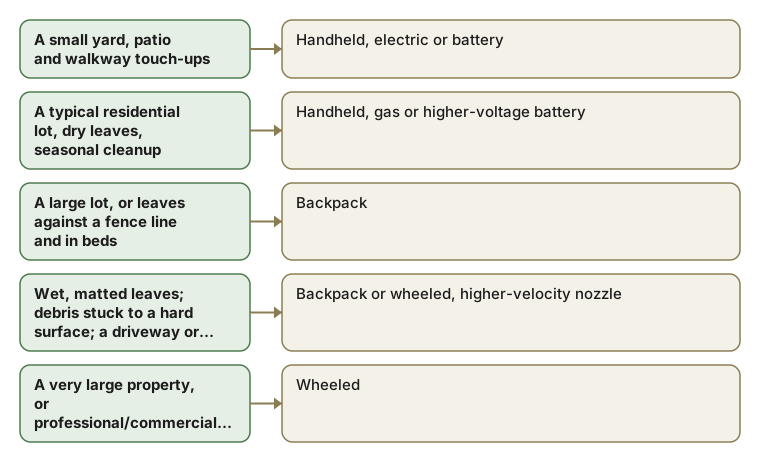
CFM and MPH answer different questions, and the job decides which matters
Air volume (CFM) and air speed (MPH) are both quoted on every blower, and neither alone predicts whether a machine clears a job: they trade against each other by nozzle design, and the combination that matters depends on what is being moved. A pile of dry leaves on a driveway needs volume to push a wide swath at once; a wet, matted leaf layer or debris stuck to a surface needs velocity to break it loose before it can be moved at all.
| The job | Best-fit class | What matters more |
|---|---|---|
| A small yard, patio and walkway touch-ups | Handheld, electric or battery | Neither figure needs to be large; runtime and noise matter more. |
| A typical residential lot, dry leaves, seasonal cleanup | Handheld, gas or higher-voltage battery | CFM for volume across an open lawn. |
| A large lot, or leaves against a fence line and in beds | Backpack | CFM for sustained volume over a longer session without arm fatigue. |
| Wet, matted leaves; debris stuck to a hard surface; a driveway or lot | Backpack or wheeled, higher-velocity nozzle | MPH to break the material loose before volume can move it. |
| A very large property, or professional/commercial use | Wheeled | Sustained high CFM at a walking pace, with the least operator fatigue. |
Where a manufacturer publishes it, "blowing force", a combined figure from CFM and MPH, is a combined performance comparison than either number alone, in the same way cleaning units are for a pressure washer. See leaf blowers in full for how that figure is derived and where it is and is not published.
Handheld, backpack or wheeled is mostly an ergonomics decision
Beyond a certain point, more power in a handheld body just tires the operator's arm faster, which is why backpack and wheeled formats exist, not because handheld motors cannot be made more powerful. If a job regularly runs past fifteen or twenty minutes at a stretch, the ergonomics of a backpack unit usually matter more to how the job gets finished than any additional CFM would.
A leaf blower moves whatever is on the ground, including gravel, small stones and debris, at speed: aim away from people, pets, vehicles and open windows, and treat it with the same thrown-object caution as a mower.
How to size a leaf blower: questions
What size or how strong of a leaf blower do I need for my yard?
A handheld electric or battery unit covers a small yard and touch-up work; a handheld gas or higher-voltage battery unit suits a typical residential lot with dry leaves; a backpack unit earns its weight on a large lot or leaves packed against fences and beds; a wheeled unit fits a very large property or commercial use where sustained CFM at a walking pace matters most.
Is CFM or MPH more important for a leaf blower?
It depends what you are moving. Dry leaves across an open lawn need volume (CFM) to push a wide swath at once. A wet, matted leaf layer or debris stuck to a surface needs velocity (MPH) to break it loose before volume can move it at all.
A high-CFM, low-MPH machine can stall out on exactly that job.
When should I switch from handheld to a backpack blower?
Once a typical session regularly runs past fifteen to twenty minutes at a stretch. Beyond that point, arm fatigue from a handheld unit usually affects how the job gets finished more than any additional CFM would, which is the real reason backpack units exist rather than makers simply building more powerful handheld motors.
Is there a leaf blower comparison chart by brand?
What is is the class-level comparison that holds true regardless of brand: handheld, backpack or wheeled matched to lot size, and CFM against MPH matched to what is being moved.
What voltage leaf blower is best for real power?
Higher-voltage battery platforms (40V, 60V, 80V and up) generally deliver more CFM and MPH than lower-voltage ones (20V), but voltage alone does not settle it: a platform’s watt-hour capacity (voltage multiplied by amp-hours) predicts runtime and power more than the voltage number by itself, and two "40V" tools from different makers can differ substantially on actual output. If you already own tools on a platform, that commitment usually matters more than chasing a specific voltage number for one more tool.
What size or kind of leaf blower should I buy?
Match class and spec to the job rather than to the number printed largest on the box: a handheld electric or battery unit for a small yard, a handheld gas or higher-voltage battery unit for a typical residential lot with dry leaves, a backpack unit for a large lot or debris packed against fences and beds, and a wheeled unit for a very large or commercial property. CFM (volume) matters most for dry leaves across open lawn; MPH (velocity) matters most for wet, matted leaves or debris stuck to a surface.
What size leaf blower will dry a wet car?
A handheld unit is useful for this and doesn’t need to be large: MPH (velocity), not CFM, is what pushes water out of body panel gaps, mirrors and trim, so a compact, high-velocity handheld blower drying a car works better than a big-CFM, lower-velocity unit sized for leaves. Keep the nozzle moving and at a reasonable distance from paint, the same distance discipline that matters when using any air tool near a finished surface.
Is there a cordless, full-size leaf blower, or does full power mean a cord or gas?
Yes: higher-voltage battery platforms now put backpack and even some wheeled-class blowers within reach cordlessly, closing most of the gap that used to mean "full-size" implied gas or corded electric. The trade-off that remains is runtime per charge rather than raw power: a full-size cordless unit still needs spare packs or a charging break for an all-day session in a way a gas tank refill does not.
Can I use a leaf blower to blow or clear snow?
For a light, dry dusting on a walkway or car, yes, and it works: dry snow behaves like light debris. It stops being useful fast once snow is wet, compacted, or more than an inch or two deep, where a blower simply cannot move the mass a snow blower’s auger is built to handle. Treat it as a light-duty convenience for the first flurry, not a substitute for a snow blower once real accumulation starts.
Does a leaf blower with a vacuum/mulch attachment change how I should size it?
The blowing-mode sizing (CFM against MPH, matched to the job) is unaffected by whether the unit also has a vacuum attachment, since that's a separate mode using a different intake configuration: size for the blowing job first, and treat vacuum/mulch capability as an additional feature to check for separately if collection, not just moving debris, is part of what you need.
Is a gas leaf blower always louder than a battery one at the same CFM rating?
Generally yes at a comparable output level: a two-stroke gas engine's combustion noise adds to the airflow noise both types produce, while a battery motor contributes little noise beyond the airflow itself. This is part of why HOA and municipal noise-restriction scenarios point toward battery on the gas-vs-battery-for-your-yard page, independent of the CFM-and-MPH sizing decision covered here.
Leaf blowers
A leaf blower is quoted on two numbers, CFM, the volume of air moved, and MPH, the speed of that air at the nozzle, and neither one alone tells you whether the machine will lift a wet, packed leaf mat off a lawn. Volume without speed is a broad push; speed without volume is a narrow jet. Where a manufacturer publishes blowing force in newtons, measured under a defined test, that combined figure is the plainest single comparison available.
Handheld, backpack and wheeled versions scale the same airflow numbers upward and mostly change what the operator has to carry rather than what the machine is capable of, and the fuel choice, gas, corded electric or battery, decides the runtime and noise trade-off more than the airflow rating does.

Two numbers, and the third that decides it
Blowers are quoted in CFM (cubic feet per minute of air moved) and MPH (air speed at the nozzle). Both are real and neither is sufficient on its own.
High speed with low volume is a narrow jet that moves one leaf at a time; high volume with low speed is a broad push that will not lift anything wet. What moves a wet leaf mat off a lawn is the momentum of the air, which is volume and speed together, and this is why some manufacturers publish a blowing force in newtons, measured under a defined test.
Where that figure is published, it is the combined performance figure available for comparison.
CFM
Volume of air moved
Broad push. Clears large areas of dry, loose debris.
MPH
Air speed at the nozzle
Penetration. Lifts material stuck to a surface.
Newtons
Blowing force, where published
Volume and speed combined. The comparison that survives marketing.
A nozzle changes the split without changing the machine: a narrow round nozzle trades volume for speed, a flat nozzle spreads it.
| Type | Typical airflow | Best suited to |
|---|---|---|
| Handheld | Lowest of the three | Small domestic properties, patios and short driveways. |
| Backpack | Higher, sustained without arm fatigue | Larger domestic lots and light commercial use. |
| Wheeled | Highest, no arm or shoulder involved | Commercial properties and large open areas. |
Handheld, backpack and wheeled: the same three numbers, different shoulders
A handheld blower is the lightest and least powerful of the three and is what most domestic properties need. A backpack unit moves the engine weight onto the shoulders and hips rather than one arm, which is what lets it run a larger engine and higher airflow for longer without fatigue: the specification gain is really an ergonomics gain. A wheeled blower removes the operator's arm from the equation entirely, pushed like a mower, and scales airflow well past what a person could hold; these are a commercial-property machine more than a domestic one.
None of the three is a smaller or larger version of another. The engine and airflow numbers scale, but the ergonomics is the actual reason to choose between them.
Gas, corded electric and battery
A gas blower is the small two-stroke engine this class shares with trimmers and chainsaws, with the same fuel-mix and stale-fuel problems. A corded electric blower gives up mobility for unlimited runtime and is usually the lightest option for a small property.
A battery blower trades runtime for cord-free operation and near-silence relative to a two-stroke engine, and, as with every class on a battery platform, the pack's watt-hours, not its voltage, is the number that predicts how long it runs. See Compare batteries by watt-hours and compatibility for how packs compare across brands.
The two-stroke fuel problem, if it is gas
A gas blower runs on the same mixed fuel as a trimmer or chainsaw: no separate oil sump, a fuel-to-oil ratio printed on the fuel cap or the label, and a carburetor that varnishes if the machine sits with fuel in it over a season. The fuel mix calculator gives the oil quantity for any ratio and tank size, and ethanol, stabilizer and stored gasoline covers why stale fuel is this class's most common failure.
Blowers throw whatever is on the ground in front of them, grit, gravel and small stones , at the height of a face. Eye protection is the minimum. These are also among the loudest machines a homeowner operates for an extended period, and a growing number of municipalities restrict gas blower operating hours or decibel levels; check local rules before running one early or late.
- Outdoor Power Equipment, Internal Combustion Engine-Powered Handheld and Backpack Blowers and Blower-Vacuums, Safety Requirements and Performance Testing Procedures: Outdoor Power Equipment Institute / ANSI, ANSI/OPEI B175.2-2012.
- Control of Emissions from New, Small Nonroad Spark-Ignition Engines and Equipment: U.S. Government Publishing Office (eCFR), 40 CFR Part 1054.
Leaf blowers: questions
How much does a leaf blower cost?
Price tracks CFM and MPH rating, power source, and handheld versus backpack versus wheeled far more than brand: a light handheld electric unit sits at one price band, a backpack gas unit at a considerably higher one. Settle the airflow and ergonomics you need first, then compare current prices for machines at that spec.
How much does a leaf blower weigh?
A handheld electric or battery blower is generally the lightest, often under 10 pounds; a handheld gas unit runs somewhat heavier for the same airflow because of the two-stroke engine; a backpack unit moves that same weight onto the shoulders and hips rather than one arm, which is why it can carry a larger engine without adding perceived fatigue.
Which leaf blower should I buy?
What is answerable here is CFM and MPH together, not either alone (a blowing-force figure in newtons, where published, is the plainest single comparison), and handheld against backpack against wheeled based on property size and how long you run it at a time.
How much CFM do I need for a leaf blower?
There is no single number, because CFM has to be read against MPH rather than alone. A machine can post a high CFM figure and still move wet, packed leaves poorly if its MPH is low. For a small residential property, a mid-range handheld blower is generally sufficient; larger properties or wet, heavy leaf conditions favor higher airflow and, where published, a higher blowing-force figure in newtons.
What is the best leaf blower for wet leaves?
The mechanism answer is that the blowing-force figure in newtons, where a manufacturer publishes it, predicts wet-leaf performance better than either CFM or MPH alone, because moving a wet, packed mat depends on the momentum of the air rather than its volume or speed in isolation.
How many decibels (dB) is a leaf blower, and can I turn off or be banned from using gas leaf blowers where I live?
A gas-powered handheld or backpack blower is louder than a battery or corded electric unit of comparable airflow, and this is the one class where noise has produced actual local restrictions: some municipalities and HOAs limit gas leaf blower operating hours, set decibel limits, or ban gas-powered units outright in favor of electric, distinct from and in addition to the federal emissions rules that apply nationally. Check local ordinances directly if noise or timing restrictions could affect your purchase.
How many amps does a corded electric leaf blower use or draw?
Most corded handheld electric blowers draw somewhere in the 8 to 12 amp range on a standard 120-volt household circuit, which most single outlets handle without issue on their own: the practical limit is usually the extension cord (undersized cord gauge over a long run causes voltage drop and lost power) rather than the household circuit itself. Check the tool’s own nameplate rating and match cord gauge to its length before assuming a cord is adequate.
What size extension cord do I need for a leaf blower?
Match gauge to the cord’s total length and the blower’s rated amps, the same undersized-cord-drops-voltage logic that applies to any corded power tool. A longer run needs a heavier (lower-gauge-number) cord to deliver the blower’s full rated current without a voltage drop that shows up as lost power. The generator extension cord calculator runs the same gauge-versus-length arithmetic and works for any corded electric tool, not just a generator load.
Does a leaf blower's nozzle shape change its CFM and MPH ratings, or just how the air feels?
A nozzle changes the split between the two without changing the machine's underlying output: a narrow round nozzle concentrates the same airflow into higher speed (MPH) and lower effective volume at any one point, while a flat nozzle spreads it into a wider, lower-speed stream. The engine or motor's total output is unchanged; the nozzle just redistributes it.
Is a leaf blower's vacuum/mulch function a completely separate mode from blowing?
Yes: vacuum and mulch mode typically uses a different intake configuration (an attachment or a switched airflow path) to draw debris in rather than push it, often through an impeller that also shreds leaves into a smaller volume for a collection bag. This is a separate function from blowing, not a reversed use of the same blowing airflow.
Does a backpack blower need a different maintenance routine than a handheld one with the same engine?
The engine maintenance itself (fuel, spark plug, air filter for gas units) is the same regardless of body style, since it's the same underlying engine technology: the backpack-specific items are the straps and harness, which need periodic inspection for wear, and the flexible tube connecting the engine unit to the nozzle, which can crack or split with age and use.
Does a blower's CFM or MPH rating change noticeably as the machine ages?
Both can decline gradually as the engine or motor loses efficiency, the fan or impeller wears, or the nozzle and housing develop small gaps that leak airflow: a machine that once cleared a job easily and now struggles at the same task is worth checking for a worn air filter, degraded spark plug, or loose housing seams before assuming the unit is simply worn out.