Edging, aerating or dethatching: identify what the lawn needs
Choose the lawn-care task before renting equipment. An edger shapes a boundary, a core aerator addresses compaction, and a dethatcher removes a measured thatch layer.
They do not substitute for one another and should not all be scheduled automatically. Check turf species, active growth and local extension advice.
Measure thatch rather than guessing from loose clippings
University of Minnesota Extension identifies excessive thatch above half an inch in its regional lawn guidance. Measure the layer between soil and living growth in a representative sample, not loose leaves sitting on top.
A measured three-quarter-inch layer is a quarter inch above that half-inch threshold, or 50 percent thicker. It warrants assessing thatch management under the applicable turf guidance; it is not proof that every species or season needs the same machine.
| Observation | Task to assess |
|---|---|
| Untidy turf boundary | Edging |
| Compacted soil / poor penetration | Core aeration and underlying soil conditions |
| Excessive measured thatch | Thatch-management approach and suitable timing |
| Poor growth without these findings | Diagnose water, light, soil and turf health first |
Aeration does not guarantee thatch removal
UMN’s April 2024 turf newsletter notes research that does not support treating aeration as effective dethatching. Core removal may serve a compaction problem without removing an excessive thatch layer.
Before aeration, account for utilities, irrigation and other buried private lines. Sunshine 811’s guidance explains why private locating can be separate from the utility request. Follow local notice and clearance requirements.
Keep the tool’s limits separate from the turf diagnosis
An edger can throw grit and contact a hidden obstruction. Retain its guard and prescribed protection, clear bystanders and stop before adjustments. A handheld trimmer used for edging still needs its approved configuration.
For powered or tow-behind implements, confirm controls, hitch approval and operating limits from the actual manuals. Do not add ballast, remove guards or improvise a tow connection. Soil moisture and depth settings should follow the task and machine instructions rather than a fixed calendar routine.
Edgers, aerators and dethatchers
Edgers, aerators and dethatchers get shopped for as one category of periodic lawn care and are three unrelated jobs. An edger cuts a clean vertical line at a boundary, on a schedule tied to how the edge looks. An aerator relieves soil compaction so water and nutrients reach the root zone, needed once or twice a year on most lawns and more on heavy clay.
A dethatcher pulls up the dead-stem layer a mower cannot reach, needed only when thatch has built up, not on a calendar. Doing all three when a lawn needs one, or doing them in the wrong order, is the most common mistake the guide exists to prevent.
Three different jobs that get shopped for as one
Edging, aerating and dethatching are commonly bundled in retail displays and buying guides because they are all periodic lawn-care tasks rather than routine mowing, but the three machines do different work and none substitutes for another.
| Machine | What it does | How often it is needed |
|---|---|---|
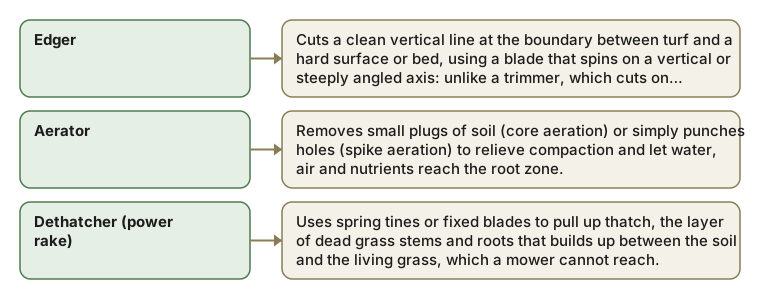
| Edger | Cuts a clean vertical line at the boundary between turf and a hard surface or bed, using a blade that spins on a vertical or steeply angled axis: unlike a trimmer, which cuts on a roughly horizontal plane. | Every few mowing cycles, to maintain a line already established. A first edge on an overgrown boundary takes noticeably more passes than maintenance edging. |
| Aerator | Removes small plugs of soil (core aeration) or simply punches holes (spike aeration) to relieve compaction and let water, air and nutrients reach the root zone. | Once or twice a year on most lawns; more often on heavy clay soil or turf that gets foot traffic. Core aeration is the more effective of the two for compacted soil. |
| Dethatcher (power rake) | Uses spring tines or fixed blades to pull up thatch, the layer of dead grass stems and roots that builds up between the soil and the living grass, which a mower cannot reach. | Only when thatch has built up past about half an inch. Dethatching a lawn that does not need it stresses the turf for no benefit. |
The practical consequence is sequencing: dethatching removes the buildup first, aerating relieves compaction under what remains, and edging is cosmetic maintenance that can happen on its own schedule independent of the other two. Doing them in the wrong order, or doing all three when the lawn only needs one, is the most common mistake: most lawns need aeration far more often than dethatching.
Edgers: the standard that governs the handheld gas class
A handheld gas-powered edger is certified to ANSI/OPEI B175.5, the standard specific to internal combustion engine-powered hand-held edgers, distinct from the trimmer/brushcutter standard even though the two tools are frequently sold as attachments on the same multi-head power unit. The blade guard geometry and the operator-hand clearance requirements are specified for a vertical cutting edge, which behaves differently from a horizontal trimmer line in exactly the moment a rock is struck and thrown.
An edger throws debris, gravel, mulch, small stones, along the direction of blade rotation with real force, not the gentle deflection a string trimmer produces. Wear eye protection every time, keep bystanders and pets well clear of the discharge side, and never edge toward a window, a parked car or a person.
Aerators and dethatchers: no dedicated handheld standard, because they are not handheld
Unlike edgers, trimmers and chainsaws, aerators and dethatchers are walk-behind or tow-behind implements, self-propelled, push, or pulled behind a riding mower or a lawn tractor, and they do not appear as a distinct class in the OPEI B175 handheld series. A tow-behind aerator or dethatcher is an implement rather than a powered machine in its own right when it has no engine of its own, and its safety requirements are governed by whatever it is attached to rather than by a standard specific to the attachment. Where either is sold as a self-propelled powered machine, it falls under the general consumer turf-care equipment requirements the same way a walk-behind mower does, rather than under a dedicated implement standard: a gap in the standards landscape worth knowing about rather than papering over with a citation that does not exist.
The soil-moisture check that decides whether either job works
Both core aeration and dethatching work far better, and cause far less collateral damage to healthy turf, when the soil has enough moisture to let tines penetrate cleanly rather than skip across a hard, dry surface. Watering a day or two before either job, rather than aerating or dethatching bone-dry ground, is the single change that most affects the result , and it costs nothing beyond timing the job around the weather.
Edgers, aerators and dethatchers: questions
What is the difference between an edger and a trimmer?
An edger cuts a clean vertical line at the boundary between turf and a hard surface or bed, with a blade spinning on a vertical or steeply angled axis. A string trimmer cuts on a roughly horizontal plane with flexible line, not a rigid blade. The two are sometimes sold as attachments on the same multi-head power unit, but they are different cutting geometries for different jobs.
How often does a lawn need aeration?
Once or twice a year for most lawns, more often on heavy clay soil or turf that gets regular foot traffic. Core aeration, which removes small plugs of soil, relieves compaction more effectively than spike aeration, which simply punches holes without removing material.
Should I dethatch every spring?
Only if thatch has built up past about half an inch. Dethatching a lawn that does not need it stresses the turf for no benefit. It is not a calendar task the way mowing is.
Check the thatch layer by cutting a small wedge of turf and measuring it before deciding.
In what order should I aerate and dethatch?
Dethatch first if thatch has built up, so the aerator is not just punching through dead material. Aerate to relieve compaction under what remains. Edging runs on its own schedule and does not need to be sequenced with either.
It is cosmetic maintenance on the boundary line rather than a soil-health task.
When should I power rake my lawn?
"Power rake" is another name for dethatching, and the answer is the same either way: only when thatch has built up past about half an inch, not on a fixed calendar schedule. Cut a small wedge of turf and measure the thatch layer before deciding: power raking a lawn that does not need it stresses the turf for no benefit.
Should I get a gas, electric or battery dethatcher?
The same tradeoff that applies’s gas-versus-battery pages applies here: gas gives more sustained power for a large lawn dethatched in one session, corded electric is light and maintenance-free but tethers you to an outlet across the yard, and battery has closed most of the gap for a small to mid-size residential lawn without the cord or the fuel. Since dethatching is an occasional, not a routine, job, the runtime limitation that matters most for a weekly mower matters far less here: most residential lawns finish well within one battery charge.
What is the difference between core aeration and spike aeration?
Core aeration removes small plugs of soil from the lawn, physically relieving compaction by taking material away; spike aeration simply punches holes into the ground without removing anything, which can increase compaction immediately around each hole even as it creates a channel. Core aeration is the more effective of the two for compacted soil.
Why does soil moisture matter so much for aerating and dethatching results?
Because tines and blades need enough moisture in the ground to penetrate cleanly: on bone-dry, hard soil, they tend to skip across the surface rather than dig in, producing a poor result and unnecessary stress on the turf. Watering a day or two beforehand, rather than working dry ground, is the single change that most affects how well either job works.
Why do edgers fall under a different safety standard than string trimmers, even when sold as attachments on the same power unit?
Because an edger's vertical cutting geometry behaves differently from a trimmer's horizontal line in exactly the moment a rock or debris is struck: the blade guard geometry and hand-clearance requirements in ANSI/OPEI B175.5 are specified for that vertical-blade hazard, distinct from the trimmer/brushcutter standard even though the two heads commonly share the same power unit.
Is it a problem that aerators and dethatchers have no dedicated handheld safety standard?
It reflects that they're not handheld tools in the way a chainsaw or trimmer is. Most are walk-behind, self-propelled, or tow-behind implements, so they fall under general consumer turf-care equipment requirements (the same framework a walk-behind mower uses) or under whatever machine tows them, rather than under a dedicated implement-specific standard. No standard exists for this specific equipment shape, which is the gap worth naming.
Can dethatching damage a healthy lawn if done unnecessarily?
Yes: dethatching a lawn that doesn't have a significant thatch buildup stresses the turf by pulling up living material along with any thatch, for no benefit, since the thatch layer wasn't thick enough to be blocking water and nutrients in the first place. Checking the actual thatch depth (cutting a small wedge of turf to measure it) before dethatching avoids this unforced error.
Does an edger's blade need sharpening the way a mower blade does?
Yes: an edger's vertical blade dulls with use the same way any cutting edge does, and a dull edger blade tears rather than cleanly slices the turf-to-hard-surface boundary, producing a ragged line instead of the crisp edge the tool is meant to create. Sharpening or replacing the blade restores that clean cut the same way sharpening restores a mower blade's cut quality.