Mower injury figures: read the dates and act on the hazards
CPSC’s cited fact sheets report historical mower injuries, not a current probability that an owner will be hurt. Use the dated figures to understand blade-contact, run-over and rollover hazards. Keep people outside the work area, retain safety controls and isolate power before clearing or servicing the mower.
Read the period with each number
| Measure | Reported figure | Period |
|---|---|---|
| Walk-behind ER-treated injuries | About 35,000 annualaverage | 2013–2015 |
| Riding-mower ER-treated injuries | About 35,000 annualaverage | 2012–2014 |
| Riding-mower deaths | About 90 annualaverage | 2008–2010reportedincidents |
The walk-behind fact sheet discusses severe hand/foot blade-contact injuries and thrown objects. The riding-mower fact sheet reports a different time window for injuries and fatalities. Neither figure should be presented as a 2026 count.
Equal counts do not establish equal risk
The two injury averages are both about 35,000, but they do not include equal numbers of machines, operators or operating hours. Without exposure information, they cannot establish that the two mower types have the same injury probability.
Dividing the 90 deaths by the 35,000 injury estimate would also mix different periods and case definitions. It is not a valid estimate of the chance that a riding-mower injury is fatal.
Use the actual controls and terrain instructions
CPSC’s walk-behind guidance explains the scope of mandatory 16 CFR Part 1205. Covered blade-stop requirements do not authorize reaching underneath as soon as a bail is released. Wait for motion to stop and follow the manual’s isolation procedure.
For riding equipment, never carry an extra passenger or assume a child remains where last seen. Stop and inspect the area before reversing. A no-reverse feature or seat switch is not a replacement for controlling access to the work zone.
Use the mower’s exact slope limits and required direction. A general safety fact sheet cannot establish the configuration, traction or terrain on your property. The slope guide explains the model-specific checks.
Lawn mower injury patterns, by the numbers
Walk-behind and riding mowers are governed by the same safety standard but hurt people in different ways, and the CPSC’s own published figures show it plainly: roughly 35,000 emergency-room-treated injuries a year for each type, but a walk-behind mower’s characteristic injury is a hand or foot reaching the blade, often while clearing a clogged chute with the engine running, while a riding mower’s is the machine itself, tipping over, running over someone, or throwing the operator clear, with an estimated 90 deaths a year attributed to riding mowers specifically. Two different hazards, which is why the safety standard requires two different sets of features rather than one.
Two machines, two different injury patterns
Walk-behind and riding mowers are governed by the same safety specification: ANSI/OPEI B71.1: because the underlying hazard category is the same, but the U.S. Consumer Product Safety Commission's own published figures show the two hurt people in different ways, which is why the safety features on each are different rather than identical.
| Machine | Estimated annual ER-treated injuries | Estimated annual deaths | Dominant injury pattern |
|---|---|---|---|
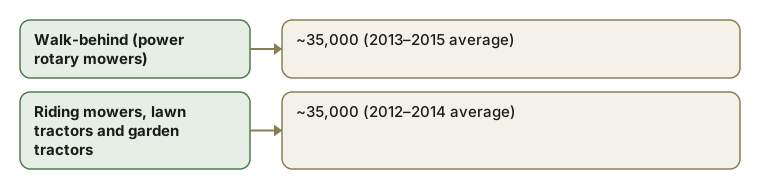
| Walk-behind (power rotary mowers) | ~35,000 (2013–2015 average) | Not separately published in this fact sheet | Hand or foot contact with the rotating blade, including toe and finger amputations. |
| Riding mowers, lawn tractors and garden tractors | ~35,000 (2012–2014 average) | ~90 (2008–2010 average) | Tip-over, being run over or falling under the machine, or being thrown from it. |
The two figures happen to land near the same annual injury count, which makes it easy to assume the machines are equally dangerous in the same way. They are not: a walk-behind mower's characteristic injury is a hand or foot reaching the blade, most often while clearing a clogged discharge chute with the engine still running. A riding mower's characteristic injury involves the whole machine: losing control on a slope, backing over a child who was not visible, or being thrown clear on a rollover.
Two different hazards need two different sets of safety features, which is exactly what the standard requires of each.
What the standard requires of a walk-behind mower
Every walk-behind rotary mower built since a 1982 federal safety standard took effect must stop the blade within three seconds of the operator releasing the handle-mounted control bar, and must pass a foot-probe test confirming neither a foot nor a trailing shield can reach the blade path from the rear. A mower built before 1982 has neither feature: treat an older machine with real caution around the discharge chute, and never clear a jam without first shutting off the engine and letting the blade stop completely.
What the standard requires of a riding mower
ANSI/OPEI B71.1's 2003 revision added an operator-presence control that stops the blades if the operator leaves the seat without disengaging them, a requirement that the machine not be able to mow in reverse with the blades engaged (with a resettable override), and increased seatback height and dynamic-stability requirements aimed specifically at reducing rollover and thrown-from-machine injuries. None of that changes the one rule that matters most on a slope: see slopes, rollover and ride-on mowers for why the manual's own slope figure, not a general rule of thumb, is the number to follow.
Never assume a child will stay where you last saw them, and treat every reverse movement on a riding mower as a full stop-and-look, not a glance.
Why the walk-behind standard is older than the riding-mower revision
The walk-behind blade-control-and-foot-shield requirement dates to 1982; the riding-mower operator-presence and no-reverse-mowing requirements were added to the voluntary standard in 2003: over two decades later. A used mower bought secondhand can predate either requirement, which is exactly why checking build date and looking for the safety features described above, not just the CPSC certification label, matters more on an older machine than a new one.
- Power Lawn Mowers: U.S. Consumer Product Safety Commission, CPSC Publication 5126.
- Riding Lawnmowers: U.S. Consumer Product Safety Commission, CPSC Publication 588.
- Consumer Turf Care Equipment, Pedestrian-Controlled Mowers and Ride-On Mowers, Safety Specifications: Outdoor Power Equipment Institute / ANSI, ANSI/OPEI B71.1-2017.
Lawn mower injury patterns, by the numbers: questions
How many lawn mower injuries happen each year?
Per the U.S. Consumer Product Safety Commission’s own published figures, roughly 35,000 people a year were treated in hospital emergency rooms for walk-behind power mower injuries (2013–2015 average), and a similar roughly 35,000 a year for riding mower incidents (2012–2014 average): but the two machines hurt people in different ways, covered.
How many people die from riding mower accidents each year?
The CPSC estimates an annual average of about 90 deaths attributed to riding mowers (2008–2010 data), most commonly from the machine tipping over, the operator or a bystander being run over or falling under the machine, or being thrown from it.
What is the most common lawn mower injury?
For walk-behind mowers, hand or foot contact with the rotating blade, often while clearing a clogged discharge chute with the engine still running, including toe and finger amputations. For riding mowers, the pattern is different: loss of control on a slope, being run over, or being thrown clear in a rollover.
Are older mowers less safe than new ones?
Potentially yes, in a specific and checkable way: the walk-behind blade-stop and foot-shield requirements date to a 1982 federal standard, and the riding-mower operator-presence control and no-reverse-mowing requirements were added to the voluntary standard in 2003.
What does the federal blade-stop requirement require of a walk-behind mower?
Every walk-behind rotary mower built since the 1982 standard took effect must stop the blade within three seconds of the operator releasing the handle-mounted control bar, and must pass a foot-probe test confirming neither a foot nor a trailing shield can reach the blade path from the rear.
What does the riding-mower operator-presence control do, specifically?
It stops the blades automatically if the operator leaves the seat without first disengaging them: added to ANSI/OPEI B71.1 in its 2003 revision, alongside a requirement that the machine not be able to mow in reverse with blades engaged (with a resettable override) and increased seatback height and dynamic-stability requirements aimed at reducing rollover and thrown-from-machine injuries.
Why do children appear so often in fatal riding-mower incidents specifically?
Both CPSC fact sheets note that children are drawn to the machine and the mowing activity itself, and a child given a ride in the past may reappear in the mowing area expecting another one, which is why treating every reverse movement on a riding mower as a full stop-and-look, rather than a quick glance, is the specific practice the guide recommends against that pattern.
Is the walk-behind mower's characteristic injury usually caused by the blade catching a limb during normal cutting?
Less often than one specific recurring scenario: clearing a clogged discharge chute with the engine still running. Hand or foot contact with the rotating blade during that specific task, rather than during ordinary mowing, is the pattern the guide and the CPSC figures behind it identify as characteristic.
Why does ANSI/OPEI B71.1 impose different safety requirements on walk-behind and riding mowers if it's one standard?
Because the standard is written to address the actual dominant hazard for each machine class: a walk-behind's risk is a hand or foot reaching a spinning blade near the ground, addressed by blade-stop timing and foot-probe testing, while a riding mower's risk is loss of control or rollover of the whole machine, addressed by operator-presence controls and stability requirements. One standard covering both classes still tailors its specific requirements to each machine's actual failure mode.
Does a mower manufactured today automatically meet both the 1982 and 2003 safety requirements?
A new walk-behind or riding mower built to the current version of ANSI/OPEI B71.1 should meet the requirements applicable to its class, since both were incorporated into the standard well before current production, but confirming compliance on any specific machine, especially an unusual or imported one, is still worth doing rather than assuming by default.