Mower will not drive: identify the release, belt and transmission
Identify the mower’s drive design before testing a no-drive complaint. Confirm the permitted push-release and operating-control positions, then inspect accessible drive parts with starting power isolated. Do not assume every rider has a serviceable fluid reservoir or that every weak drive needs a hydrostatic purge.
Start with the actual control arrangement
| Machine | Evidence to gather |
|---|---|
| Self-propelled walk-behind | Model, cable/control action, correct belt and wheel-drive parts |
| Hydrostatic rider | Model, bypass position, brake behavior and prescribed drive inspection |
| Either design | Recent repairs, leakage, noise and conditions when drive fails |
The TimeCutter SW manual describes its bypass controls and cautions for moving the machine. A push-release position is a setup question, not proof of internal transmission wear. Move and secure equipment only as the manual permits; a released drive can allow rolling.
A close-looking belt can leave the fault unresolved
In a single owner report about a Recycler drive repair, the owner reported restoring drive after fitting the correct OEM belt following transmission work. That is one repair account, not evidence that belt length explains most no-drive failures.
For an example parts order, a nominal length match alone leaves belt profile, effective-length convention and application unresolved. Use the exact parts listing rather than choosing the nearest shelf size. See belt identification.
Do not run a generic wheels-raised purge
A transmission procedure may differ in fluid access, support, control position and purge method. Some units have no operator fluid-service instruction. Do not remove a sealed plug, substitute a guessed fluid or run raised wheels from a universal internet sequence.
The 20370-series Recycler manual gives its own drive-control adjustments. A cable feeling loose cannot by itself distinguish adjustment, broken attachment or internal drive damage.
Record a one-direction or hot-drive fault for service without testing on a slope. A rider that weakens uphill is not a safe platform for repeated hill trials. Use a scoped diagnosis before the repair-cost comparison.
TS-23 · Troubleshooting
Mower will not drive: self-propel and hydrostatic faults
When the engine runs and a mower will not move, the transmission is rarely the first thing to suspect. On a riding mower the release lever, the parking brake, the drive belt and the control linkage come first; on a self-propelled walk-behind, the drive cable and the belt. Each is cheap and each is checked with the engine off.
Only after those do the fluid level and trapped air in a hydrostatic drive matter, and only after those does a worn transaxle or a stripped wheel gear become the likely answer. A machine that drives on the flat and fails on a slope, or drives one way only, is telling you which early check to make first.
Stop the engine, set the parking brake and pull the spark plug lead before looking at a drive belt, a cable or the area around the transmission. Chocks behind the wheels matter on a slope: with the drive released, a riding mower can roll. Never put your hands near a belt or pulley while the engine is running.
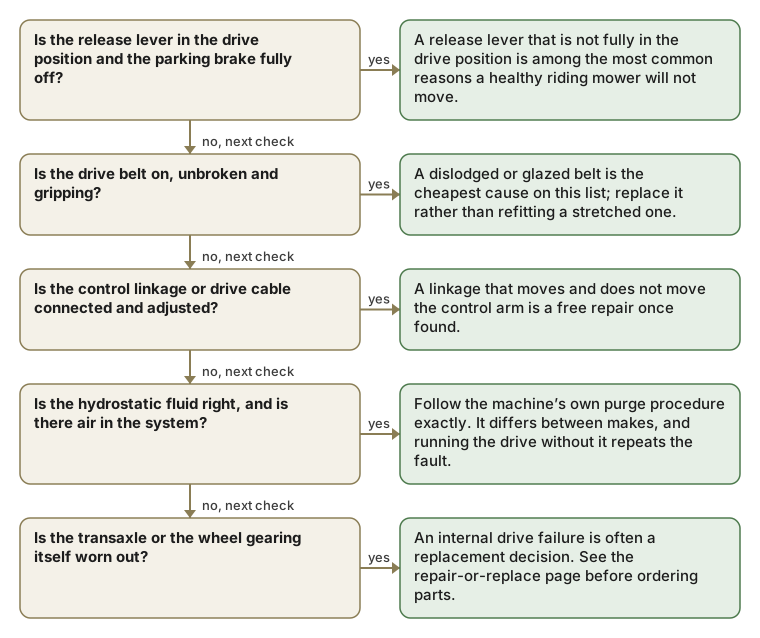
An engine that runs and a machine that will not move is often not the transmission
The engine turns and the blades may even spin, but the mower will not move, or moves weakly, or only one way, or only on the flat. There are two common ways a mower is driven. A self-propelled walk-behind mower takes power to the wheels through a belt or a shaft and a gearbox, engaged by a bar on the handle and a cable.
Many riding mowers, and most zero-turns, drive hydrostatically: a hydraulic pump and motor, often sealed in one transaxle housing, fed by a belt and controlled by a pedal or lever through a linkage. In both, the parts that fail most often sit in front of the transmission and cost the least, so they come first.
1. Is the release lever in the drive position and the parking brake fully off?
Riding mowers have a lever or a rod that disconnects the drive so the machine can be pushed. Left partway, or in the push position, it leaves the machine free-wheeling or weak. A parking brake that is still dragging, or a brake return spring that has broken, holds the wheels back in the same way.
Both are seconds to check.
If that is it: A release lever that is not fully in the drive position is among the most common reasons a healthy riding mower will not move.
2. Is the drive belt on, unbroken and gripping?
With the engine off and the plug lead pulled, look at the belt path. A belt that has come off a pulley, snapped, or glazed shiny and stretched slips: the engine runs and the blades turn, but almost nothing reaches the transmission. A slipping belt may drive on the flat and gives up on a slope or under load.
On a walk-behind the drive belt is under the deck cover or behind a guard.
If that is it: A dislodged or glazed belt is the cheapest cause on this list; replace it rather than refitting a stretched one.
3. Is the control linkage or drive cable connected and adjusted?
On a walk-behind, squeeze the drive bar: if it moves freely with no resistance, the cable has stretched or come off its anchor, and the belt is never tensioned. Many have an adjuster where the cable meets the housing. On a riding mower, follow the pedal or lever to the control arm on the transaxle: a bent rod, a lost clip or a loose bolt at that arm leaves the pedal moving and the transaxle doing nothing.
Movement in one direction only often points at the linkage or the belt.
If that is it: A linkage that moves and does not move the control arm is a free repair once found.
4. Is the hydrostatic fluid right, and is there air in the system?
A hydrostatic drive needs its fluid at the level the manual specifies, measured on level ground. Low or contaminated fluid, or air trapped after service, gives a whine or noise, weak drive, drive that fades after a short run, and a transaxle that runs hot. Air is cleared by the purge procedure in the manual, which cycles the control through forward and reverse with the release lever in a stated position, engine running, drive wheels off the ground.
If that is it: Follow the machine’s own purge procedure exactly. It differs between makes, and running the drive without it repeats the fault.
5. Is the transaxle or the wheel gearing itself worn out?
If the release, the brake, the belt, the linkage and the fluid all check out and the machine still will not drive, the fault is inside: a hydrostatic pump or motor that has worn, or on a walk-behind a wheel gear that has stripped. A grinding or ratcheting noise under drive, or wheels that turn freely with the drive engaged, points that way.
If that is it: An internal drive failure is often a replacement decision. See the repair-or-replace page before ordering parts.
Mower drive symptoms and repairs
| What you observe | What it points to | Fix |
|---|---|---|
| Engine runs, machine free-wheels or will not move at all | Release lever not in the drive position, or a dragging brake | Set the lever fully to drive; release the brake and check its return spring. |
| Blades spin but drive is weak or gives up on a slope | A glazed, stretched or dislodged drive belt | Inspect the belt path; replace a glazed belt. |
| Drive bar or pedal moves with no resistance | A stretched or disconnected cable, or a loose control linkage | Re-seat and adjust the cable; reconnect the rod at the control arm. |
| Drives one direction only | Control linkage out of adjustment, or a slipping belt | Adjust the linkage; check the belt. |
| Whine, weak drive that fades, hot transaxle | Low or contaminated fluid, or trapped air | Correct the fluid level; run the purge procedure. |
| Grinding, or wheels turn freely with drive engaged | A worn transaxle, or stripped wheel gears | Repair or replace: weigh it against the machine’s age. |
Mower will not drive: questions
Why does my riding mower run but not move?
Check the cheap things at the pedal end first: the release lever that disconnects the drive must be fully in the drive position, and the parking brake must be fully off. Then the drive belt, which may have come off or snapped, and the control linkage to the transaxle. Only after those does an internal transmission fault become likely, because the parts in front of it fail more often and cost less.
What does the bypass or release lever on a riding mower do?
It opens a valve or disconnects the drive so the machine can be pushed without the engine, and it has to be fully returned to the drive position for the machine to move under power. Left in the push position, or only partly returned, a healthy mower will not drive or drives weakly. The manual gives the lever’s location and the position for driving.
How do I know if the drive belt is the problem?
With the engine off and the plug lead pulled, follow the belt path. A belt that has come off a pulley, snapped, or that looks shiny and stretched will slip. A slipping belt often lets the machine move on the flat and fail on a slope or under load, and the engine and blades run normally throughout, which is why the belt is easy to miss.
What is a hydrostatic transmission?
A drive in which a pump, turned by the engine through a belt, pushes hydraulic fluid to a motor that turns the wheels. The pedal or lever changes the pump’s output, giving stepless speed and reverse without gears or a clutch. On many riding mowers the pump and motor sit in one sealed housing, the transaxle.
It is why the fluid level and trapped air matter to how the machine drives.
What does it mean to purge a hydrostatic transmission?
Purging clears air trapped in the hydraulic circuit, usually after service or after topping up. The procedure in the manual cycles the drive control through forward and reverse several times with the engine running and the release lever in a stated position, drive wheels off the ground, then repeats it with the lever in the drive position. Air causes noise, weak drive and heat, because it compresses where fluid does not.
What are the symptoms of low or contaminated hydrostatic fluid?
A whine or other noise, weak drive, a machine that drives at first and then fades after a short run, and a transaxle that gets hot to the touch. These overlap with trapped air, which is why the level is checked first on level ground, and topped up or changed as the manual says, before any purge. Contaminated fluid, milky or dark and gritty, should be changed, not topped up.
Why does my mower only drive in one direction?
The usual causes are the ones outside the transmission: a control linkage that is bent or out of adjustment so the pedal cannot reach full travel in one direction, or a slipping drive belt that carries the lighter load but not the heavier one. Check the linkage travel at the transaxle control arm and the belt before suspecting the transaxle itself.
Why does the mower drive on the flat but not up a slope?
Driving up a slope needs the most torque, so anything that slips shows there first: a glazed or stretched belt, low fluid, air in a hydrostatic system, or a weak engine speed. A machine that drives on the flat and stalls its drive on a rise is telling you the drive train is marginal. Start with the belt and the fluid level.
Why is my riding mower’s transaxle running hot?
Heat comes from a transaxle working harder or cooling worse: grass and dirt packed around the housing or the cooling fan, a damaged fan, low or contaminated fluid, trapped air, or an overloaded machine towing or carrying more than it is built for. Clean the housing and fan, check the fluid, and reduce the load before treating heat as a failed component.
My self-propelled walk-behind mower will not pull itself: what should I check?
Squeeze the drive bar. If it moves freely with no resistance, the cable has stretched or come off its anchor, and it is worth adjusting at the cable adjuster or re-seating. If the bar has tension and the mower still will not move, check the drive belt under the cover, then the wheel gears, which can strip so that the wheels turn freely with the drive engaged.
Can I push or tow a hydrostatic mower?
Only with the release lever in the push position, and only slowly and over short distances as the manual allows. Towing a hydrostatic drive with the release closed, or at speed, forces the wheels to turn the motor with no lubrication assurance behind it, which can damage it. If a machine has to be moved any distance, use a trailer or a ramp.
When is a mower that will not drive worth repairing?
When the fault is outside the transmission, a belt, a cable, a linkage, a lever, the repair is small and worth doing on almost any machine. When the transaxle itself has failed, weigh the cost of a replacement against the age and value of the whole mower. The repair-or-replace page sets out that comparison, and it usually favors replacing the machine only once several major parts are worn.