Choose a cut-off saw by wheel approval, depth and dust controls
Choose a cut-off saw and wheel together for the material and required depth. Match the approved diameter, arbor, speed rating and wet/dry application.
The saw’s actual cutting-depth specification matters more than half the wheel diameter. Concrete and masonry work also needs effective silica control before cutting begins.
Diameter is not depth of cut
STIHL’s TS 420 specification pairs a 14-inch wheel with a maximum 4.9-inch cutting depth. Half the nominal diameter is seven inches, 2.1 inches greater than the stated depth. The arbor, mounting arrangement and machine geometry prevent treating radius as usable cutting depth.
| Check | Required evidence |
|---|---|
| Diameter and arbor | Actual saw-approved wheel size and mounting |
| Maximum speed | Wheel rating suitable for the saw’s specified spindle speed |
| Material | Wheel approval for the intended concrete, metal or other material |
| Water | Wheel and machine approval for wet/dry operation |
| Condition | No damage; storage and expiry requirements where applicable |
The TS 410/420 manual supplies wheel and handling instructions. Engine RPM is not the same as spindle RPM; do not compare a wheel marking to the wrong number. Never adapt a wheel by drilling its arbor or removing a guard to gain depth.
Water does not remove every respiratory requirement
OSHA’s handheld-power-saw fact sheet describes integrated water delivery under construction Table 1. It identifies APF 10 respiratory protection for indoor/enclosed wet cutting and outdoor use exceeding four hours per shift. Read the complete task conditions and employer respiratory requirements; a dust mask chosen by appearance does not establish compliance.
Do not use a gasoline saw in an enclosed space because dust controls do not remove exhaust hazards. Check electrical precautions when water is used with electric equipment. Support the work according to the cutting plan so it cannot close on the wheel.
Keep both hands on the approved grips, stay out of the wheel’s plane and avoid twisting or side-loading a cutting wheel. A job requiring a deeper cut or an uncertain support arrangement needs a different approved tool or qualified assistance.
Cut-off saws (concrete saws)
A cut-off saw, sold as a concrete saw or partner saw, is a handheld saw that spins a 12 or 14 inch abrasive or diamond wheel from a small petrol engine or a battery motor. Select a cut-off saw by the material, blade compatibility and required cutting depth. Two numbers decide whether a blade is safe: its maximum rated speed has to be at least the saw’s spindle speed, and its arbor and diameter have to fit.
Abrasive blades cut metal and wear away; diamond blades cut masonry and run best wet. The hazards are a burst blade, kickback and, above all, the fine crystalline silica dust that concrete and stone release.
A cut-off saw spins an abrasive or diamond blade at very high speed. A blade that is cracked, wrong for the saw, or rated below the saw's spindle speed can break apart in use. Inspect every blade before it goes on, wear a face shield, eye protection, hearing protection, gloves and a respirator, and never cut without the blade guard fitted.
A handheld saw for masonry, metal and pipe, sized by its blade
A cut-off saw, also sold as a concrete saw, partner saw or cut-off machine, is a handheld saw that drives a flat abrasive or diamond wheel from a small petrol engine, a battery motor, or in some cases a hydraulic or electric drive. It cuts concrete, brick, block, paving, stone, cast iron and steel pipe, rebar and roofing tile. The wheel is 12 or 14 inches on the common petrol models, and the blade diameter sets the maximum depth of cut, which is a little under half the blade diameter less the guard.
It is closer to an angle grinder than to a chainsaw. The engine is a two-stroke built to run near a fixed high speed, the blade is a disc that cuts by grinding, and the injuries that go with it are burst blades, kickback and dust.
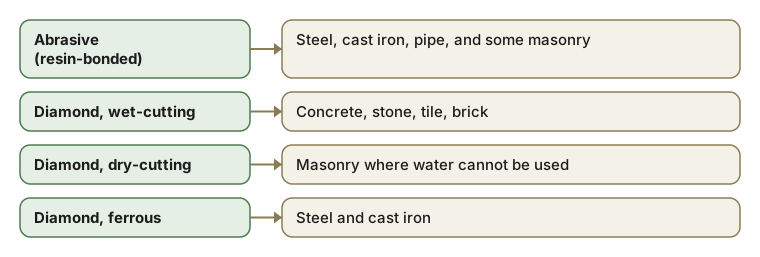
| Blade | Cuts | What to know |
|---|---|---|
| Abrasive (resin-bonded) | Steel, cast iron, pipe, and some masonry | Wears away as it cuts, so its diameter shrinks. It has a shelf life, and cracks if stored damp or dropped. |
| Diamond, wet-cutting | Concrete, stone, tile, brick | Needs a water supply at the blade to cool it and keep dust down. Runs cool and lasts longest. |
| Diamond, dry-cutting | Masonry where water cannot be used | Runs hot, wears faster, and throws the most dust. Not for cutting long lines. |
| Diamond, ferrous | Steel and cast iron | A different bond from a masonry diamond blade. The wrong one glazes and stops cutting. |
The number on the blade must be at least the number on the saw
Every cutting wheel is marked with a maximum operating speed in revolutions per minute (RPM), and every saw states the speed its spindle turns. The wheel's rating must equal or exceed the saw's, and the wheel's diameter and its arbor hole must fit the saw. A blade rated below the saw's spindle speed is a blade being asked to fly apart.
Read both numbers, and read the arbor size and the shape of the drive, before ordering a replacement.
Silica dust is the long-term hazard
Cutting concrete, brick, block and stone releases fine crystalline silica. Breathed in over time, it causes an incurable lung disease. In the United States, OSHA's rule for respirable crystalline silica in construction lists handheld power saws and requires water at the blade to hold the dust down, with respiratory protection in some conditions.
The practical answer on the ground is the same: cut wet where you can, work outdoors or in good airflow, and wear a respirator rated for the dust. Sweeping the dust up dry puts it back in the air, so wet it or use a vacuum made for the job.
Wet
Water at the blade
Cools the blade, extends its life and holds most of the dust down. It is the first control, before any respirator.
Guard
Always fitted
The guard catches broken pieces and sets the depth. Never remove it to reach a cut.
Rating
Blade RPM at or above saw RPM
The single number that separates a safe blade from a dangerous one.
Kickback, pinch and how to cut
A cut-off saw kicks back when the top part of the blade catches the work, and it throws the saw up and back toward the operator. A wheel that pinches in the cut as the work moves stops suddenly and does the same. Plan the cut so the material is supported on both sides of the line and cannot close on the blade, start the cut at full speed, and let the saw cut without forcing it or twisting it sideways.
Twisting a wheel in the cut side-loads it, which is how many burst.
A cut-off saw is heavy and it vibrates. Keep a firm grip with both hands, stand to the side of the plane of the blade rather than behind it, and take breaks. The engine care is the same as on the other two-stroke machines on this site: fresh mixed fuel, a clean air filter, and a check of the spark arrestor screen on the muffler.
Cut-off saws (concrete saws): questions
What is a cut-off saw used for?
A handheld cut-off saw, also sold as a concrete saw or partner saw, drives a flat abrasive or diamond wheel to cut concrete, brick, block, paving, stone, cast iron, steel pipe, rebar and roofing tile. The common petrol models take a 12 or 14 inch wheel. An abrasive cut-off saw removes material by grinding with a rotating wheel.
What is the difference between an abrasive and a diamond blade?
An abrasive blade is a resin-bonded wheel that wears away as it cuts, suits steel, cast iron and some masonry, and has a shelf life. A diamond blade has diamond segments bonded to a steel core, cuts concrete, stone and tile, lasts far longer and runs best with water. Steel needs a ferrous-rated blade, since a masonry blade glazes on it.
Can I use any blade on my cut-off saw?
No. The blade's maximum rated speed must be at least the saw's spindle speed, and its diameter and arbor hole must fit the saw. A blade rated below the saw's speed can break apart in use.
Read the RPM marking on the blade and the saw's plate or manual before ordering a replacement, and use only the blade types the manufacturer approves.
Should I cut wet or dry?
Wet where you can. Water at the blade cools it, extends its life and holds most of the silica dust down, and it is the first control before any respirator. Dry cutting suits short cuts where water is not possible, but the blade runs hot, wears faster and throws far more dust, so a respirator and good airflow are essential.
What is silica dust, and why does it matter?
Cutting concrete, brick, block and stone releases fine crystalline silica. Breathed in over time it causes an incurable lung disease. In the United States, OSHA's construction rule for respirable crystalline silica lists handheld power saws and requires water at the blade to hold the dust down, with respiratory protection in some conditions.
Use water, work with airflow and wear a respirator rated for the dust.
What causes a cut-off saw to kick back?
The top part of the blade catching the work throws the saw up and back toward the operator, and a wheel that pinches as the material moves stops suddenly and does the same. Support the material on both sides of the cut so it cannot close on the blade, start the cut at full speed, and let the saw cut without forcing or twisting it.
Why do cut-off blades break?
Most burst blades were cracked, damp, dropped, worn below their safe size, rated below the saw's speed or side-loaded by twisting in the cut. Inspect every blade before fitting it, store abrasive blades dry and within their date, and never use a blade that has been dropped or a bent one. Twisting a wheel to steer the cut is a common cause.
Is a battery cut-off saw as good as a petrol one?
Battery models are quieter, produce no exhaust and start instantly, which suits short cuts and work in enclosed spaces. Petrol models run longer without a recharge and cut at higher power for long jobs. Either takes the same kind of blade and needs the same dust control, guard and personal protection.
Compare rated cutting depth and usable runtime for the actual material.
What limits a cut-off saw’s cutting depth?
The blade diameter sets the depth. A 14 inch wheel cuts a little under half its diameter once the guard and flange are allowed for, so several inches, and a 12 inch wheel cuts less. The maximum depth is printed in the specification.
For deeper cuts you cut from both sides, or use a different machine such as a floor saw.
Do I need hearing and eye protection for a cut-off saw?
Yes, both, with a face shield, gloves, sturdy boots and a respirator. A cut-off saw is loud and it throws sparks, chips and dust. Never cut with the blade guard removed, since it catches broken pieces and sets the depth.
Keep bystanders clear and stand to the side of the blade’s plane.
Does a cut-off saw need special fuel?
It uses the same mixed fuel as other two-stroke machines, at the ratio in the manual, using fresh fuel and the right oil. The engine runs near a fixed high speed under load, so a lean mixture is more damaging than on a trimmer. Keep the air filter clean and check the muffler's spark arrestor screen, which clogs with carbon.
How do I store cut-off saw blades?
Keep abrasive blades flat or hung, dry and away from extremes of temperature, and use them within the date printed on them, because moisture and age weaken the resin bond. Diamond blades are less sensitive but should be kept clean and undamaged. Never use a blade that has been dropped, soaked or stored leaning against a wall.