Choose a hedge trimmer for reach, stem limits and safe handling
Choose a hedge trimmer for the height, shape and permitted stem size of the hedge, then compare configured weight and runtime. Blade length does not establish branch capacity or safe reach. Use a ground-based tool appropriate to the job, and stop and isolate power before clearing any branch from the blades.
Read the cutting description precisely
ECHO’s HC-2020 page specifies 20-inch double-sided, double-reciprocating blades. “Double-sided” describes cutting edges; “double-reciprocating” describes blade motion. Neither term alone gives a safe maximum branch diameter.
In a simplified 120-inch hedge face, a 20-inch useful pass width with four-inch overlap advances 16 inches after the first pass. Eight passes cover 132 inches. This is geometric planning only: vegetation, technique and the actual usable blade section change coverage.
| Requirement | Evidence |
|---|---|
| Height and depth | Ground access and tool reach without overextension |
| Stems | Manufacturer-approved material and cutting capacity |
| Weight | Tool with fitted pack or fuel |
| Runtime | Same vegetation and operating conditions |
| Blade care | Actual lubrication, clearance and sharpening instructions |
Use a separate tool for oversized growth
A thicker stem that fits between tooth openings is not automatically approved. Use the actual capacity instruction; consider a suitable hand pruner or qualified help rather than forcing the hedge trimmer.
The HC-2020 operator manual supplies model-specific controls and maintenance instructions. Another trimmer may have different blade adjustments or lubricant requirements. Do not loosen blade fasteners using a generic clearance rule.
Keep the work within stable reach
Do not reach across moving blades to pull a twig or guide the hedge. Retain guards and use both designated grips. Manage an electric cord so it stays outside the cutting path; a battery removes the cord but not the blade hazard.
For high or deep hedges, compare an approved extended-reach tool or professional service. A longer blade or rotating handle does not by itself remove the need for stable footing and safe control.
Hedge trimmers
A hedge trimmer is sold on blade length, which tells you how much hedge face one pass covers and nothing about how cleanly it cuts. The two figures that decide cut quality are the gap between the reciprocating teeth and how fast they move, and the configuration, straight, pivoting or extended-reach, decides what you can reach without a ladder. Fuel type is a close call on this tool, unlike a chainsaw: gas delivers the most power and unlimited runtime at the cost of two-stroke fuel handling and the highest noise, corded electric is light and maintenance-free but ties you to an outlet, and a higher-voltage battery unit has closed most of the power gap while adding a runtime limit set by the pack.
Blade length is a reach number, not a quality number
Hedge trimmers are sold on blade length, and like a chainsaw's bar, that figure describes the largest single pass the tool can make, not how well it makes it. A longer blade clears a flat hedge face faster; a shorter, stiffer blade controls better around a shaped or dense hedge and stays lighter at the end of your arm for the twenty minutes that matter. The number that decides how the tool cuts is not on the box at all: it is the gap between the two reciprocating blades and how fast they move.
Blade gapmm
Space between the tooth openings
A wider gap cuts thicker stems; a narrower gap leaves a cleaner face on fine growth.
Strokes/min
How fast the blades reciprocate
At the same movement speed, a higher stroke rate makes more cuts through the growth.
Single vs doubleaction
One or both blades move
Double-action cancels vibration at the handle; single-action is simpler and lighter.
Straight, offset and extended-reach are three different jobs
| Configuration | What it suits | Where it runs out |
|---|---|---|
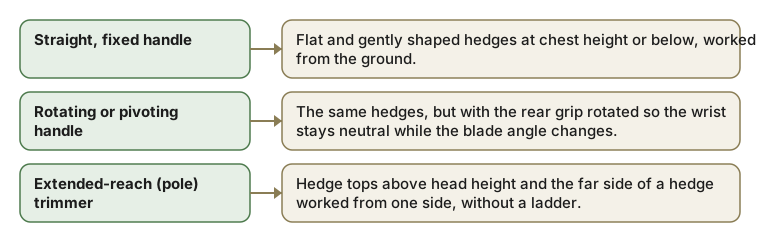
| Straight, fixed handle | Flat and gently shaped hedges at chest height or below, worked from the ground. | Cutting a flat top forces the wrist into an awkward angle, which is the single biggest cause of an uneven line. |
| Rotating or pivoting handle | The same hedges, but with the rear grip rotated so the wrist stays neutral while the blade angle changes. | Adds weight and a pivot joint that needs to stay clean; it does not add reach. |
| Extended-reach (pole) trimmer | Hedge tops above head height and the far side of a hedge worked from one side, without a ladder. | The head is usually smaller and the reach comes at the cost of control near the base of the plant. |
The two things that decide the fuel or power question
Hedge trimmers exist in gas, corded-electric and battery form, and unlike a chainsaw the choice is close for most owners rather than settled by the work. Gas gives unlimited runtime and the most power at the blade, at the cost of two-stroke fuel management and the highest noise and vibration of the three.
Corded electric is light and maintenance-free but tethers you to an outlet and a cord you have to keep clear of the blade. Battery units have closed most of the power gap on the higher-voltage platforms and remove both the cord and the fuel, at the cost of a runtime that ends mid-hedge if the pack is undersized: covered in full on Battery energy and approved tool fit.
The standard governing the class: ANSI/OPEI B175.6 for gas-powered hand-held hedge trimmers: requires a hand guard positioned to keep the operating hand clear of the blade line and sets blade-stop-time requirements once the trigger is released, the same family of requirement that governs a chainsaw's chain brake. Electric and battery units are instead certified to UL 62841-1, the harmonized hand-held-tool and lawn-and-garden safety standard, which is why a corded or battery trimmer carries a different mark than a gas one even though the blade hazard is identical.
Both blades are sharp on both edges and the guard between the handle and the blade only protects the hand that is behind it. The most common hedge-trimmer injury is the front hand reaching past the blade to clear a branch while the machine is still running. The trigger should be released and the blades stopped before your free hand goes anywhere near the cutting edge, every time.
Maintenance a hedge trimmer needs
The blades run in a light oil film, and most manufacturers specify applying a few drops before and after each use rather than relying on splash from a gearbox. A dry blade heats, binds on green wood, and dulls faster than a lubricated one under identical use: this is the single most-skipped maintenance step in the class precisely because nothing fails immediately when it is skipped. Beyond lubrication, the class shares gas or battery maintenance with every other tool on this site of the same fuel type: see ethanol fuel and stabilizer for a gas unit going into storage, or the pack-storage guidance on the battery page for a cordless one.
- Outdoor Power Equipment, Internal Combustion Engine-Powered Hand-Held Hedge Trimmers, Safety and Environmental Requirements: Outdoor Power Equipment Institute / ANSI, ANSI/OPEI B175.6-2016 (R2024).
- Electric Motor-Operated Hand-Held Tools, Transportable Tools and Lawn and Garden Machinery, Safety, Part 1: General Requirements: UL Standards & Engagement / IEC / CSA, UL 62841-1 (harmonized with IEC 62841-1).
Hedge trimmers: questions
Does a longer hedge trimmer blade cut better?
No: blade length is a reach figure. Blade length sets how much hedge face one pass covers. Cut quality comes from the gap between the reciprocating teeth and how fast they move; a shorter blade with a tight gap and a high stroke rate leaves a cleaner face than a long blade run at the same speed, and it stays lighter at the end of your arm.
What is the difference between single-action and double-action blades?
Double-action blades reciprocate in opposite directions, which cancels most of the vibration transmitted to the handle and cuts more smoothly at the cost of a slightly heavier mechanism. Single-action trimmers move only one blade against a fixed one, which is simpler and lighter but transmits more vibration into the hand over a long session.
Should I buy a gas, corded or battery hedge trimmer?
It is close in this class, unlike most equipment. Gas gives unlimited runtime and the most power at the blade but carries two-stroke fuel management and the most noise and vibration. Corded electric is light and needs no maintenance but tethers you to an outlet.
Battery removes the cord and the fuel and has closed most of the power gap on higher-voltage platforms, at the cost of a runtime that ends mid-hedge on an undersized pack: see battery and cordless equipment for the platform math.
How far should an extended-reach hedge trimmer reach?
Far enough to clear the top of a hedge from the ground without a ladder, which is what the configuration is built for, not for fine detail work at the base of the plant, where a shorter head gives more control. The tradeoff is control, not power: the head on a pole trimmer is usually smaller than a standard model’s.
What is blade gap on a hedge trimmer, and why does it matter more than blade length?
Blade gap is the space between the tooth openings on the reciprocating blades: a wider gap cuts thicker stems, while a narrower gap leaves a cleaner face on fine growth. Unlike blade length, which only sets how much hedge face one pass covers, gap directly determines what diameter of stem the tool can cut cleanly, which is the figure that decides whether a trimmer chokes on woody growth.
Does a hedge trimmer’s stroke rate determine cutting speed?
No: a higher stroke rate cuts cleaner at a given ground speed (fewer torn or missed stems as the blade moves across the hedge face), not necessarily faster overall. The actual pace of finishing a hedge depends more on how quickly you move the tool across the face than on how fast the blades reciprocate underneath that motion.
Why do gas hedge trimmers and battery/corded trimmers get certified to different safety standards?
Because they fall under different regulatory frameworks for the same underlying blade hazard: ANSI/OPEI B175.6 covers gas-powered hand-held hedge trimmers specifically, while UL 62841-1 is the harmonized standard for electric and battery hand-held and lawn-and-garden tools generally. Both require guard positioning and blade-stop-time requirements addressing the same hazard, just codified under separate standard families tied to the power source.
Why does a hedge trimmer blade need oiling if it doesn't run on a chain the way a chainsaw does?
The reciprocating blades still run in continuous metal-on-metal contact with each other, and most manufacturers specify a light oil film applied before and after use rather than relying on any internal lubrication system. A dry blade heats up, binds more readily on green wood, and dulls faster: a maintenance step easy to skip precisely because nothing fails immediately when it's neglected.
Does a rotating or pivoting handle hedge trimmer change how the blade cuts?
No: a pivoting handle changes the operator's wrist angle and grip position relative to the blade, letting the wrist stay neutral while the blade angle changes for cutting a flat top, but it doesn't change the blade gap, stroke rate, or cutting mechanism itself. A rotating handle changes the working grip for a vertical or horizontal cut.
Is a hedge trimmer's blade replaceable if it becomes damaged, or is the whole tool replaced?
On most hedge trimmers, the blade assembly is a replaceable part separate from the motor or engine housing: a bent or badly nicked blade (from contact with a fence, wire, or foreign object embedded in a hedge) can typically be swapped for a new blade assembly rather than requiring replacement of the entire tool.
Does a wider blade gap ever produce a cleaner cut than a narrower one?
No: a wider gap is for cutting thicker stems, not for cut quality on fine growth; a narrower gap produces the cleaner face on light, fine material specifically because the closer-spaced teeth engage more of each stem at once. Match the gap to the material rather than assuming either extreme is universally "better."