Snow blower will not throw: shut down before chute and drive checks
Stop the engine, remove the key and follow the manual’s isolation and wait instructions before approaching a clogged chute or auger. Use the supplied clearing tool, never a hand.
A blocked mechanism can retain energy after shutdown. Check recalls before testing a machine with an abnormal stop or control response.
Check the safety campaign before the snow path
Ariens’ 2025 recall concerns certain snow throwers whose rotating parts may not stop as intended. Applicability and repair status depend on model and serial information. A drive adjustment is not a substitute for the campaign remedy.
Match the shear part and assembly
The cited 2019 Ariens Deluxe manual lists shear-bolt kit 52100100. The 2013 Troy-Bilt Storm manual specifies shear pin 738-04124A for its described assembly. Neither is a generic license to fit a stronger hardware bolt.
| Observation | Next evidence |
|---|---|
| Obstruction in chute / housing | Approved clearing and inspection |
| Broken prescribed shear part | Correct replacement and impact-damage inspection |
| Belt or cable defect | Actual routing, part and adjustment procedure |
| Reduced throw in particular snow | Conditions and engine/load observations, not a fixed verdict |
For an example order, two machines both using a nominal quarter-inch fastener have not established equal length, material or shear specification. Select by the exact model’s parts listing. A stronger substitute can move impact damage into another component.
Do not watch an exposed operating auger to diagnose it
Keep guards fitted and observe only from the prescribed operating position. A slow or stationary auger does not uniquely identify belt slip, a shear failure or a blocked drive. Single-stage and two-stage systems also need different inspection paths.
Use the manual’s scraper, skid and cable settings rather than an improvised impeller-clearance modification or universal lubricant spray. Record snow conditions when comparing throw distance. See snow-blower setup and selection and the 826 LE service guide for their separate model-specific tasks.
TS-06 · Troubleshooting
Snow blower will not throw
The diagnosis here is almost entirely an observation: stand where you can safely see the auger and the chute with the machine running and the auger engaged, and note what is turning. An auger that does not turn at all points at a broken shear pin, a part designed to fail so the gearbox does not, or at the auger belt and the tensioner that engages it. An auger that turns but slows under load is a belt slipping, usually because a cable is not giving it full travel.
An auger that turns normally while nothing leaves the chute means the separate impeller is not working, or the chute has bridged solid with wet snow. And a machine that throws only a short distance in heavy wet snow may be behaving exactly as it should.
Stop the engine, remove the key, and wait for everything to stop turning before you go near the auger or the chute. A jammed auger stores energy: when the obstruction shifts, it turns. Use the clearing tool the machine came with, never a hand, and never with the engine running: this is the injury that defines this machine.
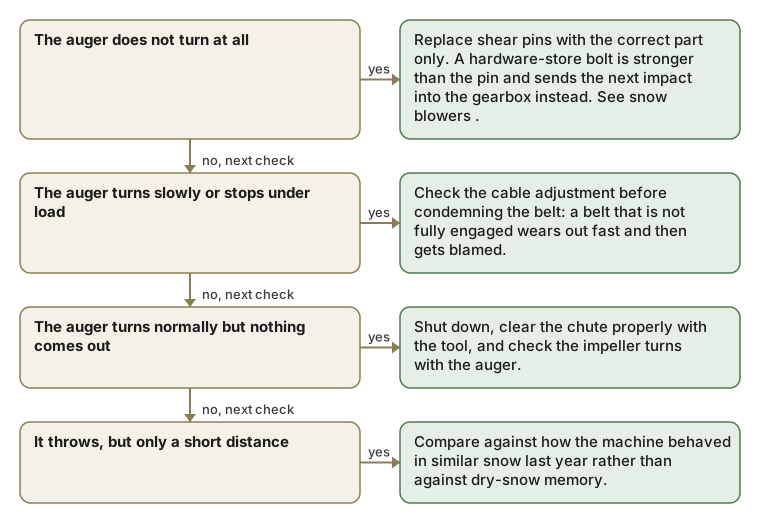
Watch what is turning: that is the whole diagnosis
Stand where you can see the auger and the chute safely, with the machine running and the auger engaged. Three observations separate every common cause.
The auger does not turn at all
Either the drive to it has failed or something has broken between the engine and it. On a two-stage machine, check the shear pins first: they are designed to break and save the gearbox, and one broken pin will let the auger sit still while the shaft under it turns. Then check the auger belt and the tensioner that engages it.
If that is it: Replace shear pins with the correct part only. A hardware-store bolt is stronger than the pin and sends the next impact into the gearbox instead. See snow blowers.
The auger turns slowly or stops under load
The belt is slipping. Look for glazing, a shiny hard surface, and a burned smell. The cause is usually a stretched belt or a tensioner or cable that is not applying full travel, so the belt never fully grips.
If that is it: Check the cable adjustment before condemning the belt: a belt that is not fully engaged wears out fast and then gets blamed.
The auger turns normally but nothing comes out
On a two-stage machine the auger and the impeller are separate. If the auger turns and the chute stays empty, the impeller is not doing its job. Its own shear pin or key has failed, or the chute is packed solid with wet snow that has bridged across the opening.
If that is it: Shut down, clear the chute with the specified clean-out tool, and check the impeller turns with the auger.
It throws, but only a short distance
Wet, dense snow simply does not throw as far as dry snow, and that is physics rather than a fault. If it has got worse, look for impeller-to-housing clearance that has opened up with wear, a partly slipping belt, or an engine that is down on power.
If that is it: Compare against how the machine behaved in similar snow last year rather than against dry-snow memory.
The wet-snow problem, and the two things that help
Heavy wet snow sticks to the inside of the chute and to the auger housing, and each pass deposits a little more until the passage is narrower than the snow going into it. Two practical measures make a real difference: take narrower bites so the machine moves less snow per second, and treat the inside of the chute and the auger housing with a silicone or PTFE spray at the start of the season so the snow slides rather than sticks.
| Symptom | Usual cause |
|---|---|
| The machine will not drive forward, though the auger works | The drive belt or the friction disc on a disc-drive machine. On many two-stage machines the friction wheel is a wear part with a rubber ring. |
| It scrapes the drive and throws gravel | Skid shoes worn or set too low. Reset them for the surface: higher on gravel, lower on concrete. |
| The chute will not rotate | The chute gear or crank has iced, or the plastic worm gear has stripped. Ice first, then the gear. |
| It only works well on one side | One shear pin of a pair has broken, so half the auger is free-wheeling. Easy to miss and common. |
What causes this the following winter
A snow blower is idle for eight months, which makes it the machine most likely to arrive at the first storm unwilling to work. The two things that prevent the majority of first-storm failures are fuel management before storage and a short run under load in the autumn: both on winter storage. Keep a set of the correct shear pins in the garage; the moment you need one is not the moment a parts counter is open.
Snow blower will not throw: questions
My snow blower runs but the auger will not turn: what broke?
Usually a shear pin. On a two-stage machine the pins are designed to break and save the gearbox, and one broken pin lets the auger sit still while the shaft under it turns. Check the pins first, then the auger belt and the tensioner that engages it.
Replace a shear pin only with the correct part, because an ordinary bolt is stronger and sends the next impact into the gearbox instead.
The auger turns but nothing comes out of the chute, why?
On a two-stage machine the auger and the impeller are separate, so an auger that turns while the chute stays empty means the impeller is not doing its job, its own shear pin or key has failed, or the chute has packed solid with wet snow bridging the opening. Shut down, remove the key, clear the chute with the tool it came with, and confirm the impeller turns with the auger.
Why does my snow blower only throw snow a short distance?
Heavy wet snow simply does not throw as far as dry snow, so compare against how the machine handled similar snow last year rather than against dry-snow memory. If it has worsened, look for impeller-to-housing clearance that has opened up with wear, a partly slipping belt, or an engine down on power. Taking narrower bites and treating the chute with a silicone spray both help with wet snow.
How do I stop wet snow clogging the chute?
Take narrower bites so the machine moves less snow per second, and treat the inside of the chute and the auger housing with a silicone or PTFE spray at the start of the season so the snow slides rather than sticks. Wet snow otherwise deposits a little on each pass until the passage is narrower than the snow going into it, and then it bridges across the opening and blocks.
Why do shear pins exist instead of just building a stronger auger shaft connection?
A shear pin is a sacrificial connection designed to break before the more expensive gearbox does when the auger strikes something solid. Replacing a broken pin costs a few dollars and minutes, while a damaged gearbox from a connection that didn't give way can cost far more to repair. The pin is engineered to fail first, on purpose.
Why should a shear pin never be replaced with an ordinary bolt?
Because an ordinary bolt is stronger than the specified shear pin, which defeats its entire purpose: the next time the auger strikes something solid, a too-strong bolt won't break, and the impact force it was supposed to absorb instead transmits directly into the gearbox, causing exactly the expensive damage the correct pin exists to prevent.
How do I tell whether a snow blower fault is the auger, the impeller, or the belt?
Watch what physically moves: an auger that turns but produces nothing at the chute points at the impeller or its own shear key; an auger that doesn't turn at all while the engine runs points at a broken shear pin or a failed auger belt and its tensioner; observing which component is and isn't rotating narrows the fault before any parts come off.
Does cold weather make a snow blower more likely to jam on wet snow?
Indirectly: snow near the freezing point (wetter, heavier snow) is more prone to sticking and bridging in the chute than colder, drier powder, so a storm with temperatures hovering near 32°F tends to produce more clogging issues than a colder, drier snowfall, independent of any mechanical fault with the machine.
Can a worn impeller-to-housing clearance be repaired, or does the whole impeller need replacing?
Some machines have adjustable scraper bars or shims that can restore clearance without replacing the impeller itself: check the specific machine's service documentation for an adjustment procedure before assuming a worn clearance requires full impeller replacement, since this varies by design.
Why does a two-stage machine have separate shear protection for the auger and the impeller?
Because the auger and impeller are two mechanically separate systems on a two-stage machine, each capable of encountering its own obstruction independently: the auger can strike a buried object while the impeller jams on packed snow, so each needs its own sacrificial protection (a shear pin for the auger, a shear key for the impeller) rather than sharing one weak point.
Does a snow blower's belt stretch or wear differently than a mower deck belt?
The underlying v-belt wear mechanisms (stretching, glazing, cracking) are similar, but a snow blower's auger and drive belts operate in cold temperatures that make rubber stiffer and more prone to cracking than a mower belt typically experiences in its warm-weather operating season: inspecting for cold-weather cracking specifically is worth adding to a snow blower's pre-season belt check.
Can a snow blower that worked fine last season suddenly not throw snow at all this season?
Yes, most commonly from a shear pin that sheared at the very end of last season and went unnoticed, or from fuel left in the carburetor over the off-season varnishing and affecting engine power even though the auger and impeller mechanisms are unchanged. Checking both the shear pins and confirming the engine runs at full power are worth doing together on a machine that suddenly underperforms.