Splitter will not move, split or return: keep hydraulic diagnosis separate
Stop a splitter with leakage, abnormal motion, damaged hoses or an unsafe control response. Record whether the cylinder fails to move, moves without adequate force, or fails to return.
Use the exact model’s fluid and inspection procedure. A motion symptom cannot uniquely identify a pump, seal or valve.
Record the direction and load
| Observation | What service still needs to establish |
|---|---|
| No movement in either direction | Drive, supply, controls and hydraulic condition |
| Moves unloaded but stops under load | Pressure and flow under the specified test |
| Extends but will not return | Control, obstruction and circuit diagnosis |
| Visible leakage | Safe location and repair of the actual leak |
| Abnormal sound or fluid appearance | Interpretation using the specific manual |
Do not use a hand to search for a pinhole leak. Hydraulic injection can be a medical emergency even when the skin wound looks small. Keep people clear and obtain urgent medical attention for a suspected injection injury.
Rated cycle time is not a fault limit
Champion lists an 11-second cycle for the 27-ton 201518. A hypothetical observed 15-second cycle is four seconds longer, about 36 percent. That comparison alone does not condemn the pump: load, fluid temperature and the prescribed measurement conditions matter.
The force rating also does not promise to split every knot, fork or oversized piece. Use permitted log dimensions and handling instructions; never reach into a loaded split or force the control beyond its intended travel.
Use the complete shutdown and pressure-release procedure
The 201518 operator manual provides model-specific fluid, maintenance and shutdown instructions. Stopping the engine or retracting the ram alone is not a universal guarantee that every hydraulic line is depressurized. Do not loosen a fitting to find out.
A generic “top up with the cylinder retracted” rule cannot replace the actual checking procedure for another splitter. Likewise, foamy appearance alone is not a universal failure diagnosis.
Have unresolved pressure, flow, control-valve or cylinder faults tested by qualified service. Do not increase relief pressure to gain force. The splitter selection guide distinguishes equipment capacity from hourly production; neither solves a hydraulic defect.
TS-09 · Troubleshooting
Log splitter will not split, return, or holds fluid
A log splitter that is "not working right" is usually one of three separate machines-within-the-machine failing: the ram develops no real force, the ram extends but will not come back, or fluid is visibly escaping. Low hydraulic fluid, checked with the ram fully retracted, because checking it extended reads low even on a healthy machine, causes more of these than any other single fault, and it costs nothing to rule out first. After that the order runs through the pump drive, a leaking seal or fitting, and a control valve not shifting fully, each with its own distinct symptom pattern rather than a shared "no power" cause the way a generator has.
Relieve hydraulic pressure before disconnecting any fitting: retract the ram fully and stop the engine or motor first. A pressurized line can spray hot fluid when loosened.
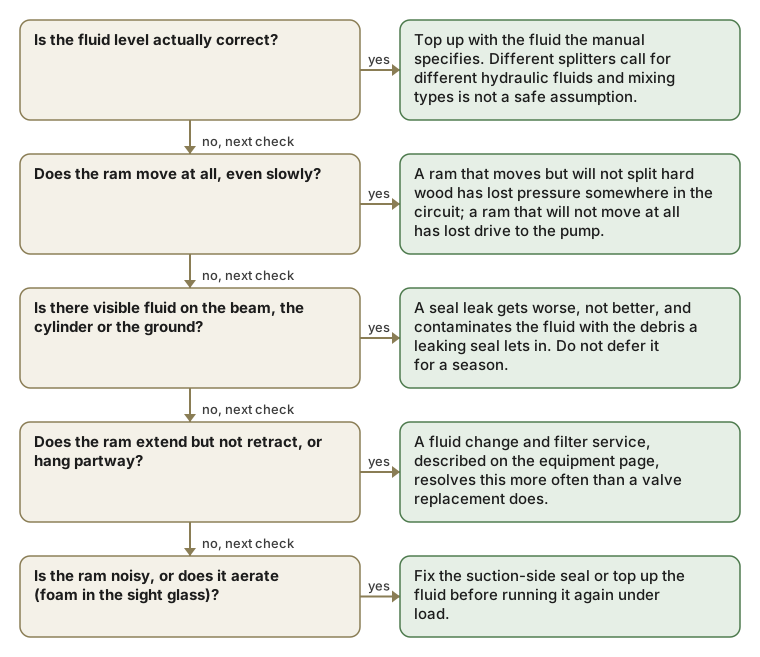
Three different complaints, three different systems
"Something is wrong with the splitter" usually means one of three separate faults: the ram will not extend with force, the ram extends but will not retract, or fluid is visibly escaping somewhere. Each has its own short list of causes.
1. Is the fluid level correct?
Check with the ram fully retracted, on level ground: checking with the ram extended reads low because fluid is sitting in the cylinder. Low fluid is the single most common cause of a weak or slow ram on this machine.
If that is it: Top up with the fluid the manual specifies. Different splitters call for different hydraulic fluids and mixing types is not a safe assumption.
2. Does the ram move at all, even slowly?
A ram that moves slowly in both directions but never develops force is usually a relief valve stuck open or badly worn pump, not a blockage. A ram that does not move at all with the engine running at full throttle points at the pump drive: a sheared key or coupling between engine and pump is common after a jam.
If that is it: A ram that moves but will not split hard wood has lost pressure somewhere in the circuit; a ram that will not move at all has lost drive to the pump.
3. Is there visible fluid on the beam, the cylinder or the ground?
A wet cylinder rod usually means a worn rod seal, which leaks more as the ram extends further. A wet fitting or hose usually means exactly that connection has loosened or perished. Wipe everything dry, run one cycle, and look again to find the actual source rather than guessing from old residue.
If that is it: A seal leak gets worse, not better, and contaminates the fluid with the debris a leaking seal lets in. Do not defer it for a season.
4. Does the ram extend but not retract, or hang partway?
This points at the control valve not shifting fully, often from grit in the fluid holding a spool from returning to center. It can also be a control linkage that has worked loose and no longer moves the valve its full travel.
If that is it: A fluid change and filter service, described on the equipment page, resolves this more often than a valve replacement does.
5. Is the ram noisy, or does it aerate (foam in the sight glass)?
A whining pump with foam visible in the reservoir is drawing air, usually from a loose suction-side fitting or a low fluid level exposing the pickup. Running on aerated fluid wears the pump quickly and is worth stopping for immediately rather than finishing the pile.
If that is it: Fix the suction-side seal or top up the fluid before running it again under load.
Ram, seal or valve: condensed
| Symptom | Likely cause | Fix |
|---|---|---|
| Ram moves but never develops real force | Low hydraulic fluid, checked with the ram fully retracted | Top up with the fluid the manual specifies. |
| Ram does not move at all at full throttle | Sheared key or coupling between engine and pump, often after a jam | Inspect the pump drive coupling. |
| Ram moves slowly in both directions, no force | Relief valve stuck open or a badly worn pump | Service or replace the relief valve or pump. |
| Wet cylinder rod | Worn rod seal, leaking more as the ram extends further | Replace the seal: it will not stop leaking on its own. |
| Wet fitting or hose, dry rod | A connection that has loosened or perished | Tighten or replace the fitting or hose. |
| Extends but will not retract, or hangs partway | Control valve not shifting fully (grit in the fluid) or a loose linkage | Change the fluid and filter first; check the linkage. |
| Whining pump, foam visible in the sight glass | Air being drawn in at a loose suction fitting or from low fluid exposing the pickup | Fix the suction seal or top up fluid before running it again. |
What is not on this list
A round that will not split despite a healthy machine is very often the wood, not the splitter. A knotty, forked or green round exceeds what a given tonnage can do, and rotating the round ninety degrees to attack a different grain line solves more "stuck" rounds than any adjustment to the machine. The mechanism behind the two-stage pump slowing as it meets resistance, and the maintenance schedule that prevents most of the faults above, are covered on log splitters.
Log splitter will not split, return, or holds fluid: questions
Why does my log splitter ram have no force?
Check the hydraulic fluid level first, with the ram fully retracted on level ground: checking it extended reads low even on a healthy machine, because fluid is sitting in the cylinder. Low fluid is the single most common cause of a weak or slow ram, and it costs nothing to rule out before suspecting the pump or relief valve.
Why does my log splitter ram extend but not retract?
This usually points at the control valve not shifting fully, often because grit in the fluid is holding the spool from returning to center. A fluid change and filter service resolves this more often than replacing the valve. A worked or loosened control linkage that no longer moves the valve its full travel is the other common cause.
Why does the ram fail to move at all, even at full engine throttle?
This points specifically at lost drive to the pump rather than a hydraulic circuit fault: a sheared key or coupling between the engine and the pump, often the result of the pump jamming against a stuck relief valve or an obstruction, disconnects the engine's rotation from ever reaching the pump at all, so no amount of fluid or valve adjustment will help until that mechanical link is repaired.
How do I safely check for a hydraulic fluid leak on a log splitter?
Wipe every surface (the beam, the cylinder, all fittings and hoses) completely dry first, run one full cycle, then inspect again: old residue makes it impossible to tell where a leak is originating versus where fluid simply pooled or dripped from a source further away. Checking after a clean wipe-down finds the real source rather than the most visible old stain.
Why is a wet cylinder rod a more serious problem than a wet fitting?
A wet rod means the internal rod seal has worn, and that seal wears progressively worse, leaking more as the ram extends further, and also lets contaminants into the fluid, accelerating wear elsewhere in the system. A wet fitting is usually a simple loosened or perished connection that a tightening or a replacement part resolves without ongoing degradation.
Can a round of wood be too tough for a splitter to handle, even with the machine working correctly?
Yes, and the guide explicitly separates that possibility from a machine fault: a knotty, forked, or green round can exceed what a given tonnage rating can split regardless of the machine's mechanical health, and rotating the round ninety degrees to attack a different grain line resolves more "stuck" rounds than any adjustment to the splitter itself.
Should I depressurize a log splitter before checking or changing the hydraulic fluid?
Yes, always: retract the ram fully and stop the engine or motor before disconnecting any fitting, since a pressurized line can spray hot fluid when loosened. This applies to routine fluid checks and top-ups as much as to a repair, since even a routine check can involve a fitting under residual pressure.
Does the type of hydraulic fluid matter, or can I use whatever hydraulic oil is on hand?
It matters: different splitters call for different hydraulic fluids, and mixing types or using an unspecified substitute is not a safe assumption, since fluid viscosity and additive packages affect both cold-weather performance and long-term seal compatibility. Check the manual for the specified fluid before topping up with whatever is convenient.
What is the actual mechanism behind a slow, weak ram that still develops some force?
A relief valve stuck partially open, or a pump worn enough to lose efficiency internally, both let hydraulic pressure escape or fail to build fully even though the ram still moves: this is mechanically distinct from low fluid (which starves the system of volume) and produces a different symptom pattern: motion without adequate force, in both directions, rather than a ram that simply won't move.
Is a log splitter's hydraulic filter something that needs periodic replacement, separate from the fluid itself?
Yes: a hydraulic filter that goes into bypass (clogged enough that fluid routes around it unfiltered) exposes the pump to all the wear metal and contamination the system has accumulated, which is exactly the condition the guide and the equipment page describe as accelerating a control valve's failure to shift. Changing the filter on schedule, not just the fluid, is part of the maintenance that prevents this.
Does ambient temperature affect log splitter hydraulic performance the same way it affects engine oil?
Yes: hydraulic fluid, like engine oil, thickens in cold weather, which can make a splitter feel sluggish or slow to build force on a cold morning even with fully healthy hydraulics. This is normal cold-weather behavior distinct from the low-fluid, worn-pump, or valve faults the guide otherwise diagnoses, and it typically improves once the fluid warms during use.