Compressor pressure faults: distinguish tank, regulator and tool demand
Separate tank pressure from regulated outlet pressure, and note whether the fault occurs with the motor off, while filling, or during tool demand. Keep a leaking or damaged tank out of service. Do not adjust factory pressure controls, weld a tank or tighten a pressurized fitting.
Read the two gauges separately
The DEWALT DXCMS20045 US manual identifies tank and regulated-pressure gauges as different components. An outlet regulator setting cannot establish the tank’s stored pressure. A motor staying off above its cut-in point can also be normal operation.
| Observation | Check before naming a part |
|---|---|
| Tank fills; outlet low | Regulator setting and permitted outlet checks |
| Pressure falls only with a tool running | Tool demand, hose restriction and compressor delivery |
| Tank loses pressure while disconnected | Approved leak inspection and tank condition |
| Motor fails to restart | Power, protection and actual cut-in instructions |
Demand can exceed delivery
The model’s published delivery is 5 CFM at 90 PSI. A hypothetical tool needing 7 CFM at that pressure has a 2-CFM deficit during continuous demand. A larger tank can buffer use for a time, but it does not create the missing continuous flow.
A rapid pressure decline when a tool is connected therefore does not uniquely diagnose a check valve. Record the tool’s specified consumption and duty cycle. Use the correct rated hose and accessories rather than raising pressure beyond their ratings.
A tank leak is a stop-use condition
The cited manual calls for replacing a leaking tank or compressor and prohibits drilling, welding or modifying the tank. It also gives a removal-from-service year on the tank warning label. A soap bubble at a weld is not a prompt for a home patch.
Unplug or otherwise isolate power and follow the specified depressurization procedure before service. A gauge indication alone is not permission to remove an unknown fitting. Internal valves, pressure-switch faults and motor work require the actual service procedure or qualified repair.
See compressor capacity selection before treating an undersized supply as a pump failure.
TS-14 · Troubleshooting
Air compressor will not build or hold pressure
A compressor that never builds pressure and one that builds pressure fine but leaks back down before the next use are two different faults, and treating them as one sends the diagnosis the wrong way. A motor running with the gauge staying near zero points at the pump itself: a worn head, a stuck check valve inside the pump, or a slipping belt. A motor that will not start at all is more often a full tank against the pressure switch’s cut-out or a tripped breaker than a real fault.
Once pressure builds, a slow bleed-down with the compressor off and unplugged is almost always a fitting, weld or corroded tank wall found with a soap test; an immediate bleed-down the moment a tool is connected points at the check valve instead; and a motor that short-cycles far more than the job explains usually means a leak feeding the low-pressure cut-in repeatedly.
Relieve tank pressure through the drain valve before working on any fitting or the drain itself, and unplug the unit first. A compressor tank stores real energy: treat every fitting as pressurized until you have confirmed the gauge reads zero.
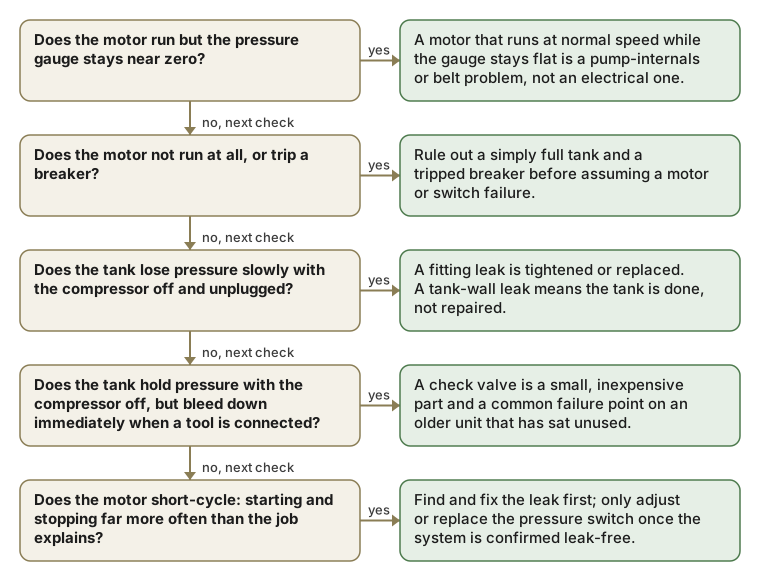
Not building pressure and not holding pressure are different faults
A compressor that will not build pressure at all has a different cause than one that builds pressure, runs, shuts off, and then leaks back down before the next tool trigger: treating them as the same problem sends the diagnosis in the wrong direction from the start.
1. Does the motor run but the pressure gauge stays near zero?
This points at the pump itself: a worn or gasket-failed head, a stuck or damaged reed/check valve inside the pump, or a drive belt slipping on a belt-driven unit rather than a direct-drive motor. Confirm the belt is tight and intact first, since it is the cheapest cause to rule out.
If that is it: A motor that runs at normal speed while the gauge stays flat is a pump-internals or belt problem, not an electrical one.
2. Does the motor not run at all, or trip a breaker?
Check the power supply and breaker first, then the pressure switch: most consumer compressors will not start if the tank is already at or above the switch's cut-out setting, so check the pressure against the switch setting before diagnosing the motor. A motor that hums but does not start can be trying to start against residual tank pressure it is not built to start against.
If that is it: Rule out a simply full tank and a tripped breaker before assuming a motor or switch failure.
If it builds pressure but will not hold it
3. Does the tank lose pressure slowly with the compressor off and unplugged?
Soap-test every fitting, the drain valve, and the tank welds with the compressor off and depressurized to a safe working pressure, then listen and look for bubbles. A leaking fitting is a cheap fix; a leaking weld or a corroded tank wall is not. The tank should be retired rather than repaired if the tank itself is leaking.
If that is it: A fitting leak is tightened or replaced. A leaking pressure vessel needs replacement or the manufacturer’s authorized service process; do not improvise a patch.
4. Does the tank hold pressure with the compressor off, but bleed down immediately when a tool is connected?
That points at the check valve, which is supposed to keep compressed air from backing out of the tank through the pump on shutdown. A check valve stuck open lets air drain back through the pump the moment demand is placed on the line.
If that is it: A check valve is a small, inexpensive part and a common failure point on an older unit that has sat unused.
5. Does the motor short-cycle: starting and stopping far more often than the job explains?
Short-cycling wears the motor and the pressure switch faster than normal use and usually means a leak somewhere in the system large enough to trigger the low-pressure cut-in repeatedly, or a pressure switch itself that has drifted out of adjustment.
If that is it: Find and fix the leak first; only adjust or replace the pressure switch once the system is confirmed leak-free.
Pressure loss: faults, checks and repair paths
| Symptom | Points to | Fix |
|---|---|---|
| Motor runs, gauge stays near zero | A worn or gasket-failed pump head, a stuck check valve inside the pump, or a slipping belt | Check belt tension first: it is the cheapest cause to rule out. |
| Motor will not run at all, or trips a breaker | A full tank sitting at the pressure switch’s cut-out, a tripped breaker, or a motor starting against residual pressure | Check the breaker and tank pressure before suspecting the motor. |
| Tank loses pressure slowly, compressor off and unplugged | A leaking fitting, drain valve, or a corroded tank weld | Soap-test to find it. Tighten or replace a fitting; retire the tank if the weld or wall leaks. |
| Tank holds pressure until a tool is connected, then bleeds down immediately | A check valve stuck open, letting air back through the pump | Replace the check valve. |
| Motor short-cycles far more than the job explains | A leak feeding the low-pressure cut-in repeatedly, or a drifted pressure switch | Find and fix the leak first; adjust or replace the switch only once leak-free. |
Air compressor will not build or hold pressure: questions
Why does my air compressor motor run but the pressure gauge stays near zero?
This points at the pump itself: a worn or gasket-failed head, a stuck or damaged reed or check valve inside the pump, or a slipping drive belt on a belt-driven unit. Confirm the belt is tight and intact first, since it's the cheapest cause to rule out before suspecting the pump's internal components.
Why will my air compressor motor not run at all, or why does it trip a breaker?
Check the power supply and breaker first, then the pressure switch: most consumer compressors will not start if the tank is already at or above the switch's cut-out setting, so check the pressure against the switch setting before diagnosing the motor. A motor that hums but doesn't start can be trying to start against residual tank pressure it isn't built to start against.
Why does my compressor tank lose pressure slowly even when the compressor is off and unplugged?
Soap-test every fitting, the drain valve, and the tank welds with the compressor off and depressurized to a safe working pressure, then look for bubbles. A leaking fitting is a cheap fix; a leaking weld or a corroded tank wall is not, and the tank should be retired rather than repaired if the tank itself is what's leaking.
Why does my compressor hold pressure fine until I connect a tool, then bleed down immediately?
That points at the check valve, which is supposed to keep compressed air from backing out of the tank through the pump on shutdown. A check valve stuck open lets air drain back through the pump the moment demand is placed on the line: it's a small, inexpensive part and a common failure point on an older unit that has sat unused.
Why does my compressor's motor start and stop far more often than the job would explain?
Short-cycling like this wears the motor and pressure switch faster than normal use, and it usually means a leak somewhere in the system large enough to trigger the low-pressure cut-in repeatedly, or a pressure switch itself that has drifted out of adjustment. Find and fix any leak first; only adjust or replace the pressure switch once the system is confirmed leak-free.
Is not building pressure at all a different fault from building pressure and then losing it?
Yes, and treating them as the same problem sends the diagnosis in the wrong direction: a compressor that never builds pressure points at the pump, motor, or switch, while one that builds pressure and then leaks down points at a fitting, weld, or check valve downstream of a functioning pump. Splitting the fault into these two categories first is what the guide's diagnostic order is built around.
What should I do before working on any fitting or the drain valve on a compressor?
Relieve tank pressure through the drain valve and unplug the unit first, and treat every fitting as pressurized until the gauge confirms zero: a compressor tank stores real stored energy, and working on a fitting under pressure can cause a sudden, forceful air release.
Can a compressor with a worn drive belt still build some pressure, just slowly?
Yes: a belt that's slipping but not fully failed can still turn the pump at reduced speed, producing some pressure buildup but far slower and to a lower maximum than the compressor is rated for, which is a different symptom pattern from a gauge staying flat at zero and is still resolved by tightening or replacing the belt.
Does a compressor's pressure switch ever need recalibration, or does it only fail outright?
A pressure switch can drift out of its factory calibration over time rather than failing completely, causing it to cut in or cut out at pressures slightly different from its rated settings: this can produce short-cycling or a tank that runs fuller or emptier than expected without a dramatic, obvious failure.
How do I know if a small compressed-air leak is worth fixing immediately or can wait?
Any detectable leak is worth fixing promptly, since it forces the motor to cycle more often to maintain pressure, which accelerates wear on the motor and pressure switch beyond normal use, even a small leak that seems tolerable in the short term compounds into real extra wear over repeated cycles.
Is a compressor that "can't keep up" with a tool always a leak or pump problem?
Not necessarily: if the tool's CFM requirement at its operating pressure exceeds what the compressor can sustainably deliver, the compressor is working within its design rather than failing, the same duty-cycle limitation covered on the equipment page. Confirm the tool's CFM-at-PSI requirement against the compressor's rating at that pressure before assuming a fault.
Can moisture damage an air-compressor tank and cause pressure loss?
Moisture itself doesn't directly cause a pressure leak, but accumulated condensation left undrained corrodes the tank from the inside over time, and a corroded or rusted-through section of tank wall is exactly the kind of leak the guide says means retiring the tank rather than repairing it. Regular draining prevents the corrosion that eventually causes this specific failure.