Choose an air compressor by delivered flow and duty limit
Match a compressor’s delivered airflow at the required pressure to the tool’s demand, then check duty cycle and hose losses. Tank gallons provide reserve; they do not increase sustained pump output. Single-stage, two-stage, oil-free and oil-lubricated labels do not by themselves establish continuous-duty capability.
Use a pressure-qualified output figure
DEWALT’s DXCMS20045 US specification gives a 4.5-gallon tank and 5.0 CFM at 90 PSI. It is described as a two-stage oil-free design, which disproves a blanket rule that all two-stage compressors require oil service or belong only in industrial shops.
For a hypothetical tool requiring 7 CFM continuously at 90 PSI, a 5-CFM delivered rating leaves a 2-CFM deficit. The tank can delay pressure loss but cannot remove that sustained deficit. An intermittent nailer and a continuously running sander therefore need different demand estimates.
Check more than the advertised maximum pressure
| Item | Required match |
|---|---|
| Delivered flow | Same test/pressure basis as the tool demand |
| Duty cycle | Permitted run and rest pattern |
| Hose and fittings | Flow capacity and pressure loss at the tool |
| Power supply | Approved circuit and starting requirements |
| Tank | Condition, working-pressure limits and drain procedure |
A higher tank pressure does not authorize exceeding a tool’s rated inlet pressure. Set the regulator to the tool’s instructions and account for flow while operating, not only a static gauge reading.
Read tank pressure and delivery as separate ratings
The DXCMS20045 US manual identifies a 200-PSI maximum tank rating and separate tank and regulated-pressure gauges. The 5-CFM figure is specified at 90 PSI. The 110-PSI difference between those pressure numbers is not extra airflow available to a tool.
A hypothetical 50-percent duty limit over a stated ten-minute period would permit five minutes of running in that period. It would not permit ten minutes continuously. Use the actual compressor’s published duty conditions rather than assuming this example is its rating.
When considering a used unit, read the tank’s warning label as well as the price. This manual requires removal from service by the year shown on that label. A low asking price does not resolve an expired, damaged or leaking tank.
Tank condition is a safety decision
Drain condensate by the actual shutdown/depressurizing procedure and interval. Stop using a damaged or corroded pressure vessel and obtain the manufacturer’s assessment. Do not weld, drill, patch or defeat a relief device.
Use the pump’s own maintenance instructions: an oil-free unit does not need oil added to its compression chamber. A compressor that runs continuously without maintaining pressure may be undersized or faulty; the pressure-loss guide separates those cases.
Air compressors
A compressor is sold on CFM, and that figure is only meaningful paired with the pressure it was measured at. A CFM number with no PSI attached, sometimes measured at zero pressure, does not tell you whether the machine can run the tool you own. Match a tool’s own stated CFM-at-PSI requirement against the compressor’s rating at that same pressure.
Tank size is reserve capacity for a burst of demand, not a way to raise sustained output; duty cycle is how much of the time the motor can run before it needs to rest, and a consumer unit that seems to "run out of air" under sustained use is often working exactly as designed. Single-stage suits intermittent homeowner use; two-stage suits continuous shop or trade use. The tank itself is a pressure vessel that needs its moisture drained after every use.
Untreated condensation is what corrodes a steel tank from the inside.
CFM at a stated PSI, not CFM alone
A compressor's output, cubic feet per minute of air delivered, is only meaningful at a stated pressure, because output falls as the target pressure rises. A rating of "CFM at 90 PSI" describes a tool running continuously at that pressure; a headline CFM number with no pressure attached, sometimes advertised at 0 PSI, is not comparable to a rating that states its test pressure and is not what a nail gun or an impact wrench draws against. Compare the tool’s airflow requirement with delivered CFM at the same operating pressure.
| Figure | What it means |
|---|---|
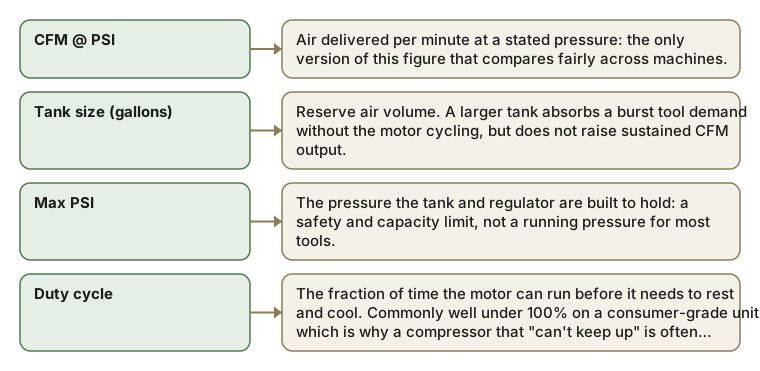
| CFM @ PSI | Air delivered per minute at a stated pressure: the only version of this figure that compares fairly across machines. |
| Tank size (gallons) | Reserve air volume. A larger tank absorbs a burst tool demand without the motor cycling, but does not raise sustained CFM output. |
| Max PSI | The pressure the tank and regulator are built to hold: a safety and capacity limit, not a running pressure for most tools. |
| Duty cycle | The fraction of time the motor can run before it needs to rest and cool. Commonly well under 100% on a consumer-grade unit, which is why a compressor that "can't keep up" is often working within its design rather than failing. |
Single-stage against two-stage
A single-stage compressor pumps air to final pressure in one piston stroke and is what most portable and shop compressors are: adequate for intermittent tool use up to roughly 150 PSI. A two-stage compressor compresses air in one cylinder, cools it, then compresses it further in a second, smaller cylinder, reaching higher pressure more efficiently and running cooler under sustained load. Two-stage units are larger, heavier, and built for continuous industrial duty rather than intermittent homeowner use.
Oil-lubricated against oil-free
An oil-lubricated pump runs cooler, lasts longer under sustained use and needs an oil-level check and change on a schedule, the same discipline as any small engine. An oil-free pump needs no oil service and starts reliably in cold weather, but runs louder and wears faster under sustained duty, which is why oil-free units are sold for occasional light use and oil-lubricated units for a shop that runs air tools regularly.
A compressor tank is a pressure vessel that stores real stored energy. A corroded or rusted-through tank can rupture violently. Drain the tank of condensed moisture after every use (a manual or automatic drain valve on the tank underside), because that trapped moisture is exactly what corrodes a steel tank from the inside where it cannot be seen.
Never exceed the tank's stamped maximum working pressure, and never weld, drill or modify a compressor tank.
What wears on a compressor
The intake air filter is the wear item that gets ignored: a clogged filter starves the pump and increases run time and heat for the same air delivered, the same story as an air filter on any small engine. The check valve and the tank drain are the two components most often found seized or painted shut on an older unit, and both need to move freely: the check valve keeps compressed air from backing out of the tank through the pump on shutdown, and the drain is what removes the moisture doing the corroding.
Air compressors: questions
What size air compressor do I need for my tools?
Match the compressor’s CFM rating at the same PSI the tool is rated at, not the compressor’s peak or zero-pressure figure. A tool’s own label states CFM at a stated PSI, and that is the number to compare against the compressor’s output at the same pressure, not against a headline CFM figure measured differently.
Why does my compressor keep running out of air?
The tool may be using air faster than the compressor can supply it within its duty cycle. A consumer-grade motor is commonly built to run well under 100% of the time, resting and cooling between cycles, and a larger tank only absorbs a burst of demand: it does not raise sustained output. A tool drawing more CFM than the compressor sustains at that pressure will outrun the tank regardless of its size.
Do I need a single-stage or two-stage air compressor?
Single-stage suits intermittent homeowner and shop use up to roughly 150 PSI and is what most portable compressors are. Two-stage compresses in two steps with cooling between them, reaches higher pressure more efficiently and runs cooler under sustained load, but is larger, heavier and built for continuous industrial duty rather than occasional tool use.
Why is there water coming out of my air compressor?
Compressing air concentrates the moisture already in it, and that moisture condenses in the tank as the air cools. The gauge can fall during sustained demand even when the tank and fittings hold pressure. The tank has a drain valve on its underside made for exactly this, and it needs to be opened after every use, because standing condensation is what corrodes a steel tank from the inside where it cannot be seen.
Is an oil-free or oil-lubricated air compressor better?
Oil-lubricated runs cooler, lasts longer under sustained shop use and needs an oil check and change on a schedule, the same discipline as a small engine. Oil-free needs no oil service and starts reliably in cold weather but runs louder and wears faster under heavy use, which is why it suits occasional light use rather than a shop that runs air tools daily.
What does a compressor's tank size change if it doesn't raise sustained CFM?
A larger tank stores more reserve air volume, which absorbs a burst tool demand, a nail gun's brief high-draw shot, for example, without the motor having to cycle on immediately. It buys time between motor cycles for intermittent tool use; it doesn't change how much air the motor and pump can deliver continuously once the tank's reserve is used up.
What is the maximum PSI rating on a compressor tank for, if most tools run well below it?
It's the pressure the tank and its regulator are built and rated to safely hold: a structural and safety limit on the vessel itself, not a running pressure most tools need. A compressor typically shuts off well before that maximum and a regulator drops the actual working pressure down further to match a specific tool's requirement.
What are the check valve and drain valve on a compressor, and why do both need to move freely?
The check valve prevents compressed air from backing out of the tank through the pump when the motor shuts off, and the drain valve is what removes accumulated moisture from the tank. Both are commonly found seized or painted shut on an older, neglected unit. A stuck check valve causes hard restarts, and a stuck drain valve leaves corrosive moisture sitting in the tank indefinitely.
Can a rusted or corroded compressor tank be repaired, or does it need replacing?
A compressor tank is a pressure vessel storing real stored energy, and a corroded or rusted-through tank can rupture violently under pressure. This is not a component to patch or weld, and a tank showing significant rust, especially internal rust discovered through the drain, should be replaced rather than repaired.
Does a compressor's intake air filter need the same attention as a small engine's air filter?
Yes, and it's the wear item most often ignored: a clogged intake filter starves the pump, increasing run time and heat for the same air delivered, the same consequence a dirty air filter has on any small engine. Checking and cleaning or replacing it periodically is a low-cost habit against a real performance and longevity cost.
Is a pancake compressor a different type from a single-stage compressor, or just a tank shape?
"Pancake" describes the tank's flat, low-profile shape for stability and portability, not a different compression mechanism: a pancake compressor is typically a single-stage unit like most portable and shop compressors, just built around that specific tank geometry rather than the more common upright or horizontal cylindrical tank shape.
Does ambient temperature affect a compressor's CFM output?
Yes: colder, denser air is slightly more efficient to compress than hot air, so a compressor's real-world CFM output can vary modestly with ambient temperature the same way an engine's power output varies with air density. This is a secondary effect compared to matching CFM-at-PSI correctly in the first place, but it explains small performance differences between a summer and winter reading on the same machine.