Choose a water pump from head, flow and permitted material
Choose a pump from the required flow at total dynamic head, the permitted liquid/solids and the suction arrangement. Maximum flow and maximum head are different points, not a simultaneous promise. Verify priming, hose and power requirements before using a portable pump for dirty water or dewatering.
Maximum figures do not describe one operating point
Honda’s WB20 page lists 164 GPM capacity, 105-foot total head and 25-foot suction head. Do not interpret that as 164 GPM at 105 feet. Use its curve for the required head, and distinguish the suction limit from total head.
For an example with eight feet of suction lift, 12 feet of discharge elevation and an estimated ten feet of hose/fitting loss, total dynamic head is 30 feet. The ten-foot loss is an assumed input here, not a measured result. Hose diameter, length, fittings and flow determine the actual friction loss.
Identify the water before the pump
| Question | Evidence to obtain |
|---|---|
| Clean or debris-laden water? | Approved liquids, solids limit and strainer |
| Required delivery? | Flow at calculated head |
| Above or below the water? | Permitted suction setup and priming |
| Hose arrangement? | Suction-rated hose, joints and discharge limits |
| Power source? | Safe engine location or electrical protection |
The WB20XT/WB30XT manual supplies model-specific operating and priming instructions. A general-purpose centrifugal pump is not automatically a sewage or trash pump. Keep its approved strainer in place and do not assume that “utility pump” guarantees solids handling.
Do not infer a safe closed-valve test
Do not run dry or against a closed discharge unless the actual instructions expressly permit the test. A generic description of centrifugal pumps cannot establish a safe duration. Stop for loss of prime, leaks or abnormal heat and investigate with the pump isolated.
CPSC’s engine-driven-tool guidance warns against indoor or enclosed operation because of carbon monoxide. An engine-driven pump belongs outside with exhaust away from openings, even when the water to remove is in a basement. Keep electrical equipment and connections protected as their instructions require.
Water pumps
A pump is sold on gallons per minute, and that figure is only true at one stated total head. The vertical lift plus the friction loss of the hose it is pushing through. The same pump moves far less water lifting forty feet than it does lifting four, and its real output is a curve that falls to zero at its maximum lift, not a single number.
Most portable pumps are centrifugal, where output falls smoothly as head rises and the pump tolerates a closed valve briefly; a positive-displacement pump moves a fixed volume per cycle regardless of head and needs a pressure relief if the line can close. A trash or utility pump adds a solids-handling rating, the largest particle the impeller can pass, and buying by GPM alone while ignoring that rating is the standard mistake for water that is not clean.
Flow and head, not one number
A pump is sold on gallons per minute (GPM), and that figure only applies at a stated total head. The vertical lift plus the friction loss of the hose or pipe it is pushing through. The same pump moves far less water lifting forty feet than it does lifting four, and every pump's real output is a curve, not a single figure: GPM falls as head rises, down to zero at the pump's maximum lift.
A rating printed on the box with no head stated is the rating at the easiest possible case, which is not the job most owners buy the pump for.
| Term | What it means |
|---|---|
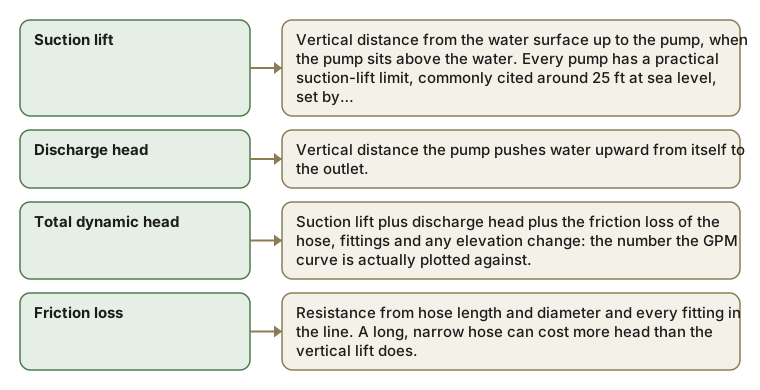
| Suction lift | Vertical distance from the water surface up to the pump, when the pump sits above the water. Every pump has a practical suction-lift limit, commonly cited around 25 ft at sea level, set by atmospheric pressure, not the motor. |
| Discharge head | Vertical distance the pump pushes water upward from itself to the outlet. |
| Total dynamic head | Suction lift plus discharge head plus the friction loss of the hose, fittings and any elevation change: the number the GPM curve is plotted against. |
| Friction loss | Resistance from hose length and diameter and every fitting in the line. A long, narrow hose can cost more head than the vertical lift does. |
Centrifugal against positive-displacement
Most portable pumps, utility, trash and sump pumps, are centrifugal: an impeller spins and flings water outward, output falls smoothly as head rises, and the pump can run briefly against a closed valve without damage. A positive-displacement pump, a diaphragm or piston pump, common on some sprayer and well applications, moves a fixed volume per cycle regardless of head, delivers a steadier flow at low pressure, and can build damaging pressure if run against a fully closed line with no relief.
What "trash pump" rates
A trash or utility pump adds a solids-handling rating: the largest solid particle, given as a diameter, that can pass through the impeller without clogging or jamming it. A pump rated to pass a half-inch solid will clog on gravel or debris larger than that; buying by GPM alone and ignoring the solids rating is the standard mistake with a pump bought for muddy or debris-laden water rather than clean water.
A gas-engine pump is a small engine running in the same location as standing water and, often, in an enclosed or below-grade space: a basement, a window well, a trench. Running one indoors or in a confined space produces the same carbon monoxide hazard covered on generator carbon monoxide, for the same reason: the exhaust has nowhere to go. Run a gas pump outdoors, with the exhaust directed away from any opening into the structure.
What wears on a pump
On a centrifugal pump, the impeller and the seal behind it are the wear items. A seal that has started to leak announces itself as fluid weeping from the pump housing rather than the volute, and running a pump dry for any length of time is what burns a mechanical seal that grit and sand would otherwise only wear slowly.
A pump should never run dry on purpose; most portable units are not rated for it and some are damaged within seconds. Priming, filling the pump housing and suction line with water before starting, is what a centrifugal pump needs to move any water at all, since the impeller cannot draw air the way it draws water.
Water pumps: questions
Why does my pump move less water than the box says?
Because GPM is only true at one stated total head, and total head is suction lift plus discharge head plus friction loss in the hose and fittings. The same pump moves far less water lifting forty feet than lifting four, and a long or narrow hose can cost more head than the vertical lift does. Check the pump curve at the lift and hose resistance the job requires.
What size water pump do I need for a flooded basement?
Size on total dynamic head for the actual lift and hose run, not on GPM alone, and check the solids-handling rating if the water carries mud or debris: a pump rated to pass a half-inch solid clogs on anything larger. Most gas-engine trash pumps sold for basement and construction cleanup handle moderate debris; clean-water sump applications need less solids capacity.
Can I run a gas water pump in my basement?
No. A gas engine running in a basement, window well or any enclosed space produces the same carbon monoxide hazard as a portable generator run indoors, and the confined, below-grade space a pump is often used in allows carbon monoxide to accumulate. Run a gas-powered pump outdoors with the exhaust directed away from any opening into the structure.
Why did my pump stop pumping even though it is running?
Almost always lost prime: a centrifugal pump’s impeller cannot draw air the way it draws water, so once the housing and suction line lose their water column the pump spins without moving anything. Refill the housing and suction line before restarting, and check for a suction-side leak if it keeps losing prime.
What is the difference between a sump pump and a trash pump?
A sump pump is built for clean or lightly silted water and a fixed pit installation. A trash pump adds a solids-handling rating, the largest particle diameter its impeller can pass, for muddy, debris-laden water on a construction site or a flooded area, and is usually portable rather than installed in one pit.
What is the difference between a centrifugal and a positive-displacement pump?
A centrifugal pump spins an impeller to fling water outward, its output falls smoothly as head rises, and it tolerates running briefly against a closed valve without damage: most portable utility, trash and sump pumps are this type. A positive-displacement pump (diaphragm or piston) moves a fixed volume per cycle regardless of head, delivers a steadier flow at low pressure, and can build damaging pressure if run against a fully closed line with no relief.
Why does suction lift have a practical limit around 25 feet regardless of the pump's motor power?
Because suction lift is limited by atmospheric pressure, not motor power: a pump creates a partial vacuum that atmospheric pressure then pushes water up into, and that mechanism has a physical ceiling around 25 feet at sea level no matter how powerful the motor driving the impeller is. A more powerful motor increases discharge capability, not how high the pump can lift water from below itself.
Can a water pump be damaged by running it dry, even briefly?
Yes: most portable pumps are not rated to run dry, and some are damaged within seconds, because the water that would otherwise cool and lubricate the mechanical seal is absent, and that seal is what typically fails first from dry running. Priming the pump (filling the housing and suction line with water) before starting is what prevents this.
How do hose friction and vertical lift affect water-pump sizing?
Yes, and it's often underestimated: a long or narrow hose can cost more head than the vertical lift itself, which is why total dynamic head (suction lift plus discharge head plus friction loss) rather than vertical distance alone is the figure a pump's GPM curve is plotted against.
What maintenance does a water pump's seal need, and how do I know when it's failing?
A failing seal typically announces itself as fluid weeping from the pump housing rather than from the discharge outlet: this is a wear item, not something to inspect on a fixed schedule, so watching for that specific leak location during and after use is the practical check, along with never letting the pump run dry, which is the fastest way to damage a seal.
Is a higher horsepower rating on a water pump the same as a higher GPM rating?
Not directly: horsepower describes the motor's power output, while GPM describes flow at a specific head, and two pumps with the same horsepower can have different GPM-versus-head curves depending on impeller design. Compare delivered GPM at the total head your job requires.
Does a water pump's inlet hose diameter matter as much as the pump's own rated GPM?
Yes: an inlet hose narrower than the pump's intake port restricts flow before the pump's impeller ever gets a chance to move that water, effectively capping output below the pump's rated GPM regardless of how capable the pump itself is. Match the suction hose diameter to the pump’s specified intake and use a hose rated for suction.