Water pump runs without flow: check priming, suction and total head
Stop a water pump that is not moving water and follow its cooling and shutdown instructions. Check the exact pump’s priming procedure, approved suction arrangement, strainer and performance curve. A running engine with no discharge does not uniquely prove lost prime, an air leak or a failed seal.
Maximum flow and maximum head are separate endpoints
Honda lists the WB20 at 164 GPM maximum capacity, 105 feet maximum total head and 25 feet maximum suction lift. Those maxima are not simultaneous operating conditions. Select the point on the actual curve for the job.
| Input | Include |
|---|---|
| Suction lift | Vertical distance from water surface to pump |
| Discharge rise | Vertical lift above pump |
| Friction | Actual hose, fittings, diameter and flow |
| Suction equipment | Approved hose, sealed connections and strainer |
For an example layout, 8 feet of suction lift plus 12 feet of discharge rise plus an assumed 10 feet of friction gives 30 feet total dynamic head. The 10-foot friction figure is an assumption to replace with the actual installation calculation. The 164-GPM headline does not establish delivery at that head.
Inspect the suction path without an open hot housing
A suction leak can admit air without an obvious water drip. A hose that collapses under suction, damaged connection seal or blocked strainer can also interfere with flow. Use suction-rated parts and the pump’s specified inspection, not an ordinary discharge hose assumed equivalent.
A priming cap or drain can release hot water or pressure after dry or blocked operation. Let the pump cool and follow the manual before opening it. “Self-priming” does not mean that every pump may start with an empty chamber or run dry indefinitely.
Stop repeated unsuccessful trials
If the prescribed setup and priming checks do not restore delivery, obtain service for the seal, impeller, engine speed and other possible faults. A wet housing does not uniquely identify the source without inspection.
Never operate an engine-driven pump indoors or in an enclosed or below-grade space. Use pump selection to compare the installation with the actual curve before buying a larger engine or replacing pump parts.
TS-13 · Troubleshooting
Water pump runs but moves no water
The complaint "it runs but does not pump" on a portable water pump is, in the large majority of cases, lost prime rather than a mechanical failure: a centrifugal pump cannot draw air the way it draws water, and once the housing and suction line lose their water column the impeller spins and moves nothing no matter how healthy the engine sounds. Re-priming resolves most of these outright. Where re-priming does not hold, the order runs through a suction-side air leak that lets the pump lose prime again within minutes, a clogged intake screen or impeller, a total head near or beyond what the pump can deliver at all, and finally a worn mechanical seal weeping from the housing itself.
Disconnect the spark plug lead on a gas-engine pump, or unplug an electric one, before opening the housing or clearing the intake. Never run a gas-engine pump indoors or in any enclosed or below-grade space: the carbon monoxide hazard is the same as a generator's, and the confined spaces pumps are often used in make it worse.
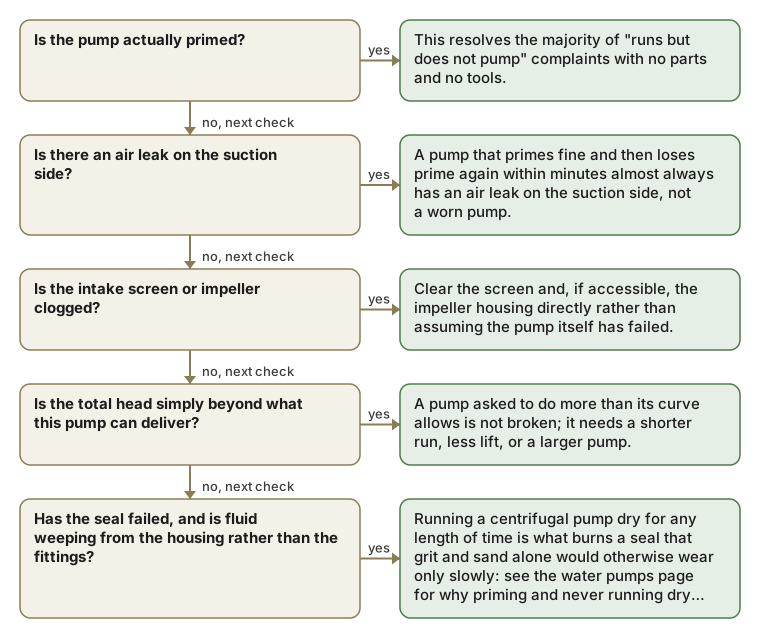
Running but moving nothing is almost always lost prime
A centrifugal pump, what most portable utility and trash pumps are, cannot draw air the way it draws water. Once the pump housing and suction line lose their water column, the impeller spins uselessly and moves nothing, even though the engine or motor sounds perfectly normal. This single failure explains the large majority of "it runs but does not pump" complaints, and it is the first thing to rule out before touching anything else.
1. Is the pump primed?
Remove the priming plug and confirm the housing and suction line are full of water. Refill completely if not: a housing that is even partially air-filled will not draw. On a self-priming unit, a longer-than-usual re-prime time after startup is normal; several minutes with no result is not.
If that is it: This resolves the majority of "runs but does not pump" complaints with no parts and no tools.
2. Is there an air leak on the suction side?
A loose suction fitting, a cracked suction hose, or a foot valve that is not sealing lets the pump draw air alongside water even after a successful prime, and it will lose prime repeatedly rather than staying primed. Inspect each suction-side joint and the full hose for cracks that could admit air.
If that is it: A pump that primes fine and then loses prime again within minutes almost always has an air leak on the suction side, not a worn pump.
3. Is the intake screen or impeller clogged?
Debris caught in the intake screen or lodged in the impeller restricts or blocks flow entirely: the engine may labor slightly or sound unchanged depending on how completely it is blocked. On a trash pump, this is more likely when the solids-handling rating has been exceeded rather than a true fault.
If that is it: Clear the screen and, if accessible, the impeller housing directly rather than assuming the pump itself has failed.
4. Is the total head simply beyond what this pump can deliver?
Every pump's output falls to zero at its maximum lift, and running a pump against a total head near or beyond its rated maximum can look like a fault when it is the pump correctly delivering close to nothing at the edge of its curve. Compare the actual lift, hose length and fittings against the pump's rated performance at that head.
If that is it: A pump asked to do more than its curve allows is not broken; it needs a shorter run, less lift, or a larger pump.
5. Has the seal failed, and is fluid weeping from the housing rather than the fittings?
A worn mechanical seal lets water weep from the pump housing itself, distinct from a leaking hose connection, and often follows a period of the pump running dry. A seal that has failed needs replacement; it does not self-correct.
If that is it: Running a centrifugal pump dry for any length of time is what burns a seal that grit and sand alone would otherwise wear only slowly: see the water pumps page for why priming and never running dry matter.
Prime, air, clog or head: condensed
| Symptom | Cause | Fix |
|---|---|---|
| Runs, sounds normal, moves no water at all | Lost prime: the housing and suction line are full of air, not water | Remove the priming plug and refill the housing and suction line completely. |
| Primes fine, then loses prime again within minutes | An air leak at a suction-side fitting, hose, or foot valve | Check every suction-side joint and the hose itself for a hairline crack. |
| Flow reduced or blocked; engine may labor | A clogged intake screen or an obstructed impeller | Clear the screen and, if accessible, the impeller housing. |
| Output falls to near zero on a long hose run or high lift | Total head near or beyond the pump’s rated maximum | Shorten the run, reduce the lift, or use a larger pump. |
| Water weeping from the housing itself, not a fitting | A worn mechanical seal, often from running the pump dry | Replace the seal: it will not self-correct. |
Water pump runs but moves no water: questions
Why does my water pump run normally but move no water at all?
Almost always lost prime: a centrifugal pump, which is what most portable utility and trash pumps are, cannot draw air the way it draws water. Once the housing and suction line lose their water column, the impeller spins uselessly even though the engine or motor sounds perfectly normal. Re-priming resolves the large majority of "runs but does not pump" complaints before any parts or tools are needed.
How do I properly re-prime a water pump?
Remove the priming plug and check that the housing and suction line are completely full of water, not air, refilling fully if they aren't: a housing that is even partially air-filled will not draw. On a self-priming unit, a longer-than-usual re-prime time right after startup is normal, but several minutes with no result is not and points at a further problem.
Why does my pump prime successfully but lose prime again within minutes?
This points at an air leak on the suction side: a loose fitting, a cracked suction hose, or a foot valve that isn't sealing lets the pump draw air alongside water even after a successful prime, so it loses prime repeatedly rather than staying primed. Inspect each suction-side joint and the full hose for cracks that could admit air.
What should I check if the pump seems to be struggling or the flow is reduced but not zero?
Check the intake screen and impeller for clogging: debris caught in the screen or lodged in the impeller restricts or blocks flow, and the engine may labor slightly or sound unchanged depending on how completely it's blocked. On a trash pump, this is more likely when the solids-handling rating has been exceeded than from a genuine impeller fault.
Can a pump be working correctly but still fail to move water at a given job site?
Yes: every pump's output falls to zero at its maximum lift, and running a pump against a total head near or beyond its rated maximum can look exactly like a fault when it's the pump correctly delivering close to nothing at the edge of its own performance curve. Compare the actual lift, hose length and fittings against the pump's rated performance at that specific head before assuming a fault.
What does it mean if water is weeping from the pump housing itself rather than from a hose connection?
That indicates a worn mechanical seal, distinct from a leaking hose or fitting connection, and it often follows a period of the pump running dry. A failed seal needs replacement: it does not self-correct, and running the pump further while the seal leaks only worsens the damage.
Is it dangerous to run a gas-engine water pump indoors or in a confined space?
Yes: never run a gas-engine pump indoors or in any enclosed or below-grade space, since the carbon monoxide hazard is identical to a portable generator's, and the confined, often below-grade spaces pumps are typically used in (basements, trenches, window wells) make the hazard worse, not better.
What should I do before opening a pump housing or clearing its intake?
Disconnect the spark plug lead on a gas-engine pump, or unplug an electric one, before opening the housing or clearing the intake: this prevents the engine or motor from starting unexpectedly while your hands are near the impeller or intake components.
Does the order of these five checks matter, or can I start with whichever seems most likely?
The order matters because it runs from free and fast to more involved. Checking prime costs nothing and resolves most complaints outright, while checking total head against the pump's curve or replacing a seal takes more time and, in the seal's case, a part. Working through re-priming first before assuming a suction leak, a clog, or a seal failure avoids unnecessary disassembly.
Why does a pump that has run dry damage its seal even if it seems to run fine afterward?
A mechanical seal relies on the fluid it's pumping for cooling and lubrication, and running the pump dry, even briefly, removes that protection and can burn or damage the seal in a way that doesn't show up immediately as a leak but shortens the seal's remaining service life significantly compared to a pump that has always been kept primed before running.
Can a pump lose prime simply from sitting unused for a long period, without any leak?
Yes, in some cases: evaporation or minor seepage through a foot valve that doesn't fully seal can allow the water column in the suction line to slowly drain away during storage, so a pump that primed and worked fine when last used can still need re-priming after sitting idle, without indicating any new fault.
Is a pump that "runs but pumps nothing" ever a problem with the discharge side rather than the suction side?
It's less common, but a fully closed or severely restricted discharge valve or line can prevent flow even with a pump primed according to its instructions. Checking that the discharge path is open is a quick check worth including alongside the suction-side and prime checks the guide focuses on, especially if those checks all come back clear.