Choose a log splitter by log fit, handling and full work cycle
Choose a log splitter that accepts your actual logs and lets you handle them safely. Compare rated force, maximum log dimensions, approved orientation and the complete loading/splitting cycle. A faster no-load ram cycle does not prove proportionally more finished firewood, and a tonnage label does not guarantee every knot will split.
Compare a named model’s limits
Champion’s 201518 specification describes a 27-ton horizontal/vertical splitter with an 11-second cycle and logs up to 24 inches long. Its published 100-pound handling limit is not a direction for an operator to lift that weight unaided.
At 11 seconds per cycle, 3,600 ÷ 11 is about 327 no-pause cycles per hour. Add a hypothetical 20 seconds to load, reposition and remove wood, and the 31-second total becomes about 116 cycles per hour. That is not 116 finished logs: some rounds need several splits.
Plan handling before force
| Item | Decision |
|---|---|
| Log length / diameter | Will the normal rounds fit the approved work area? |
| Orientation | Can heavy rounds be positioned without unsafe lifting? |
| Control arrangement | Can one operator follow the specified procedure? |
| Transport | Permitted tow speed, hitch, tires and road requirements |
| Service | Actual hydraulic fluid, level position and filter instructions |
Horizontal/vertical designs can reduce some lifting but still require safe positioning. Keep hands out of pinch areas and never reposition wood while the ram moves. Use the operator arrangement specified by the manual; do not assign one person to feed while another controls the ram.
Hydraulic service belongs to the actual design
Check fluid level with the ram and machine positioned as that manual requires. Not every splitter has the same pump, filter or return control. A slow stroke can have several causes and should not be labeled a failed relief valve without diagnosis.
Stop and relieve pressure as instructed before inspection.
Never use a hand to find a hydraulic leak. A suspected injection injury needs urgent medical attention. For a machine already failing under load, use the splitter fault guide before buying parts.
Log splitters
A log splitter is bought on tonnage and lived with on cycle time. Tonnage is the maximum force the ram can apply and it only has to be enough for the worst round in your pile, a knotty seasoned elm rather than clean straight ash, after which more of it buys weight and cost and nothing else. Cycle time, the seconds to extend and retract, is what decides how much wood you get through: a seven-second machine does twice the work per hour of a fifteen-second one regardless of their ratings.
Two more things matter more than the headline number: whether the machine pivots to vertical, because lifting heavy rounds is what ends sessions, and how the hydraulic fluid is looked after, because that is what ends pumps.
Tonnage sells it; cycle time finishes the pile
A log splitter's tonnage is the maximum force the ram can apply. It has to be enough for the worst round you will meet, a knotty, cross-grained, seasoned elm rather than a clean straight-grained ash, and past that point more tonnage buys nothing. What it does buy is weight and cost.
Cycle time, the seconds for the ram to extend fully and return, is the number that decides how long a cord of wood takes. A machine with a fifteen-second cycle does half the work per hour of one with a seven-second cycle, whatever their tonnage, and that difference compounds across an afternoon in a way that four extra tons never does.
| Specification | What it means | What it decides |
|---|---|---|
| Tonnage | Maximum ram force. | Whether the worst round in the pile splits. Above that, nothing. |
| Cycle time | Seconds to extend and retract. | How much wood you get through in an afternoon. |
| Orientation | Horizontal, vertical, or both. | Whether you have to lift every round onto a beam. |
| Engine or electric | Gasoline engine, or a mains motor. | Where you can work. Electric is quiet, indoor-safe and limited by the cord. |
| Wedge height | The height of the splitting wedge. | How large a round it will start, independent of tonnage. |
| Log capacity | Maximum length and diameter between the plates. | Whether your firewood length fits at all. |
Vertical operation exists because rounds are heavy
A horizontal splitter asks you to lift every round onto a beam roughly waist high. A big green round can weigh more than you want to lift a hundred times in a day, and that, not splitting force, is what ends most sessions. A machine that pivots to vertical lets you roll a heavy round into position and split it on the ground.
If the wood you deal with is large, that feature matters more than any number on the specification sheet.
The two-stage pump, and why the ram slows down
Most engine-driven splitters use a two-stage hydraulic pump. At low pressure it delivers high flow, so the ram moves quickly across the gap; when it meets resistance and pressure rises, it switches to a low-flow, high-pressure stage that delivers the rated force slowly. That is why the ram races out and then visibly slows as it enters the wood, and it is correct behavior rather than a fault.
A machine that never speeds up on the return stroke, or that has lost its fast stage entirely, has a pump or a relief-valve problem.
The maintenance nobody mentions
-
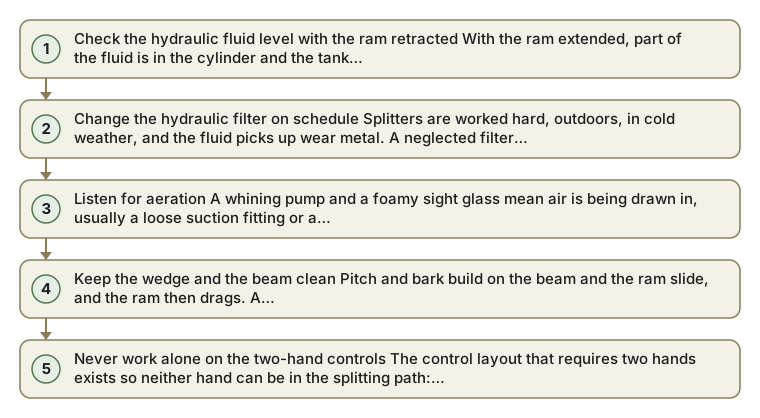
Check the hydraulic fluid level with the ram retracted
With the ram extended, part of the fluid is in the cylinder and the tank reads low. Every level check happens with the ram fully home, on level ground, or the reading means nothing.
-
Change the hydraulic filter on schedule
Splitters are worked hard, outdoors, in cold weather, and the fluid picks up wear metal. A neglected filter goes into bypass and the pump then sees everything the system has collected.
-
Listen for aeration
A whining pump and a foamy sight glass mean air is being drawn in, usually a loose suction fitting or a low tank. Running on aerated fluid damages the pump quickly.
-
Keep the wedge and the beam clean
Pitch and bark build on the beam and the ram slide, and the ram then drags. A scraper and a rag are the whole procedure.
-
Never work alone on the two-hand controls
The control layout that requires two hands exists so neither hand can be in the splitting path: a requirement of ANSI/OPEI B71.7, the standard covering powered consumer ram-type log splitters. Defeating it, or having a second person feed wood while you operate the lever, removes the entire protection.
The hand injuries from this machine come from repositioning a round while the ram is moving, and from a split piece pinching a hand against the wedge. Reposition only with the ram fully retracted and the lever released. A hydraulic leak is a second hazard: fluid under pressure can penetrate skin, so look for a leak with a piece of cardboard, never a hand.
Log splitters: questions
What engine size does a log splitter need?
Sized to keep the hydraulic pump fed, not to a horsepower target worth shopping on directly: tonnage, which describes the ram’s maximum force, is what to size against your worst rounds, and the engine on a given machine is whatever its maker paired with that pump to deliver it. A splitter that struggles or stalls under load more often has a pump or relief-valve problem than an underpowered engine, since the engine only has to sustain the pump, not do the splitting work itself.
Is tonnage or cycle time more important on a log splitter?
Tonnage only has to be enough for the worst round in your pile, a knotty seasoned elm rather than clean straight ash, and above that it buys nothing but weight and cost. Cycle time, the seconds to extend and retract, is what decides how much wood you split: a seven-second machine does twice the work per hour of a fifteen-second one whatever their ratings.
Do I need a log splitter that goes vertical?
If the wood you deal with is large, yes. A horizontal splitter asks you to lift every round onto a waist-high beam, and a big green round can weigh more than you want to lift a hundred times a day. That lifting, not splitting force, is what ends most sessions.
A machine that pivots to vertical lets you roll a heavy round into position and split it on the ground.
Why does the ram slow down as it enters the wood?
Because most engine-driven splitters use a two-stage hydraulic pump. At low pressure it delivers high flow so the ram races across the gap; when it meets resistance and pressure rises, it switches to a low-flow, high-pressure stage that applies the rated force slowly. The ram racing out and then visibly slowing in the wood is correct behavior, not a fault.
A machine that never speeds up has a pump or relief-valve problem.
How do I check the hydraulic fluid on a log splitter?
With the ram fully retracted, on level ground. With the ram extended, part of the fluid sits in the cylinder and the tank reads low, so a check taken then means nothing. Beyond the level, change the hydraulic filter on schedule, because a neglected filter goes into bypass and the pump then sees every bit of wear metal the system has collected outdoors in the cold.
Why does a log splitter need two-handed controls?
The two-hand control layout exists so that neither hand can be in the splitting path while the ram is moving. Defeating it, or having a second person feed wood while you work the lever, removes the entire protection, and the hand injuries from this machine come exactly from repositioning a round while the ram moves, so only reposition with the ram fully home and the lever released.
What is a kinetic log splitter, and how is it different from a hydraulic one?
A kinetic (flywheel) splitter stores energy in a spinning flywheel and releases it in a fraction of a second through a rack-and-pinion drive, splitting a round almost instantly rather than over the multi-second cycle a hydraulic ram takes: faster for high-volume splitting, at the cost of a sharper, less forgiving strike if a round is positioned badly. A hydraulic splitter’s slower ram gives more margin to reposition or stop mid-cycle; a kinetic splitter’s near-instant stroke does not, which is why kinetic machines lean even harder on correct hand placement and two-handed controls than a hydraulic one already does.
How many tons of log splitter do I need, is 10, 20 or 27 tons enough?
There is no single right number, because tonnage only has to beat your worst round, and wood varies enormously by species, moisture and how knotty or forked a given piece is, a straight, seasoned round that a 10-ton machine handles easily can be a real fight for a 20-ton machine if it is green, gnarled elm instead. Size to the nastiest rounds you regularly deal with, not the average ones, and remember that a higher tonnage rating buys margin on those rounds, not speed: cycle time is the separate spec that decides how fast the easy rounds go.
What is the difference between a one-stage and two-stage hydraulic pump on a log splitter?
A single-stage pump delivers one flow-and-pressure output throughout the cycle, which is simpler but slower overall since it can't prioritize speed during the empty-air part of the stroke. A two-stage pump delivers high flow (fast ram speed) at low pressure until resistance rises, then automatically shifts to low flow and high pressure to apply full splitting force: this is why the ram appears to race out and then visibly slow once it meets the wood.
Does a log splitter's hydraulic fluid need to be a specific type, or will any hydraulic oil work?
Most gas-engine splitters specify a particular hydraulic fluid grade (often AW32 or a similar anti-wear hydraulic oil) in the manual, and using the wrong viscosity can affect cold-weather starting behavior and long-term seal and pump wear: check the specific machine's manual rather than assuming any hydraulic fluid is interchangeable.
Can a log splitter's wedge be sharpened or replaced if it becomes dull or damaged?
Yes: the wedge is a wear part that dulls with use and can chip or bend on a knotty or metal-containing round, and most manufacturers sell replacement wedges or the wedge can be sharpened with a file or grinder the same way any splitting edge can, restoring its ability to initiate the split cleanly rather than crushing through the wood fiber.