Stump grinder or earth auger: access, utilities and rental cost
Resolve buried services, access and the required result before renting a stump grinder or earth auger. Utility markings do not prove the entire area is clear, and an operator must know the actual machine’s controls. Compare a fully itemized rental cost with a written professional quote for the same depth, cleanup and disposal.
An 811 request has limits
Enbridge’s safe-digging guidance directs callers to 811 before excavation, with notice requirements depending on the state. Follow the local waiting period and response process. Sunshine 811 explains that privately owned utilities need separate locating; irrigation, secondary electrical or other private lines can remain unmarked.
Do not probe unknown buried services by hand or start grinding because no paint is visible. Stop and resolve missing responses, private lines and required clearances first. A professional also needs that information; insurance does not make an unknown utility safe to strike.
Check the actual grinder’s reach and transport
Toro lists the SGR-13 model 22615 at 30 inches wide and 240 pounds, with an 11-inch below-grade cutting depth. Those are model specifications, not a universal rental-machine size or a promise that all roots will be removed.
| Item | Clarify in rental plan or quote |
|---|---|
| Depth and roots | Required below-grade result and roots included |
| Access | Actual width, slope and ground support |
| Transport | Rated ramps, restraints and vehicle capacity |
| Cleanup | Chips removed or left; backfill included? |
| Utilities | Public responses, private locating and work restrictions |
Add the full rental costs
For a hypothetical rental at $180, $60 delivery, $25 fuel and $40 permitted wear charges, total cost is $305 before taxes, locating and your time. A $350 professional quote for the same scope differs by $45, not $170. These are example inputs, not local advertised prices.
An auger adds binding torque
STIHL’s BT 131 specification includes a QuickStop auger brake. That is an identified machine feature, not proof every auger has a brake or that two people can safely operate a one-person design. Use the approved bit, handling and brake-test instructions.
For either machine, retain guards and required protection and follow bystander clearances. Stop and isolate power before clearing a bind or inspecting cutters. A stump near a foundation, a steep route or unresolved services warrants a qualified site assessment before choosing a rental.
Stump grinder or earth auger: rental or professional?
A stump grinder is rarely a machine worth owning for one job, which turns the real decision into rental against professional rather than which model to buy, and that decision turns on what is buried where the machine is about to go, not on the machine’s horsepower or wheel diameter. A single stump on open, cleared ground with utilities located and marked is a reasonable rental for an owner comfortable with mechanical equipment; a stump near a foundation, a septic field, a slope, or known buried services is a case for a professional carrying insurance for a wrong guess. An earth auger is a related but separate decision with its own hazard, a bind, where the bit catches a root or rock and transmits the stall to the operator’s arms, which is why a two-person auger exists for anything beyond light digging.
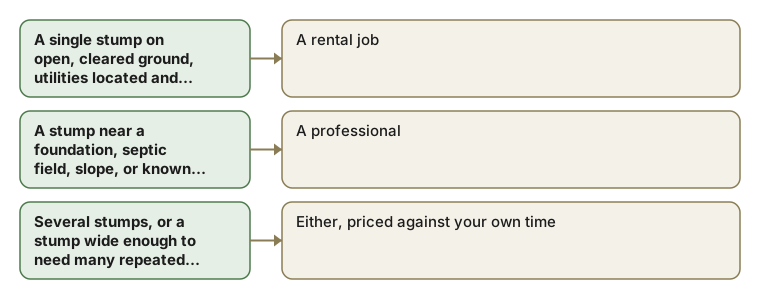
The decision is not the machine: it's what's under the ground
A stump grinder is not a machine most owners buy at all: it is bought or rented for a single occasional job, and the decision that matters is whether that job is a reasonable rental for an owner comfortable with mechanical equipment or a case for a professional who carries insurance for a wrong guess. Identify buried utilities, access and the extent of the stump before comparing rental machines.
| The job | Reasonable call | Why |
|---|---|---|
| A single stump on open, cleared ground, utilities located and marked | A rental job | A locate call is free and required in most jurisdictions; once buried lines are confirmed clear, this is a mechanical job an owner can do safely. |
| A stump near a foundation, septic field, slope, or known buried services | A professional | The margin for a wrong guess near a structure or a utility line is a liability, not a savings, and a professional carries insurance for exactly this. |
| Several stumps, or a stump wide enough to need many repeated passes | Either, priced against your own time | A rental clears a wide stump in more passes rather than being unable to; whether that time is worth the rental savings is the actual comparison. |
Whichever way the decision lands, clearing the stump of rocks, wire and metal before grinding and taking full-depth bites in repeated shallow passes rather than one deep pass are the two habits that separate a clean job from a thrown-debris incident, covered in full on stump grinders and earth augers.
An earth auger is a different decision, with a different hazard
An earth auger's main injury is a bind, the bit catching a root or rock and transmitting that stall as sudden rotational force to the operator's arms, which is why a two-person auger exists for anything beyond light-duty digging and why stance and grip matter as much as the machine's power. Neither class has its own dedicated handheld safety standard the way a chainsaw or an edger does; this site says so rather than citing one that does not exist.
A stump grinder's cutting wheel throws debris with real force through soil that reliably contains old wire, rock and buried utilities. A locate call and a full face shield matter more to the outcome of this job than the machine's rated power. Never grind before a locate is confirmed clear.
Stump grinder or earth auger: questions
Should I rent a stump grinder or hire a professional?
A single stump on open, cleared ground with utilities located and marked is a reasonable rental job for an owner comfortable with mechanical equipment. A stump near a foundation, a septic field, a slope, or known buried services is a case for a professional who carries insurance for a wrong guess.
Do I need to call before renting a stump grinder?
Yes: a utility locate is free and required in most jurisdictions before any mechanical excavation, including stump grinding, and it should be confirmed clear before collecting the rental machine.
What is the main hazard with an earth auger instead of a stump grinder?
A bind, the bit catching a root or rock and transmitting that stall as sudden rotational force to the operator’s arms, rather than the thrown-debris hazard a stump grinder carries. A two-person auger exists specifically to manage this force for anything beyond light-duty digging.
Should I just buy a stump grinder instead of renting one?
Usually not, for the same reason the guide is framed as rental versus professional rather than rental versus purchase. A stump grinder is a one-job machine for most homeowners, used for a few hours a handful of times over a property’s life, and the storage, maintenance and cost of owning one rarely pencils out against a day’s rental. Owning one starts to make sense only for someone doing this regularly, such as a landscaper, at which point it is a business tool rather than a homeowner purchase.
What should I clear from around a stump before renting a grinder, regardless of what's buried underground?
Rocks, wire, and any metal debris near the stump: the grinding wheel throws debris with real force, and hitting embedded rock or wire at speed is both a thrown-object hazard and a fast way to damage the cutting wheel on a rental unit you're responsible for.
How deep does a typical rental stump grinder cut, and is that usually enough?
Depth varies by specific rental model, but most homeowner-accessible rental grinders cut a modest distance below grade: enough to clear the stump for regrading and reseeding but not necessarily enough to eliminate all root regrowth from a species prone to suckering. Confirm the specific rental unit's depth capability against your goal (cosmetic clearing versus preventing regrowth) before assuming any rental grinder achieves the same result.
Does the size (diameter) of the stump change whether this is a rental or professional job?
Size affects how many passes a rental job takes more than whether it should be attempted at all: the guide frames a wide stump needing many repeated passes as still a valid rental candidate on open, cleared ground, priced against your own time versus the rental savings, rather than treating a large diameter alone as automatically requiring a professional.
Is a stump grinder rental typically self-service, or does the rental company operate it?
Most stump grinder rentals are self-service equipment you operate yourself, which is exactly why the guide frames the decision as whether you're "comfortable with mechanical equipment": a rental company handing over the machine expects the renter to run it, unlike hiring a professional tree service where an operator comes with the equipment.
What happens to the wood chips and debris left after grinding a stump?
Grinding produces a substantial pile of wood chips and soil mixed together at the grind site, which needs to be removed or worked into the surrounding area separately from the grinding job itself: factor this cleanup step into the total time and effort of a rental job, since it isn't part of what the grinder itself handles.
Is a two-person earth auger always required, or only for certain soil conditions?
A two-person auger becomes worthwhile for anything beyond light-duty digging specifically because of the bind hazard: a bit catching a root or rock transmits that stall as sudden rotational force to the operator's arms, and having two people manage that force is a real safety improvement for harder digging, denser soil, or ground more likely to contain roots and rocks, not a requirement tied to a specific soil type alone.
Does homeowner's insurance typically cover an injury from a rented stump grinder?
This varies by policy, so confirm it with your own insurer before renting, since coverage for a self-operated rental injury can differ meaningfully from coverage for hiring an insured professional: confirm the coverage before choosing a self-operated rental.
Stump grinders and earth augers
A stump grinder and an earth auger are both ground-engaging attachments bought for a single occasional job rather than routine use, and both share a hazard that has nothing to do with the cutting edge itself: what is buried where the machine is about to go. A stump grinder’s cutting wheel throws debris with real force through soil that reliably contains old wire, rock and buried utilities, which is why a locate call and a full face shield matter more than the machine’s horsepower rating. An earth auger’s main injury mode is a bind, the bit catching on a root or rock and transmitting that stall as sudden rotational force to the operator, which is why a two-person auger exists and why stance matters as much as grip strength.
Neither class has its own dedicated handheld safety standard the way a chainsaw or an edger does, and the guide says so rather than citing one that does not exist.
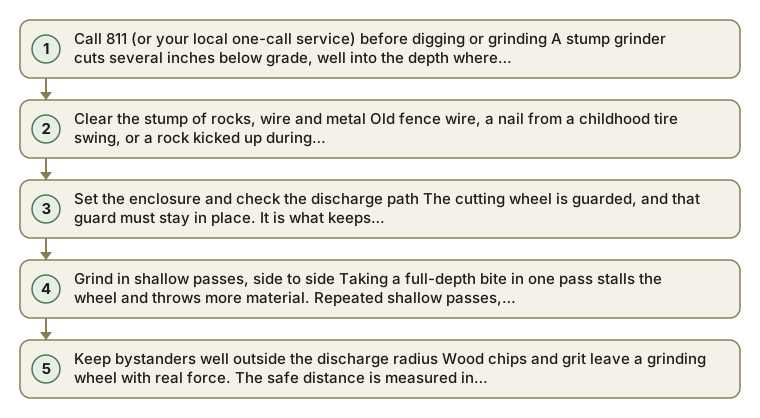
A stump grinder is a wheel, a guard, and what is under the ground
A stump grinder removes a stump by spinning a cutting wheel, studded with replaceable carbide teeth, down through the wood and the surrounding soil, rather than pulling or burning the stump out. The wheel does the same job regardless of the machine's size; what changes between a homeowner walk-behind unit and a towable or self-propelled commercial machine is wheel diameter, engine power and how deep and wide a stump it can clear in a reasonable number of passes. None of that changes the two hazards that matter most: buried utilities beneath the stump, and thrown debris from a wheel running through soil that inevitably contains rocks and old buried metal.
| Question | What decides it |
|---|---|
| How deep can it grind? | Wheel diameter and the machine’s reach below grade: typically several inches to about a foot on homeowner-class machines, deeper on commercial units. Roots beyond that depth are left in place and simply rot over time. |
| How wide a stump can it clear? | Determined by making repeated passes across the diameter, not by a single specification: a small wheel clears a wide stump in more passes rather than being unable to do it at all. |
| Can it hit something dangerous underground? | Yes: buried electrical, gas, water, or communication lines, and old debris like wire, pipe or masonry. This is why a utility locate before grinding is not optional. |
| Is rental appropriate, or should this be hired out? | A single stump on open, cleared ground is a reasonable rental job for an owner comfortable with mechanical equipment. Stumps near a foundation, a septic field, a slope, or known buried services are a case for a professional who carries the insurance for a wrong guess. |
The sequence that keeps a rental job safe
-
Call 811 (or your local one-call service) before digging or grinding
A stump grinder cuts several inches below grade, well into the depth where buried electrical, gas and communication lines run. Utility locating is free and required in most jurisdictions before any mechanical excavation, including stump grinding.
-
Clear the stump of rocks, wire and metal
Old fence wire, a nail from a childhood tire swing, or a rock kicked up during the tree’s life will not be visible once the grinder starts, and any of them can be thrown or shatter a tooth. Sweep and probe the area by hand first.
-
Set the enclosure and check the discharge path
The cutting wheel is guarded, and that guard must stay in place. It is what keeps thrown debris on a controlled path rather than an unpredictable one. Confirm nothing is standing in the discharge arc before starting.
-
Grind in shallow passes, side to side
Taking a full-depth bite in one pass stalls the wheel and throws more material. Repeated shallow passes, sweeping the wheel across the stump, remove wood faster overall and with less thrown debris per pass.
-
Keep bystanders well outside the discharge radius
Wood chips and grit leave a grinding wheel with real force. The safe distance is measured in many feet, not a polite few steps, and it applies to pets as well as people.
Thrown debris from a stump grinder is a documented cause of serious eye and facial injury even to trained operators, which is why arboricultural operations covering this equipment class, ANSI Z133, address guarding and clearance around the machine directly. Safety glasses are not sufficient; a full face shield over safety glasses, plus hearing protection, is the standard loadout for anyone operating or standing near a running grinder.
Earth augers: a power head and an interchangeable bit
An earth auger, used for fence posts, deck footings, and planting, is a rotating helical bit driven by a one-person handheld power head, a two-person power head, or a mount on a skid-steer or tractor three-point hitch. The bit diameter is chosen for the job (a small bit for a fence post, a larger one for a footing), and bits are generally interchangeable across power heads of the same mounting standard, which is the main reason to check compatibility before buying a bit separately from the power head.
| Factor | What it means in use |
|---|---|
| Bit diameter | Sets hole size; larger bits need more torque and stall more easily in dense or rocky soil. |
| One-person vs. two-person power head | A two-person head is heavier and more powerful, and critically, its second handle exists because an auger that catches on a root or a rock transmits that stall as sudden rotational force to the operator. |
| Soil type | Clay and rocky ground bind and stall an auger far more than loose or sandy soil; the same bit that drills quickly in one yard can bind repeatedly next door. |
The single most common auger injury is a catch: the bit binds on a root or a buried rock and the whole machine twists violently instead of the bit stopping. A two-person auger is operated with both people committed to releasing the throttle together at any sign of a bind, not one person holding on while the other decides. A one-person auger should be held firmly enough to control a sudden stop, and the operator’s stance should allow stepping away from the direction of twist.
Neither of these has its own dedicated OPEI handheld standard
Unlike chainsaws, trimmers, blowers, hedge trimmers and edgers, each of which has its own number in the ANSI/OPEI B175 series, earth augers do not appear as a distinct class in that series, and a walk-behind or towed stump grinder is likewise outside the B175 handheld scope. Arboricultural use of this equipment falls under the broader ANSI Z133 arboricultural operations standard rather than a product-specific OPEI number. That is a real gap in the standards landscape for these two classes, not an oversight on this page: we report it rather than inventing a citation that does not exist, the same approach taken for aerators and dethatchers.
Stump grinders and earth augers: questions
Do I need to call before grinding a stump?
Yes. A stump grinder cuts several inches below grade, well into the depth where buried electrical, gas, water and communication lines run, and a utility locate (811 in the United States) is free and required in most jurisdictions before mechanical excavation of any kind, stump grinding included.
What limits a stump grinder’s cutting depth?
Typically several inches to about a foot below grade on homeowner-class machines, more on commercial units, set by the wheel’s diameter and the machine’s reach rather than a single published specification. Roots beyond that depth are simply left in place to rot over time rather than being removed.
What causes most earth auger injuries?
A bind: the bit catching on a root or a buried rock and transmitting that sudden stop as violent rotational force to the operator, rather than a clean cutting injury. A two-person power head exists specifically so both operators can release the throttle together the instant a bind starts.
Is a post hole digger the same thing as an earth auger, and is a battery-powered one worth it?
"Post hole digger" and "earth auger" name the same machine: a rotating bit that bores a hole rather than the older hand-operated clamshell tool some people also call by that name. A battery-powered auger suits occasional light-duty use (a few fence post holes in soil without much rock) with less noise and no mixed fuel; a gas two-person power head still wins for repeated holes, harder ground, or anything approaching a fence line’s worth of postholes in one day, where sustained torque and runtime matter more than convenience.
Should I rent a stump grinder or hire it out?
A single stump on open, cleared ground with no known buried services is a reasonable rental job for someone comfortable with mechanical equipment. A stump near a foundation, a septic field, a slope, or a suspected utility line is a case for a professional carrying the insurance for a wrong guess.
What is the difference between a one-person and a two-person earth auger, beyond just size?
The second handle on a two-person auger exists specifically because the bit binding on a root or rock transmits that stall as sudden rotational force strong enough that one person alone may not be able to control it safely. Both operators are meant to release the throttle together at any sign of a bind, rather than one holding on while the other decides what to do.
Can a stump grinder or earth auger hit a buried utility even after a locate call confirms the area is clear?
A locate call marks known utility lines, but older, unrecorded, or improperly documented lines, an old irrigation pipe, an abandoned line, or a shallow private line the homeowner installed without a permit, can still exist without appearing in the locate. Digging or grinding with appropriate caution even after a clear locate, rather than treating the locate as an absolute guarantee, remains good practice.
Does the size of the stump grinder's cutting wheel change which safety precautions matter?
No: the core hazards (buried utilities beneath the stump, and thrown debris from soil containing rock and old metal) apply identically to a small homeowner walk-behind unit and a larger commercial towable machine. Wheel diameter and engine power change how many passes a job takes, not which precautions are necessary.
Is arboricultural ANSI Z133 the only standard relevant to stump grinders and earth augers?
It's the primary one the guide cites, since it addresses arboricultural operations broadly including guarding and clearance around this equipment class specifically, but check whether a specific commercial-grade machine also carries other general machinery safety certifications relevant to its power source (engine emissions standards, for instance) beyond the operational Z133 guidance.
Why do bits need to match the power head's mounting standard when buying an earth auger bit separately?
Because the mounting standard determines the physical and drive-shaft interface between the bit and the power head: a bit and power head from different mounting standards simply won't attach or transmit torque correctly, which is why checking compatibility before buying a bit separately from an already-owned power head matters as much as picking the right bit diameter for the job.
Do the carbide teeth on a stump grinder wheel need periodic replacement?
Yes: the replaceable carbide teeth studded around the cutting wheel wear down and can chip from contact with rock or buried metal, and a wheel with worn or missing teeth grinds noticeably slower and less effectively even though the wheel itself is undamaged. Most manufacturers sell replacement teeth as a routine wear-part purchase rather than requiring a whole new wheel.