Choose a tiller for soil, rows and controllable depth
Choose a tiller for soil condition, row spacing and the control you can maintain. Tine location and rotation affect behavior, but no layout guarantees that it can break every patch of sod or compacted clay.
Compare actual depth adjustment, traction and approved use. A cultivator for established beds may be the more practical tool for narrow rows.
Check working width separately from transport width
Honda’s FG110 page gives a nine-inch regular tilling width and a six-inch configuration with outer tines removed as instructed. That changes the worked strip; it does not prove the whole machine fits through a six-inch gap.
In an example 36-inch-wide bed, ignoring overlap and edge clearance, nine-inch strips require four passes and six-inch strips require six. Narrowing the working configuration increases this idealized pass count by 50 percent, while potentially avoiding plants or reaching a tighter row.
| Condition | Compare |
|---|---|
| Existing narrow beds | Working width, plant clearance and depth adjustment |
| Larger cultivated plot | Traction, turning space and operator effort |
| Unbroken or compacted ground | Permitted use, repeated shallow passes and soil condition |
| Roots, stones or buried material | Whether tilling is appropriate at all |
Do not infer the whole transmission from the engine
The FG110K1 manual identifies a worm-gear transmission and a separate GX25T engine. This is one design; another tiller may have a different transmission and service method. Do not add gearbox oil or grease based on generic small-engine advice.
Buried services and wet soil change the job
Use the applicable one-call process before disturbing soil and account for private services. NC811 explains that private lines are not covered by its ordinary utility marking. A clear-looking garden may still contain irrigation or power installed by a prior owner.
Follow the actual operator manual for moisture conditions, depth and handling. Stop for unexpected binding or hard objects. Never pull wire or roots from moving tines, and never use a foot to clear or push material near them.
A tiller prepares soil; it does not process branches. For that separate task, use the chipper/shredder selection guide.
How to choose a tiller
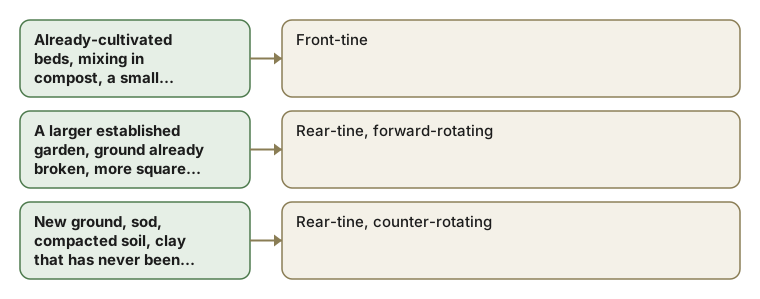
A tiller purchase most often goes wrong on layout, not size: front-tine, rear-tine forward-rotating, and rear-tine counter-rotating are three different machines, and the ground you are working decides which one fits, not the square footage of the plot or a "bigger is safer" instinct. Already-cultivated beds and small vegetable plots are a front-tine machine’s job; a larger established garden with ground already broken favors a rear-tine, forward-rotating unit that drives itself on powered wheels; new ground, sod or unbroken clay needs the counter-rotating rear-tine layout, the only one of the three that reliably bites into soil the others skip across. A wood chipper, often shopped for in the same season, is a related but entirely separate purchase sized by the material generated rather than the single largest branch on the property.
The ground decides the layout, not the size of the plot
A tiller purchase goes wrong most often by size (a "bigger is safer" instinct) rather than by layout, when layout is what the ground requires. The three arrangements are different machines, not sizes of one machine, and the wrong one for the ground presents as "this tiller doesn't work" when the tiller is working exactly as designed for soil it was never meant to break.
| Your ground | Layout that fits | Why |
|---|---|---|
| Already-cultivated beds, mixing in compost, a small vegetable plot worked every season | Front-tine | Lightest, cheapest, and sufficient once the ground is already broken: its tines pull the machine forward through soil that offers little resistance. |
| A larger established garden, ground already broken, more square footage to cover | Rear-tine, forward-rotating | Powered wheels move the machine so the tines only have to dig, which is far less operator effort over a bigger area. |
| New ground, sod, compacted soil, clay that has never been tilled | Rear-tine, counter-rotating | Tines bite downward against the direction of travel: the only one of the three that reliably opens ground the others skip across. |
The tillers page covers what wears on each layout and how the gearbox oil schedule works; this page exists for the decision of which layout to buy in the first place, which the ground answers before the budget does.
Wood chipper: a related but separate purchase
A tiller and a wood chipper are shopped for in the same season by the same owner far more often than the tools are related: a tiller breaks ground, a chipper reduces branches, and neither substitutes for the other. If a chipper is also on the list, size it by the material you generate, not the single largest branch on the property: a chipper's rated maximum branch diameter describes a best case, green, straight wood, fed squarely, sharp blade, and dry, forked or knotty material of the same diameter will stall it well under the rating. See wood chippers and shredders for chipper against shredder and the intake hazard that governs the whole class.
Both a tiller's tines and a chipper's intake are hand-and-arm hazards that act faster than a reaction time allows: a tine catching wrapped debris, or a powered infeed roller pulling a sleeve in behind a branch. Clear a wrapped tine only with the plug lead disconnected, and never reach into a chipper hopper or chute with the engine running, regardless of how stuck the material looks.
How to choose a tiller: questions
What size tiller do I need for a small garden?
Size matters less than layout for a small, already-cultivated garden: a lightweight front-tine tiller is sufficient once the ground is already broken, and buying a larger rear-tine machine for that job adds cost and weight without adding capability you need.
Can a front-tine tiller be used to break new ground?
Not effectively: a front-tine tiller is pulled forward by its own tines and needs soil that is already broken to get purchase, so it bounces or skips across compacted ground or sod regardless of condition. New or unbroken ground calls for a rear-tine, counter-rotating machine instead.
Should I buy a tiller and a wood chipper together?
Only if both jobs recur on your property: a tiller breaks ground and a chipper reduces branches, and neither substitutes for the other. Size each purchase separately against the work it does rather than bundling them because they are shopped for in the same season.
What is the difference between a front-tine and rear-tine tiller in how they're powered?
A front-tine tiller's tines are directly connected to the engine and the machine is pulled forward by the tines' own digging action into the soil ahead of it. A rear-tine tiller separates propulsion from tilling, powered wheels move the machine forward while the rear tines dig independently, which is what lets a rear-tine machine handle tougher ground without relying on the tines alone to drag it through.
Why does a counter-rotating tiller bite into unbroken ground better than a forward-rotating one?
A counter-rotating tine spins against the direction of travel, so each tine strikes downward into the soil rather than skimming across the surface the way a forward-rotating tine does on hard, unbroken ground. That downward bite is what lets it open sod or compacted clay that a forward-rotating machine's tines simply bounce or skip across.
Can a rear-tine tiller be used for light, already-cultivated garden work, or is it overkill?
It can be used for light work, but its added weight, cost, and complexity are wasted on ground a front-tine machine already handles well: the guide recommends matching the machine to the ground specifically to avoid this kind of overkill purchase for already-broken soil.
How often does a tiller's gearbox oil need to be checked?
The specific interval is machine-dependent and covered on the tillers equipment page rather than this buying page, but the guide notes that checking gearbox oil is part of what differs in ongoing maintenance between the three layouts: worth reviewing on the equipment page before committing to a specific layout if maintenance simplicity matters to the decision.
Does tine width matter as much as the front-tine vs. rear-tine layout decision?
Layout matters more: tine width mainly affects how many passes a given bed takes, while layout determines whether the machine can engage the ground at all. Get the layout right for your ground first; tine width is then a secondary decision about how much area you cover per pass within whichever layout you've chosen.
Is an electric or battery tiller a real option, or is tilling strictly a gas-engine job?
Electric and battery tillers exist and work well for light-duty, already-cultivated garden beds: the same ground a front-tine gas machine would handle. They generally lack the sustained torque for breaking new ground or working larger areas, which remains gas-engine territory for the rear-tine layouts the guide describes.
What is a "mini-tiller" or "cultivator," and is it a fourth layout?
A mini-tiller or cultivator is typically a smaller, lighter version of the front-tine layout, designed for very light surface cultivation, mixing in compost or weeding between rows, rather than a different fourth arrangement. It fits the same "already-cultivated, light work" category as a standard front-tine machine, just at a smaller scale.
Does tine depth adjustment matter when choosing between the three tiller layouts?
Depth adjustment range is a feature to check within whichever layout fits your ground, but it doesn't change the underlying layout decision: a front-tine machine with excellent depth adjustment still can't break unbroken sod the way a counter-rotating rear-tine machine can, regardless of how deep its tines are set.
Tillers
A tiller is chosen by tine layout, and the three layouts are different machines rather than sizes of one machine. A front-tine unit is pulled along by its own tines and is for beds you have already cultivated; a rear-tine, forward-rotating unit drives itself on powered wheels and lets the tines only dig; a counter-rotating rear-tine unit turns its tines against the direction of travel and is the only one of the three that reliably opens new ground or sod. Buying a front-tine machine for ground you have not already broken is the common mistake, and it presents as a machine that bounces rather than digs: the tines failing to get purchase in that ground.
Chippers and shredders, which shared the guide before it was split, are now their own page.
Three tiller layouts, for three different jobs
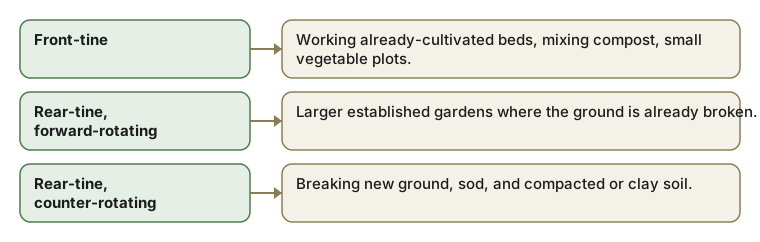
Tillers are separated by where the tines are and which way they turn, and the three arrangements are different machines rather than sizes of one machine.
| Layout | What it is for | How it behaves |
|---|---|---|
| Front-tine | Working already-cultivated beds, mixing compost, small vegetable plots. | The tines pull the machine forward and you hold it back. In hard ground it skips across the surface instead of digging. |
| Rear-tine, forward-rotating | Larger established gardens where the ground is already broken. | Powered wheels move the machine; the tines only dig. Far less operator effort. |
| Rear-tine, counter-rotating | Breaking new ground, sod, and compacted or clay soil. | Tines turn against the direction of travel and bite downward. This is the one that opens ground the others cannot. |
The practical rule is that a front-tine machine is for soil you have already tamed and a counter-rotating rear-tine machine is for soil you have not. Buying the first for the second job is the common mistake and it presents as a machine that "bounces": because the tines cannot get purchase in that ground.
Chippers and shredders
A tiller and a chipper used to share this page because they share the same small four-stroke service story. The chipper's own numbers, maximum branch diameter, chipper against shredder, and the intake hazard that is the defining injury in the class, are covered in full on wood chippers and shredders.
What wears on a tiller
The wear items are the tines themselves, they shorten and round over, gradually digging shallower while the operator concludes the ground is getting harder, and the tine shaft seals, which fail after the shaft has been run in wet clay. A tiller shares a gearbox with its own oil, separate from the engine oil, that is checked on a schedule and forgotten in practice, and it shares the small-engine service set on the engines pages. Most tillers are stored for most of the year, which makes storage the main determinant of whether the machine starts again in spring.
Tillers: questions
What is the difference between front-tine and rear-tine tillers?
Tillers work soil; chippers process woody material. A front-tine tiller is pulled forward by its own tines and is for soil you have already cultivated; in hard ground it skips across the surface instead of digging. A rear-tine tiller drives its wheels while the tines only dig, so it takes far less operator effort, and the counter-rotating version bites downward and is the one that opens new ground.
Which tiller do I need to break new ground or sod?
A rear-tine, counter-rotating tiller. Its tines turn against the direction of travel and bite downward, which is what opens compacted soil, clay and sod that the other layouts cannot. Buying a front-tine machine for that job is the common mistake, and it shows up as a machine that bounces: the tines failing to get purchase rather than a defect in the machine.
What wears out on a tiller?
The tines shorten and round over, so the machine digs shallower while the operator concludes the ground is getting harder, and the tine-shaft seals fail after the shaft has run in wet clay. Both the tines and the seals are wear items rather than faults, and a tiller that suddenly bounces instead of digging on ground it used to handle usually has worn tines, not a broken one.
What is a counter-rotating tine, and why does it bite into ground a forward-rotating tine cannot?
A counter-rotating tine spins opposite to the direction the machine travels, so each tine strikes downward into the soil as the machine moves forward, rather than skimming across the top of hard or unbroken ground the way a forward-rotating tine does. That downward strike is what lets a counter-rotating rear-tine tiller open sod or compacted clay the other layouts simply bounce across.
Does a tiller's gearbox need its oil changed on a schedule like an engine does?
Yes: the gearbox that transmits power to the tines holds its own separate oil supply, distinct from the engine's crankcase oil, and it needs checking and changing on its own schedule (commonly annual or seasonal) even though it's a less commonly remembered maintenance item than engine oil.
Why do tiller tines need to be replaced eventually rather than sharpened indefinitely?
Tines shorten and round over from abrasive wear against soil and rock, and once they've worn down significantly, sharpening the remaining edge doesn't restore the tine's original digging depth or geometry: a heavily worn tine set simply cannot dig as deep as a new one regardless of how sharp its edge is kept.
Can a tiller be used to mix compost into an already-planted garden bed without damaging existing plants?
Shallow tilling close to established plants risks damaging their root systems, so this is generally a job for careful hand cultivation or a small, controllable front-tine unit at a shallow depth rather than a full-power tilling pass: check the specific plants' root depth and sensitivity before tilling near them with any powered tiller.
Does tine width determine how many passes a tilling job takes?
Yes: a wider tine path covers more ground per pass, directly reducing the number of passes needed to till a given bed width, which is why tine width is a genuine sizing consideration once the correct layout (front-tine, rear-tine, or counter-rotating) for your ground has already been decided.
Why does a front-tine tiller bounce instead of digging when used on hard, unbroken ground?
Because a front-tine tiller relies on its own tines' bite into the soil to pull the machine forward: on ground that is too hard or compacted for the tines to get initial purchase, the tines skip across the surface instead of digging in, which reads to the operator as the machine bouncing rather than as the specific ground-hardness mismatch it is.
Does tine speed (RPM) matter as much as tine depth for how well a tiller works?
Both interact: a faster tine speed breaks up soil into smaller pieces per pass but can also cause the tiller to skip or bounce on harder ground if the tines spin too fast to bite in, similar to the front-tine-on-hard-ground problem. Manufacturers set tine speed for a given layout's typical use case; adjusting depth setting is usually the more direct control an operator has over how aggressively the machine digs.
Can a tiller be attached to a riding mower or tractor instead of being its own standalone machine?
Tow-behind or three-point-hitch tiller attachments exist for tractors and some riding mowers, functioning as an implement powered by the tractor's PTO (power takeoff) rather than carrying their own engine: a different category from the standalone front-tine, rear-tine, and counter-rotating walk-behind machines the guide primarily covers, generally used for larger-scale ground preparation than a home garden.