Choose a chipper or shredder by feed material and limits
Choose a chipper or shredder from the material you regularly need to process and the exact chute limits. A combined machine can give each opening a different capacity. Do not assume a branch that fits one chute is permitted in another, or that engine size makes an oversized branch acceptable.
Two openings can have very different limits
Champion’s 201352 specification describes a 338 cc machine with a three-inch chipper capacity and a shredder chute for suitable material no more than half an inch. The sixfold diameter difference is not an interchangeable rating.
| Opening in the cited model | Published limit | Decision |
|---|---|---|
| Chipper | Branches up to 3 inches | Use only approved material and feed method |
| Shredder | Suitable material 0.5 inch or less | Do not route larger branches here |
For a three-quarter-inch branch, the diameter is 50 percent over the half-inch figure. It is below the chipper’s three-inch maximum, but that alone does not prove the branch’s shape, contamination or condition is acceptable. Read the actual manual’s material restrictions.
Capacity does not guarantee throughput
Record the normal branch sizes, quantity, access and disposal plan. A manufacturer’s maximum is not a promise of uninterrupted feeding at that size. Ask about real material similar to yours, replacement knives and service cost before buying or renting.
Powered infeed needs its own training
NIOSH’s chipper hazard alert addresses workers being caught in chippers and stresses training and safe work practices. Follow the machine-specific feed position, clothing, exclusion area and stop controls. Never reach into an opening to advance material.
Before clearing a clog or servicing knives, stop, isolate power and wait for the rotor to stop under the manual’s procedure. An engine that has stopped does not establish that a heavy rotor is stationary. Do not open an access cover until it is safe.
Not every chipper has a separate oil-filled gearbox, and not every knife is reversible. Identify the actual drive and cutting assembly before ordering parts or applying a generic service routine. Compare rental or professional disposal if the job is occasional.
How to size a wood chipper
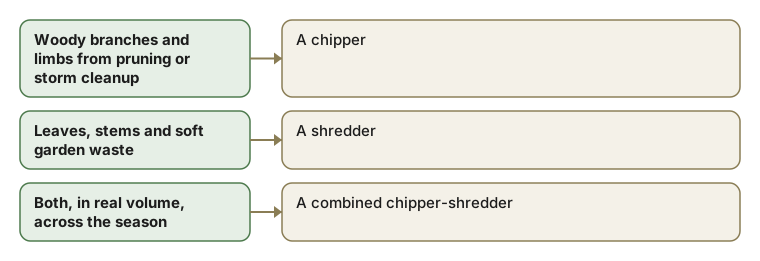
A chipper’s rated maximum branch diameter describes a best case, green, straight wood, fed squarely, with a sharp blade, and dry, forked or knotty material of the same diameter stalls the machine well under that number, which makes sizing against the single largest branch on the property the standard buying mistake in this class. The more useful question is what you generate in a normal season: mostly woody branches call for a chipper, mostly leaves and soft garden waste call for a shredder, and real recurring volume of both is what justifies the added cost of a combined unit. Choose hand feeding or powered infeed around the normal volume of material and the handling precautions each machine requires.
Maximum branch diameter is a ceiling you should rarely approach
A chipper's headline number describes the best case a laboratory would set up: green, straight wood, fed squarely into a sharp blade. Dry, forked, knotty or previously-cut material of the same diameter stalls the machine well under its rated maximum. Sizing a chipper against the single largest branch you might ever generate, rather than the material you produce in a normal season, is the standard buying mistake in this class: reserve the maximum diameter for occasional suitable branches and size for the material you normally produce.
| What you mostly generate | Fits best | Why |
|---|---|---|
| Woody branches and limbs from pruning or storm cleanup | A chipper | Blades against a fixed anvil slice woody material; a shredder’s flails are built for soft material and will not process a branch cleanly. |
| Leaves, stems and soft garden waste | A shredder | Flails or hammers smash soft material into mulch; feeding leaves through a chipper chute packs it rather than processing it. |
| Both, in real volume, across the season | A combined chipper-shredder | Two mechanisms in separate, non-interchangeable chutes: worth the extra cost only if both jobs recur. |
How material is driven into the cutting head matters as much as the rating: a homeowner-scale machine is gravity- and hand-fed, relying on the operator to let go before the machine takes over, while a larger tow-behind unit adds a powered infeed roller that pulls material in on its own. A powered infeed is more capable, and it is also the reason those larger machines carry an emergency shutoff within reach of the hopper: a real cost-and-safety tradeoff to weigh against how much material needs chipping in a season, covered in full on wood chippers and shredders.
Never feed material by hand past the point a machine can take it on its own, and never reach into a chute or hopper for any reason with the engine running. On a powered-infeed machine, a sleeve or glove caught by the roller pulls the arm in behind it faster than a reaction time allows: this is the injury the class's safety standard exists to prevent.
How to size a wood chipper: questions
What size wood chipper do I need?
Size it against the material you generate in a normal season, not the single largest branch you might ever cut: a chipper’s rated maximum branch diameter describes a best case (green, straight wood, sharp blade) that dry or forked material of the same diameter will not reach.
Is a chipper or a shredder the right machine for leaves?
Use a shredder for leaves and fine material. A chipper’s blades against a fixed anvil are built for woody branches; a shredder’s flails or hammers smash soft material like leaves and stems into mulch. Feeding leaves through a chipper’s chute packs it rather than processing it.
Is a powered infeed roller worth paying for on a wood chipper?
Only if the volume of material justifies it: a powered infeed pulls branches in on its own rather than relying on the operator to feed them, which is more capable but also requires an emergency shutoff within reach and stricter attention at the hopper, a real safety tradeoff against a homeowner-scale, hand-fed machine.
Why does dry or forked wood stall a chipper well under its rated maximum diameter?
Because the rated maximum is measured under a laboratory best case, green, straight wood fed squarely into a sharp blade, and dry wood is harder and more brittle while forked or knotty material presents an irregular cross-section the blade can't engage cleanly, both of which increase the effective resistance the engine has to overcome at any given diameter.
Does a chipper's engine size matter more than its rated maximum branch diameter?
They're related but not interchangeable specifications: engine size determines how much resistance the machine can push through, while the rated maximum diameter reflects both the engine and the physical opening the material must fit through. A larger engine on a chipper with a narrow chute still can't process a branch too wide to physically enter, and a wide chute with an underpowered engine will stall on green wood well under that physical opening size.
How do I know if I generate enough branch material each year to justify a chipper rather than just bundling for yard-waste pickup?
The threshold depends on your municipality's yard-waste pickup rules and how much labor bundling takes relative to a chipper's cost: a property with regular pruning or storm cleanup that generates a trailer-load or more of branches per season is a stronger candidate than one with only occasional, small-volume trimming.
Is chipped mulch from my own yard waste as good as bought mulch?
It serves the same basic purpose (moisture retention, weed suppression) but composition varies with whatever species and condition of wood went through the chipper, unlike commercial mulch which is typically more uniform: freshly chipped wood also benefits from aging before use close to plant stems, since fresh wood chips can temporarily tie up soil nitrogen as they begin to break down.
Can a wood chipper process material with the leaves still attached?
A chipper's blade-and-anvil mechanism is built for woody material and processes leaves poorly regardless of whether they're attached to a branch: leaves attached to a branch being chipped will pass through along with the wood, but a separate leaf-and-soft-material load is a shredder's job, not a chipper's, per the guide's own chipper-versus-shredder guidance.
Does a tow-behind wood chipper need a specific vehicle hitch class to use safely?
Yes: like any towed equipment, a tow-behind chipper has a rated weight the towing vehicle's hitch and rating must meet or exceed, which is a separate specification from the chipper's own branch-diameter and engine ratings. Check the specific chipper's tow weight against your vehicle's towing capacity before assuming any hitch will do.
Is there a chipper size appropriate for a small suburban yard with occasional pruning?
Yes: a small homeowner-scale, gravity- or hand-fed electric or gas chipper rated for branches up to a few inches in diameter covers occasional residential pruning well, without the cost, size, or powered-infeed safety considerations that come with the larger tow-behind machines the guide also covers.
Does a chipper's discharge chute direction matter when sizing or choosing one?
It matters for where chipped material lands relative to a truck bed, trailer, or pile you're building, which is a practical workflow consideration separate from the sizing questions (branch diameter, chipper vs. shredder) the guide focuses on: check whether a specific model's chute rotates or adjusts if discharge placement matters for your setup.
Should I rent a wood chipper for a single large cleanup rather than buying one?
For material that recurs every season from ongoing pruning, the ownership math shifts toward buying the sooner a chipper would otherwise be rented more than once or twice a year.
Wood chippers and shredders
A chipper’s headline number, maximum branch diameter, describes the best case: green, straight wood, fed squarely, with a sharp blade. Dry, forked or knotty material of the same diameter stalls the machine, so the rating is a ceiling you rarely reach in practice rather than a figure to size against your largest branch. A chipper cuts woody material with blades against an anvil; a shredder smashes soft material, leaves, stems, garden waste, with flails or hammers; a combined unit has both, in separate chutes that are not interchangeable.
The mechanism that defines this class’s safety record is the intake: a hand-fed homeowner machine relies on the operator letting go in time, while a larger machine with a powered infeed roller pulls material in on its own and needs a genuine emergency stop within reach, because the roller does not know the difference between a branch and an arm.
Maximum branch diameter is a limit, not a working figure
A chipper is rated for a maximum branch diameter. That figure describes the largest thing the machine can physically take when everything is ideal: green wood, straight, fed squarely, with a sharp blade. Dry, forked or knotty material of the same diameter will stall it.
Treat the rating as a ceiling you rarely approach, and size the machine for the material you generate rather than the single largest branch on the property.
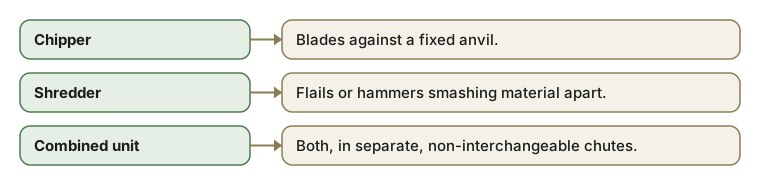
A chipper uses blades against an anvil to slice woody material into chips. A shredder uses flails or hammers to smash soft material, leaves, stems, garden waste, into a mulch. A combined chipper-shredder has both, with a chute for each, and it is worth knowing which chute is which: putting leaves through the chipper chute packs it, and putting a branch through the shredder chute breaks flails.
| Type | Mechanism | Handles |
|---|---|---|
| Chipper | Blades against a fixed anvil. | Woody branches and limbs. |
| Shredder | Flails or hammers smashing material apart. | Leaves, stems and soft garden waste. |
| Combined unit | Both, in separate, non-interchangeable chutes. | Either, fed through the correct chute only. |
How material is driven into the cutting head
A homeowner-scale machine is usually gravity- and hand-fed: the operator pushes the branch until the blade or flail takes it, then lets go. A larger, tow-behind machine adds a powered infeed roller that pulls material in on its own once it contacts the roller: which removes the operator's ability to simply stop pushing, and is the reason commercial machines carry a reversing control and, on larger units, a bar or lever that shuts the infeed down without the operator's hands going anywhere near the hopper.
Never push material in by hand past the point the machine can take it on its own, and never reach into a chute or hopper for any reason with the engine running. On a powered-infeed machine, a sleeve, glove or loose clothing caught by the roller pulls the arm in behind it: this is the injury the class's safety standard is built around preventing, and it happens faster than a reaction time allows. Feed a branch, let go, and step back.
Discharge, and the other end of the machine
Wood chips leave the discharge chute at real speed, and the chute direction should be set, the way a snow blower's is, before feeding material. Stop feeding and follow the shutdown procedure before changing chute direction. Never point a discharge chute at a person, a window or a parked vehicle, and treat a clog at the discharge end the same way as a clog at the intake: stop the engine, and only then clear it.
What wears on a chipper or shredder
The blades are the whole story on a chipper: a dull blade tears rather than cuts, which loads the engine, heats the material and produces stringy output instead of clean chips. Most chipper blades are reversible, giving a second edge before they need sharpening or replacing.
A shredder's flails wear more gradually and are checked for cracks, since a cracked flail can shed a fragment at speed. Both machines carry a gearbox with its own oil, separate from the engine oil, that is checked on a schedule and easy to forget, and both are stored for most of the year, which makes storage the main determinant of whether the engine starts again next season.
- Powered Consumer Chipper/Shredders and Pedestrian-Controlled Chipper/Shredder Vacuums: Safety Specifications: Outdoor Power Equipment Institute / ANSI, ANSI/OPEI B71.6-2021.
- Control of Emissions from New, Small Nonroad Spark-Ignition Engines and Equipment: U.S. Government Publishing Office (eCFR), 40 CFR Part 1054.
Wood chippers and shredders: questions
What size branch can my chipper handle?
Well under the rated maximum branch diameter most of the time. That figure describes the best case, green, straight wood, fed squarely, with a sharp blade, and dry, forked or knotty material of the same diameter stalls the machine. Treat the rating as a ceiling you rarely reach rather than a working figure to size against your largest branch.
What is the difference between a chipper and a shredder?
A chipper uses blades against an anvil to slice woody material into chips. A shredder uses flails or hammers to smash soft material, leaves, stems, garden waste, into mulch. A combined unit has both in separate chutes that are not interchangeable: leaves through the chipper chute pack it, and a branch through the shredder chute breaks the flails.
Why is a chipper with a powered infeed roller more dangerous?
Because a powered roller pulls material in on its own once it makes contact, which removes the operator’s ability to simply stop pushing: unlike a hand-fed homeowner machine, where letting go stops the feed. A sleeve, glove or loose clothing caught by the roller pulls the arm in behind it faster than a reaction time allows, which is why larger machines carry a reversing control and an emergency shutoff within reach.
Can I put leaves through a wood chipper?
Feed leaves through the shredder inlet of a combined machine. A chipper is built to slice woody material with blades against an anvil, and packing it with soft material like wet leaves clogs the chute rather than processing it: the two chutes on a combined chipper-shredder do different jobs and are not interchangeable.
How often do chipper blades need to be sharpened or replaced?
This depends heavily on volume and material. A dull blade shows itself as material that tears or jams rather than slicing cleanly, and as increased strain and stalling on branches that used to process easily. Most chipper blades can be sharpened several times before replacement is needed, but check for nicks or chips in the edge (common from processing wood with embedded debris) that sharpening alone won't fully correct.
What is the discharge chute hazard on a wood chipper, separate from the intake hazard?
Chipped material and wood chips exit the discharge chute at speed, similar to a snow blower's discharge, and can strike a bystander standing in the discharge path. This is a separate hazard from the intake-side pulling injury, and it means the discharge direction and clear zone matter as much as staying clear of the hopper.
Is a wood chipper's engine sized the same way a log splitter's or generator's engine is sized?
No: a chipper's engine has to overcome the resistance of slicing wood directly through the blade mechanism, which is a different load profile than driving a hydraulic pump (log splitter) or an alternator (generator). Chipper engine sizing is tied to the rated maximum branch diameter and material type the machine is built to process, not to a load list or pressure target.
What is the emergency shutoff on a chipper with a powered infeed, and where is it located?
It's a stop control positioned within the operator's reach at the hopper: typically a bar, lever, or button that immediately halts the infeed roller (and often reverses it) if something goes wrong during feeding. Its placement within easy reach during normal feeding position keeps the control accessible from the feeding position, since a powered infeed removes the "just let go" safety margin a hand-fed machine has.
Can a wood chipper process material other than tree branches, like construction lumber?
No: a chipper's blades and anvil are designed and tested for natural wood, and construction lumber, pressure-treated wood, or lumber containing nails, screws, or other embedded metal is a serious blade-damage and thrown-debris hazard. Only clean, natural branch material belongs in a wood chipper.
Does a shredder's flail or hammer mechanism wear out the same way a chipper's blade does?
Flails and hammers wear differently than a chipper's bladed edge, rather than dulling along a cutting edge, they typically wear by rounding or chipping at their impact faces from repeated contact with material, and a shredder processing a lot of abrasive or gritty material (like debris mixed with soil) wears its flails faster than one processing clean leaves and stems.
Does a chipper's engine need to idle down between feeding branches, or should it run at full throttle continuously?
Most gas chipper engines are designed to run at a consistent working RPM throughout a session rather than idling between branches, since maintaining blade or flywheel speed is what keeps each new piece of material processed cleanly rather than being fed into a slowing mechanism: check the specific machine's manual for its recommended operating approach.