Honda GCV160/GCV190 oil refill and application-specific plugs
The cited Honda GCV160/GCV190 manual distinguishes a 0.50 L dry engine from a 0.35–0.41 L oil refill after draining. Use the dipstick rather than pouring the dry capacity into a partly drained sump. It specifies BPR6ES for pressure-washer applications and BPR5ES for other applications, with the equipment maker’s directions also applicable.
Residual oil is why the two quantities differ
In the Honda engine manual, dry capacity describes an empty engine. An ordinary change leaves oil behind.
For an arithmetic example, a 500 ml target with 150 ml remaining needs350 ml more; adding the entire500 ml would produce650 ml. This example does not measure the residual oil in your engine.
Check on level ground by the manual’s dipstick method and stop at the indicated range. Excess oil can affect operation; the cure for an uncertain refill is a level check, not choosing whichever online capacity is largest. The manual recommends10 W-30, API SJ or later, for general use.
The same engine name can need a different plug
The pressure-washer BPR6ES and other-application BPR5ES distinction appears in Honda’s own instructions. The manual specifies a 0.70–0.80 mm gap. Confirm the application and actual engine type before buying a plug or assuming that a mower’s service kit fits a pressure washer.
Record the engine serial and type separately from the machine’s model number. The equipment maker selects controls and installation details; a generic engine diagram cannot establish that every tank, cable, air-cleaner housing or filter assembly fits that machine.
Use both hours and months
The initial oil change is five hours or one month. Later oil service is 50 hours or six months; heavy load or heat calls for the manual’s shorter25-hour provision.
Air-cleaner service becomes more frequent in dust. Valve, idle and fuel-tank work has its own qualification notes.
At a hypothetical 90 minutes per weekend, five hours arrives during the fourth session. A mower used less often can reach the one-month limit before accumulating five hours. Keep a dated running-hour log instead of treating either schedule measure as optional.
For deck, blade and drive work, use the Honda mower service comparison and its exact machine manual. An engine-only oil quantity does not identify a safe blade or transmission part.
Honda GCV160 and GCV190: oil capacity, spark plug and maintenance schedule
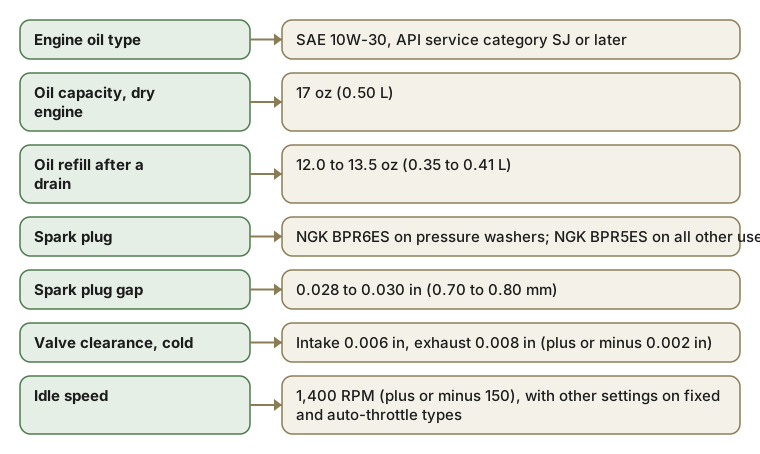
The Honda GCV160 and GCV190 take 10W-30 oil, 17 ounces in a dry engine and 12.0 to 13.5 ounces at an ordinary oil change, so a full quart is wrong. The spark plug is an NGK BPR6ES on pressure washers and a BPR5ES on everything else, gapped 0.028 to 0.030 inch. Honda schedules the first oil change at one month or 5 hours, then every 6 months or 50 hours, and the plug and air filter every two years or 200 hours.
There is no oil filter. Every figure here is taken from Honda’s own owner’s manual, and the machine’s maker may specify differently.
Every figure comes from Honda’s owner’s manual for the GCV160 and GCV190 engines, listed in the sources at the foot of the page. Your machine’s maker may specify something different, so compare with the label on your own engine, and the manual that came with the machine, before you buy oil or a plug.
A small overhead-cam engine that takes half a quart
The GCV160 and GCV190 are the vertical-shaft engines Honda sells to mower and pressure-washer makers. The GCV160 displaces 160 cubic centimeters (9.8 cubic inches) and the GCV190 displaces 187 (11.4). Both are single-cylinder, four-stroke, overhead-cam engines with forced-air cooling.
There is no oil filter to buy, because the design has none, and the tank holds a quarter of a US gallon. That makes the oil change the simplest on this site to describe and the easiest to get wrong by pouring in a full quart.
| Item | Specification | Note |
|---|---|---|
| Engine oil type | SAE 10W-30, API service category SJ or later | Recommended for general use; the manual lists other viscosities for other temperature ranges. |
| Oil capacity, dry engine | 17 oz (0.50 L) | The amount a completely empty engine takes. |
| Oil refill after a drain | 12.0 to 13.5 oz (0.35 to 0.41 L) | Some oil stays in the engine, so use the dipstick to confirm the level. |
| Spark plug | NGK BPR6ES on pressure washers; NGK BPR5ES on all other uses | The right plug depends on what the engine is fitted to. |
| Spark plug gap | 0.028 to 0.030 in (0.70 to 0.80 mm) | Set with a wire feeler gauge; bend only the side electrode. |
| Valve clearance, cold | Intake 0.006 in, exhaust 0.008 in (plus or minus 0.002 in) | Dealer or shop-manual job unless you have the tools. |
| Idle speed | 1,400 RPM (plus or minus 150), with other settings on fixed and auto-throttle types | Set by the equipment maker for the machine. |
| Fuel | Unleaded, pump octane 86 or higher, up to 10% ethanol | Higher ethanol blends are outside the warranty. |
| Fuel tank | 0.25 US gal (0.93 L) | Small, so it is refuelled often and rarely stale. |
| Dry weight, recoil start | 23.1 lb (GCV160), 27.1 lb (GCV190) | Electric-start versions weigh about three pounds more. |
The maintenance schedule, as Honda prints it
Honda’s schedule is set by whichever comes first, months or hours. A mower used a few dozen hours a year will meet the calendar interval every time, so treat the months as the real limit.
| When | What |
|---|---|
| Before each use | Check the oil level and the air filter. |
| First month or 5 hours | Change the engine oil. |
| Every 3 months or 25 hours | Clean the air filter, and more often in dust. |
| Every 6 months or 50 hours | Change the oil, clean the air filter, and check the flywheel brake pad if fitted. |
| Every year or 100 hours | Check and adjust the spark plug, clean the spark arrester if fitted, check the blade brake clutch, idle speed, fuel tank and filter, and valve clearance. |
| Every 2 years or 200 hours | Replace the air filter and the spark plug, and check the fuel lines, replacing them if needed. |
Two footnotes in the manual matter more than the table. The oil should be changed every 25 hours under heavy load or in high heat, and the idle, valves and fuel tank cleaning are marked as jobs for an authorized dealer unless you have the tools and the skill.
Reading the two plug numbers
BPR6ES
Pressure washer engines
The colder plug Honda names for the harder-worked washer application.
BPR5ES
Every other application
Mowers, tillers, and general equipment fitted with the same engine.
0.028–0.030 in
Gap for both
A new plug is not always set correctly out of the box, so check it.
If your machine is a mower, it takes the BPR5ES. The oil, the plug and the intervals are the same for the two engine sizes, which is why this page treats them together.
The parts below are the ones a GCV160 or GCV190 uses. The HRX217 mower, which has a GCV190, is covered on its own page, and the Find equipment model and engine serial IDs shows where to read the label on your engine.
Parts to buy for the Honda GCV160 and GCV190
| Part | Part number | Notes |
|---|---|---|
| Air filter (paper) | 17211-Z8B-901 | Listed filter for the specified GCV160/GCV190 applications. Confirm the equipment model and serial in its parts catalog; the HRN216 uses a GCV170, so a mower-family listing does not establish which engine is fitted. |
| Air filter, earlier GCV160 | 17211-ZL8-023 | The element on earlier GCV160 mowers. |
| Fuel filter | 16952-Z8B-000 | Fits the GCV160 and GCV190. |
| Spark plug, NGK BPR5ES | 98079-55846 | Mowers and general equipment. |
| Spark plug, NGK BPR6ES | 98079-56846 | Pressure washers. |
| Engine oil | SAE 10W-30, API SJ or later | Honda 10W-30 is part 08207-10W30 in a 32 ounce bottle. |
There is no oil filter: an oil change is a drain and a refill of about 12 to 13.5 ounces.
- Owner’s Manual: GCV160 and GCV190 engines: American Honda Motor Co., Power Equipment, Part 00X37Z8B0023.
- Owner’s Manual: HRX217VKA and HRX217HYA lawn mowers: American Honda Motor Co., Power Equipment, Part 00X31VH7N060.
- Owners Manuals: Honda Engines.
- Fuel filter 16952-Z8B-000 for Honda HRX, HRR, GC160, GC190, GCV160, GCV190: Sawzilla Parts (Honda parts seller).
- Genuine Honda air filter 17211-Z8B-901: HLS Pro Parts (Honda dealer).
Honda GCV160 and GCV190: questions
How much oil does a Honda GCV160 take?
A completely dry GCV160 takes 17 US ounces (0.50 liter), but after an ordinary drain it takes 12.0 to 13.5 ounces (0.35 to 0.41 liter), because some oil stays inside. Fill to the dipstick, not by the bottle. The GCV190 has the same figures.
What oil does a Honda GCV160 use?
SAE 10W-30 that meets API service category SJ or later is Honda’s recommendation for general use. The manual lists other viscosities for other temperature ranges. Check the API label on the bottle for the letters SJ or a later category.
What spark plug does a Honda GCV160 use?
An NGK BPR5ES for all applications except pressure washers, where Honda names an NGK BPR6ES. Set the gap to 0.028 to 0.030 inch (0.70 to 0.80 mm) with a wire feeler gauge, bending only the side electrode. The same plugs apply to the GCV190.
Does a GCV160 have an oil filter?
No. There is no oil filter on the GCV160, so an oil change is a drain and refill of about 12 to 13.5 ounces. The parts that wear are the air filter (Honda 17211-Z8B-901), the fuel filter (16952-Z8B-000) and the spark plug (98079-55846 for the NGK BPR5ES).
When should I change the oil in a GCV160?
Honda says at the first month or 5 hours, then every 6 months or 50 hours, whichever comes first. Change it every 25 hours if the engine works under heavy load or in high heat. A mower used lightly will reach 6 months before 50 hours.
How often should the air filter be cleaned on a GCV160?
Check it before each use, clean it every 3 months or 25 hours, and clean it again at 6 months or 50 hours, more often in dust. Replace it every 2 years or 200 hours. The Honda part is 17211-Z8B-901, or 17211-ZL8-023 on earlier GCV160 mowers.
What is the difference between the GCV160 and the GCV190?
Displacement and weight: 160 against 187 cubic centimeters, and 23.1 against 27.1 pounds for the recoil-start versions. The oil amount, the oil grade, the spark plug and the service intervals in Honda’s manual are the same for both.
What is the valve clearance on a GCV160?
Cold, the intake is 0.006 inch and the exhaust is 0.008 inch, each plus or minus 0.002 inch. Honda marks valve clearance as a job for an authorized dealer unless you have the tools and the skill, and it is checked every year or 100 hours.
What fuel can a GCV160 use?
Unleaded gasoline with a pump octane rating of 86 or higher, with no more than 10% ethanol. Fuel with more ethanol than that is outside the warranty. The tank holds 0.25 US gallon (0.93 liter), so it is emptied and refilled often.
How fast should a GCV160 idle?
The manual gives 1,400 RPM, plus or minus 150, for standard types, with 1,700 for fixed-throttle and 2,500 for auto-throttle types. The equipment maker sets it for the machine, and Honda marks idle speed as a dealer job.
How much does a GCV160 weigh?
23.1 pounds (10.5 kg) for the recoil-start version and 26 pounds (11.6 kg) for the electric-start version, dry. The GCV190 is heavier at 27.1 and 29.3 pounds.
Why does my mower’s manual give a different oil amount?
The machine’s maker may specify its own figure for the engine as fitted, and the engine label names the exact model. Where the two differ, follow the machine’s manual for capacity and confirm with the dipstick. The figures are Honda’s for the engine itself.
What is the fuel filter part number for a GCV160?
Honda 16952-Z8B-000 fits the GCV160 and the GCV190, and the same filter is listed for the HRX217, HRN216 and HRR216 mowers. Replace the fuel filter when the air filter and spark plug are replaced, every 2 years or 200 hours.
Honda’s HRN introduction identifies its engine as GCV170 and the outgoing HRR engine as GCV160. Identify the engine on the actual mower before using the oil, plug or parts figures in this GCV160/GCV190 chapter.
A seller listing several mower families under one part number does not make their engines interchangeable. Honda’s GCV170 introduction and specifications