Husqvarna 130BT and 350BT backpack-blower service
The older 130BT/350BT backpack manual specifies CMR7H, a 0.6–0.7 mm plug gap and 50:1 fuel. Its tank figures are 0.90 L for 130BT and 1.25 L for 350BT. These are backpack-blower instructions; the 125B handheld’s plug information and manual discrepancy must not be substituted for them.
Fuel space is part of the filling instruction
The older manual limits filling to 80 percent of full tank capacity. For its 1.25L350BT example, 80 percent is 1.00 L; for 0.90 L it is 0.72 L. These calculations interpret that document, not a fixed liter mark for every later revision.
Stop and cool the engine before opening the cap and follow the applicable manual’s filling directions. The expansion allowance does not change the 50:1mixture. Use the specified qualifying air-cooled oil rather than straight gasoline or outboard oil.
A later 350BT manual adds another plug identity
The 2024 350BT/350BF document lists NGK CMR7H and TORCH AC7R. Keep that revision attached to the parts decision. An older manual naming CMR7H alone does not disprove a later approved part, and a familiar-looking plug does not establish an equivalent.
| Older backpack-manual detail | 130BT/350BT specification |
|---|---|
| 130BT tank | 0.90 L |
| 350BT tank | 1.25 L |
| Older plug /gap | CMR7H /0.6–0.7 mm |
| Older inspection interval | 25 hours |
Keep inspection tasks separate
The older backpack schedule calls for spark-plug inspection every 25 hours. Record that inspection separately from filter condition, fuel leaks and cooling checks. At an example five hours per week, 25 hours arrives after five weeks.
A blocked tube and an engine-intake restriction can both reduce airflow but require different inspections. Stop before inspecting the fan path; damaged guards, failed controls or abnormal vibration need correction before further use. Use the backpack procedure rather than a handheld vacuum-kit disassembly.
2010 backpack manual, 2024 350BT/350BF manual
Husqvarna 130BT, 350BT, 370BTS and 380BTS backpack blowers: fuel mix, spark plug and intervals
Husqvarna’s 130BT, 350BT, 370BTS and 380BTS backpack blowers run a 50:1 gasoline and two-cycle oil mix, using JASO FC or ISO EGC oil and never a water-cooled type. The only plug the manual allows is the NGK CMR7H, gapped 0.025 inch and inspected every 25 hours. Fuel tanks run from 0.9 liter on the 130BT to 2.13 liters on the 380BTS, and the muffler spark arrester and exhaust port are cleaned at 50 and 100 hours.
Make sure the engine has stopped and is cool before you service the blower, since contact with the rotating fan or a hot muffler can injure you. Refuel on bare ground, and move at least 10 feet away from the fuelling point before you start the engine.
Four backpack blowers, one plug
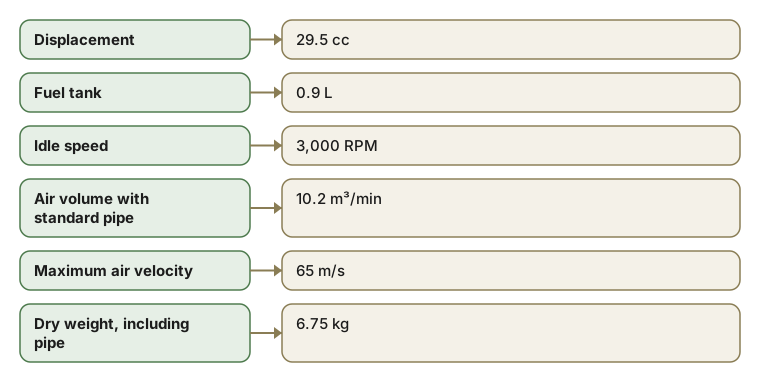
The manual covers four Husqvarna backpack blowers with air-cooled two-stroke engines: the 130BT at 29.5 cc, the 350BT at 50.2 cc, the 370BTS at 64.9 cc and the 380BTS at 71.9 cc. All four use the same NGK plug and the same 50:1 mix, and differ in tank size, airflow and idle speed.
| Item | 130BT | 350BT | 370BTS | 380BTS |
|---|---|---|---|---|
| Displacement | 29.5 cc | 50.2 cc | 64.9 cc | 71.9 cc |
| Fuel tank | 0.9 L | 1.25 L | 1.75 L | 2.13 L |
| Idle speed | 3,000 RPM | 2,200 RPM | 2,000 RPM | 2,000 RPM |
| Air volume with standard pipe | 10.2 m³/min | 14 m³/min | 16 m³/min | 19.4 m³/min |
| Maximum air velocity | 65 m/s | 80 m/s | 88 m/s | 90 m/s |
| Dry weight, including pipe | 6.75 kg | 10.2 kg | 12 kg | 13.2 kg |
| Item | Specification |
|---|---|
| Mixing ratio | Gasoline 50 to oil 1 (50:1) |
| Two-stroke oil | Husqvarna oil, or an anti-oxidant quality oil labeled for air-cooled two-cycle engines (JASO FC grade or ISO EGC grade). Never BIA or TCW water-cooled two-stroke oil. |
| Spark plug | NGK CMR7H, and no other; the manual warns other plugs may cause overheating and damage |
| Spark gap | 0.025 in (0.6 to 0.7 mm) |
| Fuel level | Fill to 80% of the full capacity |
Husqvarna lists three things to avoid for engine life: fuel with no oil, which causes severe damage very quickly; gasohol, which can deteriorate rubber and plastic parts and disrupt lubrication; and four-cycle engine oil, which can foul the spark plug. It says to label the fuel container so it is not confused with raw gasoline.
The maintenance intervals
| When | What |
|---|---|
| Daily or before use | Inspect and clean the air filter prefilter; inspect for fuel leaks; inspect and replace the fuel filter if needed; inspect and clean the fuel line, the muffler and the cooling system; tighten bolts on the muffler and screws, nuts and bolts; inspect the entire unit. |
| Every 25 hours | Inspect the fuel filter again, and inspect and clean the spark plug. |
| Every 50 hours | Inspect and replace the paper filter (370 only), and inspect and clean the muffler spark arrester. |
| Every 100 hours | Inspect and clean the cylinder exhaust port. |
Remove and inspect the spark plug every 25 hours and clean the electrodes with a wire brush as necessary, adjusting the gap to 0.025 inch. The manual adds that plug manufacturers recommend replacing the plug twice a year to avoid unexpected failure on a job. Never operate the blower without an air filter or with a deformed or broken element, and never clean the paper filter on the 370BTS or 380BTS by tapping it.
Parts to buy for the Husqvarna 130BT, 350BT, 370BTS and 380BTS backpack blowers
| Part | Part number | Notes |
|---|---|---|
| Air filter element | 504115301 | Fits the 130BT. |
| Fuel filter | 544272901 | Replaced by 520953501. |
| Spark plug | NGK CMR7H | Gap 0.025 in (0.6 mm). |
The 130BT runs on a 50:1 mix of two-stroke oil and gasoline.
50:1
Fuel to oil
JASO FC or ISO EGC oil. No water-cooled oil.
CMR7H
NGK plug only
Gap 0.025 in; inspect every 25 hours.
80%
Fill level
Tank 0.9 to 2.13 L by model.
Husqvarna 130BT, 350BT, 370BTS and 380BTS backpack blowers: questions
What fuel mix does a Husqvarna 130BT use?
50:1, gasoline to oil, using Husqvarna oil or an anti-oxidant quality oil labeled for air-cooled two-cycle engines, JASO FC grade or ISO EGC grade. Do not use BIA or TCW oil, which is for water-cooled two-stroke engines. The same applies to the 350BT, 370BTS and 380BTS.
What spark plug does a Husqvarna 130BT or 350BT use?
An NGK CMR7H, and the manual warns that any other plug may stop the engine running as intended or overheat and damage it. The gap should be adjusted to 0.025 inch (0.6 to 0.7 millimeter). Inspect the plug every 25 hours.
How big is the fuel tank on a Husqvarna 130BT?
0.9 liter. The 350BT holds 1.25 liters, the 370BTS 1.75 liters and the 380BTS 2.13 liters. Husqvarna says to fill to 80 percent of the full capacity, and to fuel on bare ground and move 10 feet away before you start the engine.
How often should I service the spark plug on a Husqvarna 130BT?
Remove and inspect it every 25 hours, and clean the electrodes with a wire brush as necessary. The manual adds that plug manufacturers recommend replacing the plug twice a year to avoid unexpected failure on a job. Adjust the gap to 0.025 inch.
What is on the daily list for a Husqvarna 130BT?
Inspect and clean the air filter prefilter, inspect for fuel leaks, inspect the fuel filter and fuel line, inspect and clean the muffler and cooling system, tighten the bolts on the muffler and screws, nuts and bolts, and inspect the entire unit. Do it before use.
When do I clean the spark arrester on a Husqvarna 130BT?
Every 50 hours, when the manual lists inspecting and cleaning the muffler spark arrester. The cylinder exhaust port is inspected and cleaned every 100 hours. A clogged screen or port is a common reason a two-stroke loses power.
How do I clean the air filter on a Husqvarna 370BTS?
Clean the prefilter daily. The 370BTS and 380BTS also have a paper filter, which is inspected and replaced every 50 hours, and the manual says never to clean the paper filter by tapping on it, because that may break the element. Never run without a filter.
What should I avoid putting in a Husqvarna backpack blower?
Three things: fuel with no oil, which quickly causes severe damage to internal engine parts; gasohol, which can deteriorate rubber or plastic parts and disrupt lubrication; and oil for four-cycle engines, which can foul the spark plug. Label the fuel container clearly.
What is the difference between the Husqvarna 130BT and 350BT?
The 130BT has a 29.5 cc engine, a 0.9 liter tank and weighs 6.75 kilograms with pipe, while the 350BT has a 50.2 cc engine, a 1.25 liter tank and weighs 10.2 kilograms. Air volume with the standard pipe is 10.2 and 14 cubic meters per minute.
How much air does a Husqvarna 380BTS move?
19.4 cubic meters per minute with the standard pipe, and 25.9 at the housing, with a maximum air velocity of 90 meters per second. It has a 71.9 cc engine, a 2.13 liter tank and a dry weight of 13.2 kilograms including the pipe.
What noise figures apply to the Husqvarna 130BT blower?
The manual gives a sound power level of 102 decibels, measured and guaranteed, and a sound pressure level at the operator’s ear of 91 decibels. The larger 370BTS and 380BTS are louder, at 110 and 109 decibels of sound power. Wear hearing protection.
Why should I never run a Husqvarna blower without an air filter?
The manual says unfiltered dusty air will quickly ruin the engine, and that a clogged filter increases fuel consumption while cutting engine power. Check the air cleaner before use, and never operate the blower with a deformed or broken filter element.
What is the Husqvarna 130BT air filter part number?
Husqvarna 504115301 is the air filter element for the 130BT. The fuel filter is 544272901, which Husqvarna has replaced with 520953501, and the spark plug is an NGK CMR7H gapped 0.025 inch.