Champion generator oil, plugs and service by model
Match the exact Champion model before buying oil or a plug. The 100522 and 201052 use a 600 ml sump; 100571 takes 380 ml and 200961 takes 500 ml.
Their replacement plugs differ. Start with the model row below, then use its linked manual for the temperature chart, level check and service schedule.
Four models, three plug specifications
| Model / manual | Oil maximum | Original / NGK replacement | Running watts gasoline / LPG |
|---|---|---|---|
| 100522 | Sump amount for this Champion model: 600 ml (20.3 US fl oz) | F6RTC / BPR6ES | 3500 / gasoline only |
| 100571 | Sump amount for this Champion model: 380 ml (12.9 US fl oz) | A5RTC / CR6HSA | 2300 / gasoline only |
| 200961 | Sump amount for this Champion model: 500 ml (16.9 US fl oz) | E 6RTC / BPR 5HS | 1850 /1665 |
| 201052 | Sump amount for this Champion model: 600 ml (20.3 US fl oz) | F6RTC / BPR6ES | 3800 /3420 |
The manuals specify a 0.6–0.8 mm plug gap for these models. Capacity is an upper quantity, not an instruction to pour a full bottle into a partly drained engine. Check the level on the surface and by the dipstick procedure in the matching manual.600 ml converts to about 0.634 US quart; the old 0.6 US-quart equivalence was inaccurate.
Break-in is measured in hours
These manuals call for an oil change after the first 5 hours, following operation at no more than half the running rating with varying loads. For example, half the 201052’s gasoline rating is 1900 W; half its propane rating is 1710 W. That limit describes break-in loading, not the starting requirement of an appliance.
After break-in, use the calendar or hour limit reached first. The 100571, 200961 and 201052 have a 100-hour/annual oil interval and a 50-hour/annual severe-load or heat provision.
The 100522 lists 100 hours/annually. Valve work differs: 100522 places it at 100 hours/annually, while the other three place it at 250 hours. Qualified service is appropriate for clearance adjustment and fuel-system work.
Electric start adds a battery task
The 201052 has a battery; the other three units here use recoil starting. Its manual limits the maintainer charge rate to 1.5 A and calls for a full charge at least monthly.
A flat battery is separate from contaminated gasoline or an empty propane cylinder. Record whether a failed start used the key or recoil and which fuel was selected before ordering parts.
A change from 1850 W gasoline to 1665 W propane on the 200961 reduces continuous capacity by 185 W, or 10%. A hypothetical 1700 W running load exceeds the propane rating even though it fits the gasoline rating. Motor-starting surge and individual receptacle limits still require separate checks with the generator load calculator.
Recall matching needs more than yellow paint
CPSC recall 13-026 identifies models 41332 and 41532 and specific serial ranges for a carburetor fuel-leak hazard. Those are different model numbers from the four above.
That historical campaign is an example of why a brand-wide result cannot establish applicability or clearance. Check the current recall lookup with the actual model and serial before using a secondhand generator.
Operate fuel-burning generators outside, at least 20 feet from the home and away from openings, with exhaust pointed away. CPSC’s generator guidance explains that placement. A CO shutoff does not replace it.
A house connection requires an appropriate installed transfer arrangement; never feed a wall receptacle or change neutral bonding from a generic web instruction.
Champion 200961 dual fuel inverter generator: oil, spark plug and schedule
The Champion 200961 takes up to 16.9 fluid ounces (500 ml) of oil and an E6RTC spark plug, replaced by NGK BPR5HS, gapped 0.024 to 0.031 inch. Champion says to change the oil after the first 5 hours and then every 100 hours or annually, with the valves checked every 250 hours. It runs on gasoline or propane.
Remove and ground the spark plug wire before any service, and never run the generator indoors or near windows and vents.
A 39 pound dual fuel inverter with a 79 cc engine
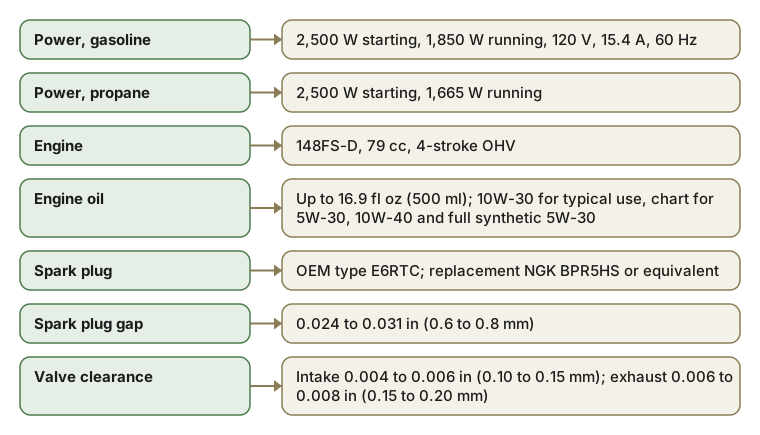
The Champion 200961 is rated at 2,500 starting and 1,850 running watts on gasoline, and 2,500 starting and 1,665 running watts on propane. It has a 148FS-D 79 cubic centimeter four-stroke OHV engine, weighs 39 pounds, and holds 1.1 gallons of gasoline. The engine takes up to 16.9 fluid ounces of oil, and the unit ships with a bottle of that size.
| Item | Specification |
|---|---|
| Power, gasoline | 2,500 W starting, 1,850 W running, 120 V, 15.4 A, 60 Hz |
| Power, propane | 2,500 W starting, 1,665 W running |
| Engine | 148FS-D, 79 cc, 4-stroke OHV |
| Engine oil | Up to 16.9 fl oz (500 ml); 10W-30 for typical use, chart for 5W-30, 10W-40 and full synthetic 5W-30 |
| Spark plug | OEM type E6RTC; replacement NGK BPR5HS or equivalent |
| Spark plug gap | Permitted electrode gap: 0.024 to 0.031 in (0.6 to 0.8 mm) |
| Valve clearance | Intake 0.004 to 0.006 in (0.10 to 0.15 mm); exhaust 0.006 to 0.008 in (0.15 to 0.20 mm) |
| Gasoline | Unleaded, 87 octane or higher, ethanol 10% or less; tank 1.1 gal (4 L) |
| Propane | Approved cylinder with an OPD valve |
The first 5 hours are the break-in: stay at or below 50% of the running watt rating, then change the oil. Champion says synthetic oil may be used after the break-in and does not shorten the change interval. Add oil with the funnel and do not overfill.
The Champion 200961 dual fuel inverter generator schedule
| When | What |
|---|---|
| Every 8 hours or before each use | Check oil level; clean around the air intake and muffler; check the propane hose for leaks. |
| First 5 hours (break-in) | Change the oil. |
| Every 50 hours or annually | Clean the air filter; change the oil if running under heavy load or in hot conditions. |
| Every 100 hours or annually | Change the oil; clean and adjust the spark plug; clean the spark arrestor; clean the fuel valve filter. |
| Every 250 hours | Clean the combustion chamber; check and adjust valve clearance (experienced owners or a certified service center). |
| Every 3 years | Replace the fuel line and the LPG hose. |
Champion refers to a technical bulletin on valve adjustment at its website. This engine has no oil filter to change.
Parts to buy for the Champion 200961 dual fuel inverter generator
| Part | Part number |
|---|---|
| Spark plug, E6RTC | 100097810 |
| Air filter element | 100075483 |
| Air filter cover | 100075482 |
| Air filter hose | 100075035 |
Order from Champion at 1-877-338-0999 or shop.championpowerequipment.com.
16.9 oz
Oil, up to
500 ml, do not overfill.
BPR5HS
NGK replacement plug
OEM E6RTC, gap 0.6 to 0.8 mm.
5 h
First oil change
Then every 100 hours or annually.
Running the Champion 200961 on propane
A dual-fuel Champion runs on gasoline or propane through a fuel system switch, and 101 Generator's troubleshooting guide is aimed at owners whose unit will not start on propane. An owner on a Sprinter van forum bought the 200961 because Champion claims up to 34 hours on a 20 lb propane bottle, then documented the problems he resolved.
The practical rule is to switch the fuel selector and run the carburetor dry on the fuel you are leaving before storage, and to treat the maker's propane runtime as a best case at light load.
Starting the 200961 on gasoline: the choke timing Champion specifies
The operator’s manual specifies three starting routines, chosen by temperature. In standard ambient temperature above 59°F (15°C), keep the EZ Start dial in CHOKE for three pulls of the recoil cord, and if it has not started, turn the dial to RUN for the next three pulls.
In cold weather below 59°F, keep it on CHOKE until the engine starts, then turn to RUN as soon as it runs smoothly, which in extreme cold may take several seconds. For a hot engine in hot weather above 86°F (30°C), use CHOKE for only one pull, then RUN for three.
The manual's reason is the same each time: too much choke fouls the spark plug and floods the engine, and then it will not start. Pull the cord slowly until you feel resistance and then pull rapidly. If the engine starts but will not keep running, check that the generator is on a flat, level surface, because the low oil sensor stops it when the oil falls below a critical threshold.
Starting on propane and dealing with frost on the cylinder
For propane, put the generator on level ground, disconnect every electrical load (the manual says never to start or stop it with devices plugged in or switched on) and open the valve on the propane cylinder. A cold engine goes to CHOKE, you pull the cord slowly three to five times to prime it, then turn the dial to the propane RUN position and pull to start. A warm engine skips the choke: turn to propane RUN and pull.
The manual also explains something owners often mistake for a fault. Frost on the cylinder, hose or regulator is common in operation, because the propane cools as it vaporizes and expands on its way to the engine. In unusual cases it can restrict flow and performance falls.
Champion's suggestions are to swap cylinders so the first can warm up, to stand the cylinder at the handle end of the generator where the engine fan air flows out slightly warmed, but never in the muffler's path, or to pour warm water over the top of the cylinder.
200961 ratings, Eco mode, altitude jets and the manual's fault table
The specification page gives 2,500 starting and 1,850 running watts on gasoline and 2,500 and 1,665 on propane, 15.4 amps at 120 volts and 8 amps at 12 volts DC, a 1.1 gallon tank and a 39 lb (17.9 kg) weight, in a case 17.3 by 12 by 17.7 inches. Eco mode lets the engine idle when nothing is drawing power and returns to normal speed when a load is connected. An AC overload light that blinks means the load must be lowered and the reset button pressed before restarting.
For altitude, the manual lists carburetor code 100160764 with high altitude jet 100005742 for 3,281 to 6,562 feet (1,000 to 2,000 m) and jet 100030032 for 6,562 to 9,843 feet (2,000 to 3,000 m).
Its troubleshooting table adds a fault peculiar to dual fuel models: if the engine will not stop, the cause is the propane valve still being open, so close the valve on the tank. An engine that hunts points to a dirty fuel valve, a lean, dirty carburetor or the choke in the wrong position, and a generator that runs but has no AC output points at the circuit breaker, a loose connection, an overloaded AC circuit or loose wiring. Champion's warranty is three years for the original purchaser, 270 days for commercial use, and it asks you to register within ten days of purchase.
Paralleling two 200961s, adding loads and shutting down
The 200961 is parallel ready. The manual says it can run in parallel with another Champion unit to increase available power using an optional Champion parallel kit, that model 100319 is the recommended kit, and that compatible models and orders go through customer service at 1-877-338-0999. Detailed instructions for installing the kit are in the kit's own operator's manual.
For loads the manual gives a sequence to prolong the life of the generator and attached devices: start it with no load, let the engine run several minutes to reach temperature, make sure the circuit breakers are in the run position, then plug in and turn on the largest item first and let the engine stabilize before adding each next item. It also gives the formula for watts, volts times amps, and says the Eco mode should be off during periods of high electrical load or momentary fluctuations.
To shut down on gasoline, turn off and unplug all loads, let the generator run at no load for several minutes, turn the fuel vent lever to OFF and turn the EZ Start dial counterclockwise to STOP. On propane the steps are the same, with the addition of closing the fuel valve on the cylinder. The manual says the dial and the fuel vent on the cap must be OFF whenever the generator is not in use, and that before moving it you should close the fuel valve, let the engine and muffler cool for typically 15 to 30 minutes and lift it only by the carrying handle.
Propane safety facts printed in the 200961 manual
The manual's LPG list is worth reading once, because it explains the precautions. Propane is highly flammable and explosive, is under pressure, and is heavier than air, so it can settle in low places while dissipating. It has a distinctive odor added to help detect leaks quickly.
In any petroleum gas fire, flames should not be put out unless the fuel supply valve is turned off, because an extinguished fire with a live supply creates an explosion hazard. When exchanging cylinders, check that the cylinder valve is the same type.
For transporting or servicing, check that the fuel valve is OFF and the gasoline tank is empty, and on LPG models make sure the cylinder is disconnected and stored securely away from the generator, with the spark plug wire disconnected. Store the generator, gasoline and propane cylinders away from sparks, flames, pilot lights and heat, and not near furnaces, water heaters or any appliance with an automatic ignition. If the generator will feed a home, the manual says the connection needs a listed 30 amp transfer switch installed by a licensed electrician that isolates the generator from the utility.
Choosing between the 200961, the 201052 and the 100571
These three Champion generators answer different jobs, and their manuals make the difference concrete. The 200961 is the small one: 2,500 starting and 1,850 running watts on gasoline, 39 lb (17.9 kg), a 1.1 gallon tank, recoil start only, and the ability to run on propane at 1,665 running watts. The 201052 is the big dual fuel unit at 4,750 starting and 3,800 running watts, 123 lb (56 kg), a 4.7 gallon tank and electric start, which is why its manual spends time on the battery.
The 100571 sits between them at 3,500 starting and 2,300 running watts, 57.8 lb (26.2 kg) and a 1.2 gallon tank, but it runs on gasoline only and adds a digital meter and CO Shield.
For a camper or a tailgate the 200961 is the one you can lift, and the price of that is runtime and power: the gasoline tank is 1.1 gallons, and in cold weather a propane cylinder can frost, which its manual explains. For a fridge, sump pump or a small air conditioner the 201052's running watts matter more than its weight. If you never intend to use propane, the 100571's wattage per pound is the best of the three.
Their manuals agree on oil, plug type and the 100 hour service, so the decision is wattage, weight and fuel, not maintenance.
What comes in the box and what each control on a 200961 does
The parts-included list is short and specific: a 2.3 ft (0.7 m) LPG hose with regulator, 16.9 fl. oz. (500 ml) of engine oil, an oil funnel and a dual-port USB adapter rated 5 volts at 2.4 amps.
The control panel is described in eight numbered items. Push-reset circuit breakers protect the generator from overload. The Economy Mode button enables or disables the automatic idle control.
The low oil warning light means the engine will shut down and not run until the oil level is checked. The AC overload reset button re-energizes the receptacles after an overload fault. Two parallel outlets connect two inverters.
The LPG inlet takes the propane hose, and a ground terminal is provided for grounding under local rules. The EZ Start dial selects gasoline or propane, operates the choke plate and stops the engine.
The outlets are two 120 volt, 20 amp NEMA 5-20R receptacles and a 12 volt, 8 amp automotive DC outlet. The manual has two cautions for that DC outlet: do not operate a device while it is plugged into it, and when charging a device, do not place it on the exhaust side of the generator, because extreme heat can damage the device and create a fire hazard.
Break-in and oil on a new 200961
The manual calls the first 5 hours of run time the break-in period. During it you should stay at or below half of the running watt rating, and after it change the oil. It says the engine ships with the oil in a 16.9 fl. oz. (500 ml) bottle and that a recommended oil quantity and type must be in the crankcase before cranking, with damage from skipping this excluded from the warranty.
Its temperature chart offers 10W-30 for typical use, 5W-30 and 10W-40 in the ranges it shows, and full synthetic 5W-30, with synthetic allowed after the break-in.
Champion also says to check the oil at every use, because the low oil sensor stops the engine when the level falls below a critical threshold, and that the engine has no oil filter to change. The remaining service is by interval: clean the air filter and change the oil every 50 or 100 hours as the table says, and leave valve adjustment and combustion chamber cleaning to experienced owners or a service center.
- Spark plug, E6RTC: NGK BPR5HS is the equivalent.
Champion 200961 dual fuel inverter generator: questions
How much oil does a Champion 200961 take?
Up to 16.9 fluid ounces (500 ml), and the unit ships with that much oil. Champion says not to overfill; check the level before each use.
What oil does the Champion 200961 use?
10W-30 for typical use. The manual’s temperature chart also shows 5W-30, 10W-40 and full synthetic 5W-30, and synthetic can be used after the 5 hour break-in.
What spark plug does the Champion 200961 use?
The original is an E6RTC. Champion lists NGK BPR5HS or equivalent as the replacement, with a gap of 0.024 to 0.031 inch (0.6 to 0.8 mm).
When is the first oil change on the Champion 200961?
After the first 5 hours of run time. During break-in stay at or below 50% of the running watt rating. After that, change the oil every 100 hours or annually.
How big is the Champion 200961 engine?
A 148FS-D, 79 cubic centimeters, four-stroke OHV. The unit weighs 39 pounds and produces 2,500 starting watts and 1,850 running watts on gasoline.
How many watts does the 200961 make on propane?
2,500 starting watts and 1,665 running watts on propane. It needs an approved LPG cylinder with an OPD valve.
What are the 200961 valve clearances?
Intake 0.004 to 0.006 inch (0.10 to 0.15 mm) and exhaust 0.006 to 0.008 inch (0.15 to 0.20 mm). Check every 250 hours; Champion refers to a technical bulletin on adjustment.
How big is the Champion 200961 fuel tank?
1.1 gallons (4 liters) of unleaded gasoline with an octane rating of 87 or higher and ethanol content of 10% or less. Do not use E15 or E85.
How often do I clean the 200961 air filter?
Every 50 hours or annually. Every 8 hours or before each use, clean around the air intake and muffler.
How do I change the oil on the Champion 200961?
Change it when warm: remove the maintenance cover and the fill cap, tilt the generator on its side to drain, refill without overfilling, and fit the cap and cover.
What are the Champion 200961 air filter and spark plug part numbers?
The air filter element is Champion part 100075483, with the cover 100075482 and the air filter hose 100075035. The spark plug is 100097810, an E6RTC, and NGK BPR5HS is the equivalent. The engine has no oil filter.
What fuel line and hose replacements does Champion schedule?
Every 3 years, replace the fuel line and the LPG hose. Champion marks this and the combustion chamber and valve items for experienced owners or certified service center.
Champion 201052 dual fuel generator: oil capacity, spark plug and schedule
The Champion 201052 takes 20.3 fluid ounces (600 ml) of oil and an F6RTC spark plug, replaced by NGK BPR6ES, gapped 0.024 to 0.031 inch. Champion says to change the oil after the first 5 hours and then every 100 hours or annually, with the valves checked every 250 hours. It holds 4.7 gallons of gasoline and runs on propane.
Remove and ground the spark plug wire before any service, and run the generator only outdoors, away from doors, windows and vents.
A 3,800-watt dual fuel portable with a 224 cc engine
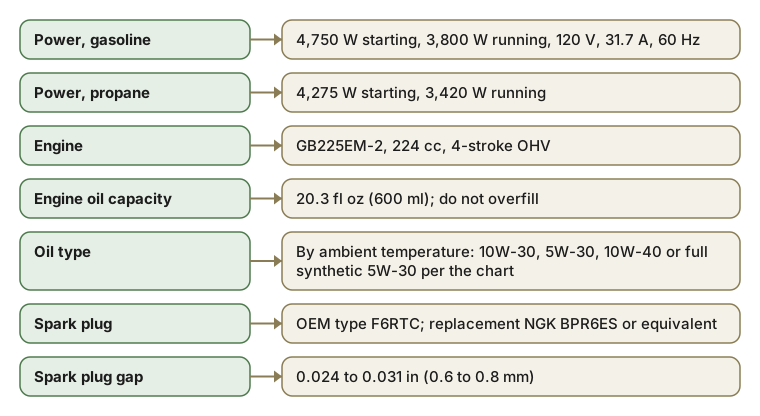
The Champion 201052 is rated at 4,750 starting and 3,800 running watts on gasoline and 4,275 starting and 3,420 running watts on propane. It has a GB225EM-2 224 cubic centimeter four-stroke OHV engine, electric and recoil start, a 4.7 gallon (17.7 liter) fuel tank, and weighs 123 pounds. The oil capacity is 20.3 fluid ounces (600 ml), and the carton includes that much oil.
| Item | Specification |
|---|---|
| Power, gasoline | 4,750 W starting, 3,800 W running, 120 V, 31.7 A, 60 Hz |
| Power, propane | 4,275 W starting, 3,420 W running |
| Engine | GB225EM-2, 224 cc, 4-stroke OHV |
| Engine oil capacity | 20.3 fl oz (600 ml); do not overfill |
| Oil type | By ambient temperature: 10W-30, 5W-30, 10W-40 or full synthetic 5W-30 per the chart |
| Spark plug | OEM type F6RTC; replacement NGK BPR6ES or equivalent |
| Spark plug gap | Permitted electrode gap: 0.024 to 0.031 in (0.6 to 0.8 mm) |
| Valve clearance | Intake 0.004 to 0.006 in (0.10 to 0.15 mm); exhaust 0.006 to 0.008 in (0.15 to 0.20 mm) |
| Gasoline tank | 4.7 US gal (17.7 L), unleaded 87 octane or higher, ethanol 10% or less |
| Battery | 12 V, 9 Ah rechargeable non-spillable lead acid |
Champion counts the first 5 hours as the break-in: stay at or below 50% of the running watts, then change the oil. Its warning on fuel is specific: do not use E15 or E85. Propane must come from an approved cylinder with an overfill prevention device valve.
The Champion 201052 dual fuel generator schedule
| When | What |
|---|---|
| Every 8 hours or before each use | Check oil level; clean around the air intake and muffler; check the propane hose for leaks. |
| First 5 hours (break-in) | Change the oil. |
| Every 50 hours or annually | Clean the air filter; change the oil if running under heavy load or in hot conditions. |
| Every 100 hours or annually | Change the oil; clean and adjust the spark plug; clean the spark arrestor; clean the fuel valve filter. |
| Every 250 hours | Clean the combustion chamber; check and adjust valve clearance. |
| Every 3 years | Replace the fuel line and the LPG hose. |
Champion marks the fuel valve filter, combustion chamber, valve and fuel line items for experienced owners or its certified service center, and points to a valve adjustment bulletin at its website. The engine has no oil filter. The air filter is a foam element that is washed, saturated in clean engine oil and squeezed out before it goes back.
Parts to buy for the Champion 201052 dual fuel generator
| Part | Part number |
|---|---|
| Spark plug, F6RTC | 100009378 |
| Air filter element | 100004771 |
| Air filter assembly | 100720109 |
| Fuel level filter | 100098838 |
20.3 oz
Oil capacity
600 ml; do not overfill.
BPR6ES
NGK replacement plug
OEM F6RTC, gap 0.6 to 0.8 mm.
250 h
Valve clearance check
Intake 0.10 to 0.15 mm.
Dual-fuel checks for the Champion 201052
101 Generator explains that Champion dual-fuel generators operate on gasoline or propane through a fuel system switch, and that a unit that will not start on propane usually points to the propane supply, the regulator or the switch position. ManualsLib lists a troubleshooting document for the 201052 alongside other dual-fuel electric-start models.
Electric start adds a battery to the service list, so check the battery and its connection as part of the yearly service alongside oil and plug.
Keeping the 201052's battery and electric start alive
Because this model has electric start, the Champion manual spends time on the battery. An automatic charging circuit charges it while the engine runs, and it stays charged if you use the generator about every two weeks. If you use it less often, Champion says to connect a trickle charger or battery maintainer, with a charging rate no higher than 1.5 amps, and to fully charge the battery at least once a month.
If the battery cannot start the engine, you can pull the recoil cord. If the battery voltage is extremely low, the charging circuit may not be able to recharge it, and the manual says to connect it to a standard automotive style battery charger first. New units ship with the two halves of the battery connector held apart by cable ties, which you cut and push together before first use.
201052 ratings, altitude jets and weight
The specification page lists 4,750 starting and 3,800 running watts on gasoline and 4,275 and 3,420 on propane, 31.7 amps at 120 volts, a 224 cc GB225EM-2 engine, a 4.7 gallon tank and a weight of 123 lb (56 kg). It gives 20.3 fl. oz. (600 ml) as the oil quantity and says oil should sit about one to two threads from running out of the fill hole, and not to screw the dipstick in when checking.
For high altitude, the manual says output falls about 3½% for every 1,000 feet, and offers an alternative main jet by carburetor code. For code 100718260 it lists jet 100005767 as the standard for 0 to 3,280 feet (0 to 1,000 m) and jet 100005754 for 3,281 to 9,842 feet (1,000 to 3,000 m). It warns that running the alternative jet below its minimum altitude can damage the engine.
The rotor bearing is sealed and pre-lubricated, so it needs no service.
Connecting propane to a 201052 and leak-testing it
The 201052 manual walks through the propane connection in five steps. Set the fuel select dial to ENGINE STOP, remove the rubber protective plug from the female connector of the LPG hose, pull and hold the outer collar, push it over the male connector and release, then pull on the hose to confirm it is seated.
Connect the other end to the cylinder valve and hand tighten, open the valve, and check every connection for leaks by wetting the fittings with soapy water. Bubbles that appear or grow mean a leak.
Turn the valve off, tighten the fitting, reopen and recheck, and if it keeps leaking or the leak is not at a fitting, do not use the generator and contact customer service.
The hose included works with standard 20, 30 and 40 pound cylinders. Check that the cylinder's requalification date has not expired, position the cylinder so the connection does not put sharp bends or kinks in the hose, and keep it upright with the valve on top at ground level, away from heat and out of sun, rain and dust. For transport and storage the manual says to turn off both the cylinder valve and the generator's LPG valve, disconnect the cylinder and fit the plug if one is available.
Filling, grounding and the neutral setting on a 201052
For gasoline, the manual says to leave a minimum of ¼ inch (6.4 mm) of space at the top of the tank for expansion, and that more is better, because fuel forced out by expansion can affect stable running. The fuel gauge on the tank top shows the approximate level, and the tank is full when the fuel reaches the red circle on the screen. It advises shutting off the gasoline and running the engine to starvation after each use, and says damage from ethanol blends above 10% by volume, improperly stored gasoline or stabilizers not formulated for ethanol blends is not covered by the warranty.
For grounding it asks for a heavy gauge copper wire, 12 AWG minimum, between the generator ground terminal and a copper rod driven into the ground. It also explains the neutral setting, which is why the specification page says floating neutral for this model. With a floating neutral the stator winding is isolated from the frame and from the receptacle ground pin, so devices that need a grounded receptacle pin will not work if that pin is not functional.
With a bonded neutral the neutral circuit is connected to the frame.
How the 201052 differs from Champion's smaller generators
Set beside the 200961 and the 100571, the 201052 is the outlier in size. It weighs 123 lb (56 kg) against 39 lb (17.9 kg) for the 200961 and 57.8 lb (26.2 kg) for the 100571, holds 4.7 gallons of gasoline against 1.1 and 1.2, and is the only one of the three with a battery and electric start. Its 224 cc engine is nearly twice the displacement of the 100571's 122 cc.
Its manual lists jet 100005767 as the standard for 0 to 3,280 feet and jet 100005754 for 3,281 to 9,842 feet.
The trade is practical. You get 3,800 running watts on gasoline and 3,420 on propane, enough for loads the small units cannot start, but you also take on a battery to maintain and a heavier machine to move and store. If the battery is dead the manual tells you to fall back on the recoil cord, which is the reason to keep the pull start in working order even though you rarely use it.
The 201052 governor and air-fuel mixture are not user adjustments
Many owners expect to tune a generator carburetor, and this manual closes that door. Under the heading Adjusting the Governor it says that tampering with the factory set governor will void the warranty, that the air-fuel mixture is not adjustable, and that tampering can damage the generator and any electrical devices connected to it. For any other adjustment it directs you to Champion's Technical Support Team at 1-877-338-0999.
The maintenance schedule then sets the intervals you can do yourself: the first 5 hours are the break-in, at every 50 hours or annually you clean the air filter and, under heavy load or hot conditions, change the oil, at every 100 hours or annually you change the oil and clean the spark plug, spark arrestor and fuel valve filter, at every 250 hours a knowledgeable service center cleans the combustion chamber and checks valve clearance, and every 3 years the fuel line and LPG hose are replaced.
- Spark plug, F6RTC: NGK BPR6ES is the equivalent.
- Air filter element: Foam element.
- Air filter assembly: Base 100727318, cover 100087055.
Champion 201052 dual fuel generator: questions
How much oil does a Champion 201052 generator take?
20.3 fluid ounces (600 ml), and the carton includes that amount of oil. Do not overfill, and check the level before each use.
What oil should the Champion 201052 run on?
10W-30 is the typical choice. The manual’s chart also shows 5W-30, 10W-40 and full synthetic 5W-30 by ambient temperature, so change the type when the season changes.
Which spark plug fits the Champion 201052?
The engine comes with an F6RTC. Champion lists NGK BPR6ES or equivalent as the replacement, set to a gap of 0.024 to 0.031 inch (0.6 to 0.8 mm).
When should I first change oil in a Champion 201052?
After the 5 hour break-in, during which you stay at or below 50% of the running watts. Later oil changes come every 100 hours or annually, or every 50 hours under heavy load.
What engine does the Champion 201052 have?
A GB225EM-2, 224 cubic centimeters, four-stroke OHV, with electric and recoil start. The generator weighs 123 pounds.
How many watts is the Champion 201052 on propane?
3,420 running and 4,275 starting watts, against 3,800 running and 4,750 starting on gasoline. Use an approved cylinder with an OPD valve.
What are the valve clearances on the Champion 201052?
Intake 0.004 to 0.006 inch and exhaust 0.006 to 0.008 inch, or 0.10 to 0.15 mm and 0.15 to 0.20 mm. Champion schedules the check every 250 hours.
How big is the fuel tank on the Champion 201052?
4.7 gallons (17.7 liters). Use unleaded gasoline of 87 octane or more with 10% ethanol or less, and never E15 or E85.
What battery does the Champion 201052 use?
A 12 volt, 9 amp-hour rechargeable non-spillable lead acid battery for the electric start.
How do I clean the Champion 201052 air filter?
Every 50 hours or annually: take out the foam element, wash it, saturate it in clean engine oil and squeeze it in a cloth to remove the excess before refitting.
What are the Champion 201052 air filter and spark plug part numbers?
The air filter element is Champion part 100004771 and the whole air filter assembly is 100720109. The spark plug is 100009378, an F6RTC, and NGK BPR6ES is the equivalent. The engine has no oil filter, so an oil change is a drain and refill.
What is replaced every 3 years on the Champion 201052?
The fuel line and the LPG hose. Champion marks these, the valve check and the combustion chamber cleaning for experienced owners or certified service center.
Champion 100571 inverter generator: oil capacity, spark plug and schedule
The Champion 100571 takes 12.9 fluid ounces (380 ml) of oil and an A5RTC spark plug, replaced by NGK CR6HSA, gapped 0.024 to 0.031 inch. Champion says to change the oil after the first 5 hours and then every 100 hours or annually, with the valves checked every 250 hours. It holds 1.2 gallons of unleaded fuel.
Remove and ground the spark plug wire before any service, and never run the generator indoors.
A 2,300-watt inverter generator with a 122 cc engine
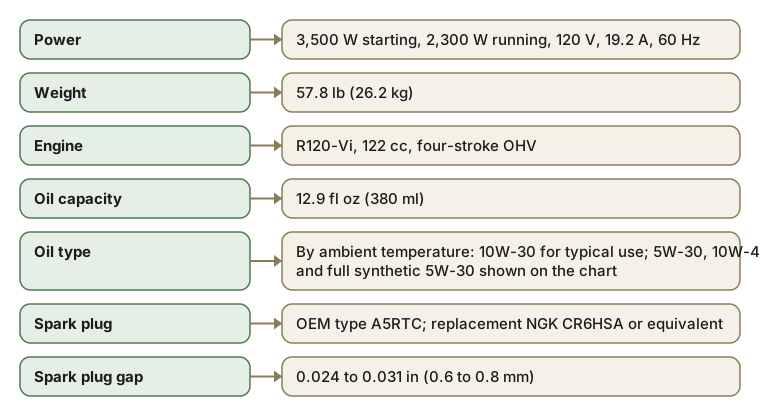
The Champion 100571 is rated at 3,500 starting and 2,300 running watts, weighs 57.8 pounds, and has an R120-Vi 122 cubic centimeter four-stroke overhead-valve engine. The engine takes 12.9 fluid ounces (380 ml) of oil, and the unit ships with a 13.5 fluid ounce (400 ml) bottle.
| Item | Specification |
|---|---|
| Power | 3,500 W starting, 2,300 W running, 120 V, 19.2 A, 60 Hz |
| Weight | 57.8 lb (26.2 kg) |
| Engine | R120-Vi, 122 cc, four-stroke OHV |
| Oil capacity | 12.9 fl oz (380 ml) |
| Oil type | By ambient temperature: 10W-30 for typical use; 5W-30, 10W-40 and full synthetic 5W-30 shown on the chart |
| Spark plug | OEM type A5RTC; replacement NGK CR6HSA or equivalent |
| Spark plug gap | Permitted electrode gap: 0.024 to 0.031 in (0.6 to 0.8 mm) |
| Valve clearance | Intake and exhaust 0.002 to 0.006 in (0.05 to 0.15 mm) |
| Fuel tank | 1.2 US gal (4.5 L), unleaded 87 octane, ethanol 10% or less |
The manual treats the first 5 hours as the break-in period: stay at or below 50% of the running watt rating, then change the oil. Synthetic may be used after break-in, and Champion says it does not shorten the recommended oil change interval.
The Champion 100571 inverter generator schedule
| When | What |
|---|---|
| Every 8 hours or before each use | Check the oil level; clean around the air intake and muffler. |
| First 5 hours (break-in) | Change the oil. |
| Every 50 hours or annually | Clean the air filter; change the oil if operating under heavy load or in hot environments. |
| Every 100 hours or annually | Change the oil; clean and adjust the spark plug; clean the spark arrestor; clean the fuel valve filter. |
| Every 250 hours | Clean the combustion chamber and check and adjust the valve clearance. |
Champion marks the fuel valve filter, combustion chamber and valve clearance items for a certified service dealer. To change the oil, run it warm, tilt the generator onto its side with the oil fill cap off, drain it fully and refill without overfilling. The engine has no oil filter to change.
Parts to buy for the Champion 100571 inverter generator
| Part | Part number |
|---|---|
| Spark plug, A5RTC | 30010-000005 |
| Air cleaner | 17100-000022 |
| Fuel filter | 16652-000007 |
| Fuel tank filter element | 16514-000002 |
| Oil dipstick subassembly | 15010-000024 |
Order from Champion at 1-877-338-0999 or shop.championpowerequipment.com.
Air filter and storage
The 100571 has a foam air filter element. Champion’s steps are to remove the oil-side maintenance cover, take off the air filter cover, wash the foam in liquid detergent and water, squeeze it dry throughout in a clean cloth, saturate it in clean engine oil, squeeze out the excess in an absorbent cloth, and refit it. Champion also says the spark arrestor must be cleaned of carbon with a wire brush and replaced if damaged.
| Storage period | What the manual says to do |
|---|---|
| Up to 30 days | Run the engine with the EZ Start dial at RUN OUT OF FUEL if you will not use it within 2 to 4 weeks, then clean it and store it cool and dry out of direct sunlight. |
| 30 days to 1 year | Add a fuel stabilizer, run it 10 minutes, run it out of fuel, let it cool, put about a tablespoon of oil into the cylinder through the spark plug hole, and pull the recoil slowly to spread it. |
| More than 1 year | Drain the fuel tank and carburetor completely through the drain screw, then follow the mid-term steps. |
The manual gives gasoline in the tank a shelf life of up to a year with a stabilizer in a cool, dry place, but warns that fuel left in the carburetor can gum and clog it within 2 to 4 weeks. When taking it out of storage, check for fuel leaks after 5 minutes of running and check the oil level first.
12.9 oz
Oil capacity
380 ml; a 13.5 oz bottle is supplied.
CR6HSA
NGK replacement plug
OEM type A5RTC, gapped 0.6 to 0.8 mm.
5 h
First oil change
Then every 100 hours or annually.
Reading the Champion 100571's numbers before you buy parts or plan a load
The 3,500 in the name is the surge figure. EnergyReckon's review points out that 2,300 watts running is the number that matters for sizing, which puts the 100571 nearer the small-inverter class than a 3,000-watt-running generator with a similar-sounding name, and lists 57.8 lb, 58 dBA, CO Shield and parallel capability as solid for the class.
WikiGenerators compares its runtime with a 2,300-watt rival on a similar 1.18-gallon tank and finds the Champion runs more than twice as long per gallon at half load. For maintenance that means the schedule above is driven by run hours, so a generator used for weekend camping and one used as a nightly RV supply reach the first oil change at very different dates.
High altitude, the Intelligauge and CO Shield on the 100571
The operator’s manual says engine power and generator output fall about 3½% for every 1,000 feet above sea level, with harder starting, higher fuel use and spark plug fouling as other high altitude symptoms. Champion offers a high altitude carburetor main jet and tells you to identify your carburetor by the code stamped on its side.
For carburetor code 16100-Z2X0210-00A0 it lists jet 16161-Z150910-00A1 for use from 3,000 feet (914 m) and jet 16161-Z150610-00A0 from 6,000 feet (1,829 m). Installation instructions come from Champion's technical support or its technical bulletin page.
The digital Intelligauge cycles through five modes: voltage, frequency, run time for the current session, total run time since first use, and a power meter as a percentage of output. Use the accumulated hours in total run time mode to determine when the 50, 100 and 250 hour services in the schedule fall due. A CO Shield LED sits beside it.
If the sensor detects elevated carbon monoxide, the manual says it shuts the engine off automatically, and it warns that tampering with the system or removing the module will not allow the generator to run.
Numbers from Champion's parts list for the 100571
Champion's parts information sheet for the 100571 (serial number range: all) lists the engine as an R120-VI of 122 cc, with the spark plug A5RTC, a recoil starter assembly, an ignition coil and igniter, an engine oil sensor, a fuel tank cap, a fuel filter and a separate filter element in the fuel tank. It also lists a CO alarm part, a rectifier, the 120 volt inverter and a dual-port USB adapter rated 5 volts at 2.4 amps.
The manual's specification page puts the generator at 3,500 starting and 2,300 running watts, 19.2 amps at 120 volts, a 12 volt DC output of 8 amps, a weight of 57.8 lb (26.2 kg) and a 1.2 gallon tank. It lists NGK CR6HSA as the replacement plug and 12.9 fl. oz. (380 ml) of oil, with 5W-30 or 10W-40 by temperature and full synthetic 5W-30 as options.
When a 100571 shuts down by itself: the CO Shield fault table
The manual's troubleshooting table has two separate CO Shield entries, and they mean different things. If the red LED on the panel blinks when the engine shuts down, carbon monoxide is accumulating near the generator.
Champion says to move it to an open outdoor area, point the exhaust away from people and buildings, and make sure nothing obstructs the space within 5 feet of the generator, because obstructions can trap the gas and cause a shutoff. See the operator’s manual for the full table.
If the exhaust faces into the wind, the wind can blow it back into the operating area and trigger the shutoff. Champion's fix is to turn the generator 45° in either direction so the exhaust blows away from it, and if shutoffs continue, to realign it with the wind direction. If instead the yellow LED blinks, the system has a fault.
Start by confirming that the yellow light blinks when the generator shuts off, and if the shutoff continues, contact technical support. The table also lists a removed or tampered CO Shield module as a reason the engine will not start at all, with the remedy of reinstalling the module or calling support.
The 100571 against the 200961 and 201052
Among Champion's three generators covered here, the 100571 is the gasoline-only one. It has no propane hose, no fuel select dial and no LPG hose to replace every three years, which removes one item from the maintenance schedule the other two carry. In exchange you get the Intelligauge and its total run time reading, which neither of the others describes, and a 12 volt DC output rated 8 amps.
On raw numbers it sits in the middle: 3,500 starting and 2,300 running watts, against 2,500 and 1,850 for the 200961 and 4,750 and 3,800 for the 201052. At 57.8 lb (26.2 kg) it weighs 18 lb more than the 200961 and about half the 201052's 123 lb. Its 122 cc engine is smaller than the 201052's 224 cc, which is why it is the lower-watt machine of the two larger units.
Choose it when you want inverter-quiet power, no fuel switching and a meter that tells you how many hours you have run.
- Spark plug, A5RTC: NGK CR6HSA is the equivalent.
- Air cleaner: Air cleaner assembly.
Champion 100571 inverter generator: questions
How much oil does a Champion 100571 take?
12.9 fluid ounces (380 ml). The unit ships with a 13.5 fluid ounce (400 ml) bottle. Do not overfill.
What oil should I use in the Champion 100571?
10W-30 automotive oil is recommended for typical use. The chart also shows 5W-30, 10W-40 and full synthetic 5W-30 by temperature; full synthetic 5W-30 helps starting below 41°F.
What spark plug does the Champion 100571 use?
The original is type A5RTC; the manual lists NGK CR6HSA or equivalent as the replacement. The gap is 0.024 to 0.031 inch (0.6 to 0.8 mm).
When is the first oil change on the 100571?
After the first 5 hours of run time, the break-in period. Stay at or below 50% of the running watt rating during it. After that, change the oil every 100 hours or annually.
Can I use synthetic oil in the 100571?
Yes, after the 5 hour break-in. Champion says synthetic does not shorten the recommended oil change interval.
How big is the 100571 fuel tank?
1.2 US gallons (4.5 liters). Use unleaded gasoline of at least 87 octane with 10% ethanol or less; do not use E15 or E85.
What engine is in the Champion 100571?
An R120-Vi, 122 cubic centimeters, four-stroke overhead-valve. It is rated 3,500 starting and 2,300 running watts.
What is the valve clearance on the 100571?
Intake and exhaust are both 0.002 to 0.006 inch (0.05 to 0.15 mm). Champion schedules the check every 250 hours and marks it for a certified service dealer.
How often do I clean the 100571 air filter?
Every 50 hours or annually. Clean around the air intake and muffler every 8 hours or before each use.
How do I change the oil on the 100571?
Change it when warm. Remove the oil drain side cover and the fill cap, tilt the generator onto its side to drain fully, then add oil without overfilling and check the level.
What are the Champion 100571 filter and spark plug part numbers?
The spark plug is Champion part 30010-000005, an A5RTC, and the air cleaner assembly is 17100-000022. The fuel filter is 16652-000007 and the fuel tank filter element is 16514-000002. The engine has no oil filter.
Where do the Champion 100571 figures come from?
Champion’s operator’s manual for the 100571, revision dated January 2023. Check the current manual for your serial number.
Champion 100522 3500W generator: oil capacity, spark plug, break-in and schedule
The Champion 100522 3500-watt portable generator has a 208 cc FH210 engine that takes 20.3 fluid ounces (0.6 US quart) of oil, 10W-30 for typical use. The spark plug is an NGK BPR6ES or equivalent, gapped 0.024 to 0.031 inch. Champion defines the first 5 hours as a break-in at half load or less, then an oil change, and after that an oil change every 100 hours or annually.
Fuel is unleaded 87 octane with 10% ethanol or less, and E15 is not allowed.
Run the generator outdoors, in a well-ventilated area and away from doors, windows and vents. Champion sells other generators with different engines, so check the model number on the generator’s label before you use any figure.
A 3,500-watt generator on a 208 cc engine with a break-in rule
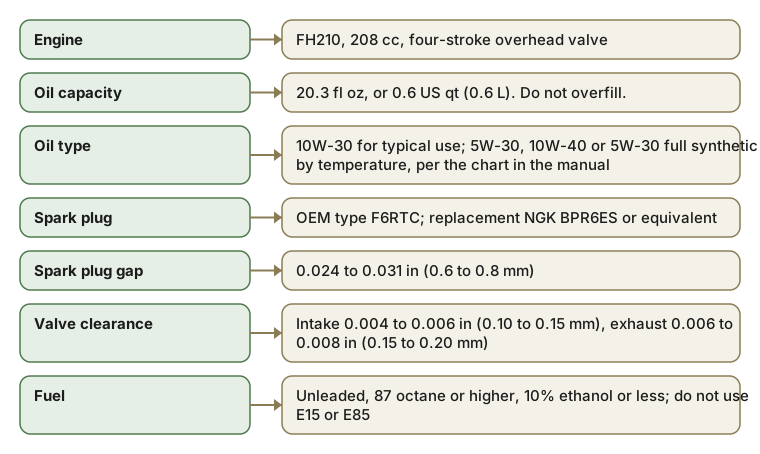
Model 100522 is Champion’s 3,500 running-watt portable generator, 4,375 starting watts, with a manual recoil start and an FH210 engine of 208 cubic centimeters. It weighs 108.5 pounds, holds 4.7 gallons of fuel and has a low-oil shut-off that stops the engine when the crankcase oil drops below a threshold. Unusually for a manual, it gives an explicit break-in procedure.
| Item | Specification |
|---|---|
| Engine | FH210, 208 cc, four-stroke overhead valve |
| Oil capacity | 20.3 fl oz, or 0.6 US qt (0.6 L). Do not overfill. |
| Oil type | 10W-30 for typical use; 5W-30, 10W-40 or 5W-30 full synthetic by temperature, per the chart in the manual |
| Spark plug | OEM type F6RTC; replacement NGK BPR6ES or equivalent |
| Spark plug gap | Permitted electrode gap: 0.024 to 0.031 in (0.6 to 0.8 mm) |
| Valve clearance | Intake 0.004 to 0.006 in (0.10 to 0.15 mm), exhaust 0.006 to 0.008 in (0.15 to 0.20 mm) |
| Fuel | Unleaded, 87 octane or higher, 10% ethanol or less; do not use E15 or E85 |
| Fuel tank | 4.7 gal (17.8 L) |
| Output | 4,375 starting and 3,500 running watts, 120 V, 29.2 A, 60 Hz |
| Operating temperature | Continuous up to 104°F (40°C); 5°F to 122°F for short periods |
Break-in, then the schedule
The manual defines the first 5 hours of run time as the break-in period. During it the load should stay at or below 50% of the running watt rating, and be varied from time to time so the stator windings heat and cool and the engine speed varies enough to help seat the piston rings. After the 5 hours, change the oil.
The generator’s control panel shows current and total run time, so the count does not depend on your memory.
| When | What |
|---|---|
| Every use | Check the engine oil level and add oil as needed. |
| After the first 5 hours | Change the oil, ending the break-in period. |
| Every 100 hours or annually | Change the oil, clean and adjust the spark plug, check and adjust the valve clearance, clean the spark arrestor, and clean the fuel tank and filter. |
| Every 250 hours | Clean the combustion chamber. |
| Every 3 years | Replace the fuel line. |
Champion marks valve clearance, the fuel tank and filter cleaning, the combustion chamber and the fuel line as jobs for knowledgeable, experienced owners or a certified service center. It also says a technical bulletin on valve adjustment is on its website. Where you live above about 3,281 feet, the manual lists a high-altitude jet by carburetor code, so ask before running the generator at height with the standard jet.
Parts to buy for the Champion 100522 3500W generator
| Part | Part number | Notes |
|---|---|---|
| Spark plug, OEM | Torch F6RTC | Gap 0.024 to 0.031 in. |
| Spark plug, replacement | NGK BPR6ES | Same gap. |
| Air filter | Amazon B07VPQZZDS | Foam element that also fits the Champion 3400, 3500, 4000 and 4375 watt models. |
| Engine oil | SAE 10W-30 | 20.3 fl oz (0.6 qt). No oil filter on this engine. |
5 h
Break-in, at half load or less
Then change the oil; vary the load as it runs.
0.6 qt
Oil capacity
Twenty and a third fluid ounces. Do not overfill.
No E15
Fuel warning
Ten percent ethanol or less, at 87 octane or above.
Champion 100522 3500W generator: questions
How much oil does a Champion 3500 watt generator take?
On model 100522, 20.3 fluid ounces, or 0.6 US quart (0.6 liter), and Champion says not to overfill. Other Champion 3500 watt models use different engines, so check the model number on the generator’s label before using this figure.
What oil should I use in the Champion 100522?
10W-30 automotive oil for typical use. For extreme temperatures the manual’s chart offers 5W-30, 10W-40 or 5W-30 full synthetic, depending on the ambient temperature. The engine has a low oil shut-off that stops it when the crankcase level falls too low.
What is the break-in procedure for the Champion 100522?
The first 5 hours of run time are the break-in period. Stay at or below 50% of the running watt rating and vary the load now and then, then change the oil after the 5 hours. The panel shows total run time, so you can see when it ends.
What spark plug does the Champion 100522 use?
The original plug is type F6RTC, and Champion’s replacement is an NGK BPR6ES or equivalent, gapped 0.024 to 0.031 inch (0.6 to 0.8 mm). Clean and adjust it every 100 hours or annually.
How often should I change the oil in the Champion 100522?
After the first 5 hours, then every 100 hours or annually. The oil level is checked at every use, and added to if needed. Change the type of oil with the temperature, as the chart in the manual shows.
What is the valve clearance on the Champion 100522?
Cold, the intake is 0.004 to 0.006 inch (0.10 to 0.15 mm) and the exhaust is 0.006 to 0.008 inch (0.15 to 0.20 mm). Champion lists it as a job for knowledgeable owners or a certified service center, and has a technical bulletin on its website.
What fuel does the Champion 100522 use?
Unleaded gasoline of at least 87 octane with 10% ethanol or less by volume. Do not use E15 or E85, and do not overfill. The tank holds 4.7 gallons (17.8 liters), and the fuel should be fresh.
How many watts is the Champion 100522?
4,375 starting watts and 3,500 running watts, at 120 volts and 29.2 amps, 60 hertz, single phase. It weighs 108.5 pounds and has a manual recoil start. Do not exceed the running rating for continuous use.
What is the operating temperature range of the Champion 100522?
Continuous operation up to 104°F (40°C), and from 5°F to 122°F for short periods. The starting range is 5 to 104°F. Always run it outdoors, in a well-ventilated area, away from doors, windows and vents.
Does the Champion 100522 have a high altitude jet?
The manual lists two high-altitude jet part numbers by carburetor code, one from 3,281 feet (1,000 meters) and one from 6,562 feet (2,000 meters). Find the code stamped on the side of the carburetor to choose the right jet.
How often should the fuel line be replaced on the Champion 100522?
Every 3 years, and Champion marks it as a job for knowledgeable, experienced owners or a certified service center. The combustion chamber is cleaned every 250 hours, and the fuel tank and filter every 100 hours or annually.
Can I run the Champion 100522 in the rain?
Not unprotected. Champion says not to spray the generator with water, because water can enter through the cooling slots and damage the windings. Run it outdoors under a dry, open-sided cover, away from the building.