Simpson pressure washer: engine versus pump oil service
Identify the engine and pump separately before servicing a Simpson washer. Some OEM Technologies axial pumps have sealed, maintenance-free crankcases; they do not use the oil-change routine for a serviceable pump.
Engine oil still follows the engine’s own manual. Never pour pump oil into the engine or infer either capacity from the washer’s pressure rating.
First identify the pump’s service design
Simpson’s 90026 pump listing explicitly describes a maintenance-free crankcase with no oil changes. That does not make every axial pump identical. Read the actual pump label and manual before opening a plug or adding oil.
For serviceable pumps, the 80138 product page describes 15W-40 pump crankcase oil. Product compatibility does not establish how much a particular pump takes or its change interval.
The broad hot-water booklet is not a universal schedule
Manual 7111522 Rev A covers multiple machines and components. Its maintenance table gives pump oil service after 25 hours, then three months or 150 hours, while an earlier passage says 50 hours initially, then 100 hours or three months. Use the instruction for the actual pump and resolve any conflict with Simpson before servicing it.
| Printed figure | Required qualification |
|---|---|
| Pump oil: 11–42 oz | A range across pumps, not a refill quantity |
| Gas-engine oil: 0.63–3 qt | Check the actual engine manual |
| Axial-pump oil-change exception | Applies to the described filled-for-life design |
| Three-month pump limit in both passages | Does not apply automatically to a sealed crankcase |
The range from 11 to 42 ounces spans 31 ounces. One 16-ounce bottle would exceed the smaller quantity by five ounces and fall 26 ounces short of the larger. Buying a bottle cannot resolve pump identity; fill by the applicable level instruction.
Pressure and freeze damage require separate checks
Stop the engine and relieve pressure by the manual’s procedure before disconnecting equipment. A leaking high-pressure hose or injection injury is not a routine oil-service problem. Never search for a pressure leak with a hand.
Drain and protect water-carrying components using the model’s storage instructions before freezing conditions. Draining engine oil does not drain the pump, hose or wand. A hot-water burner introduces additional fuel and electrical service tasks that a cold-water machine does not share.
Pressure washer maintenance: engine oil, pump oil and schedule (Simpson)
A gas pressure washer has separate engine and pump instructions; the pump-oil procedure applies only to a serviceable crankcase. The engine takes SAE 10W-30, changed after the first 10 hours and then every 50, and the pump has its own crankcase that takes SAE 15W-40 or Simpson pump oil in 11 to 42 ounces, changed after the first 25 hours and then every 3 months or 150 hours. The manual gives a second, different pump-oil interval elsewhere, and the three-month limit appears in both.
Nozzles are replaced every 6 months and the high-pressure hose annually, and Simpson warns against operating or storing below 40°F.
Never point the wand at a person, and never spray high-pressure water onto the machine itself. Do not operate or store a pressure washer where the temperature falls below 40°F (4°C). Freeze damage is not covered by the warranty.
Not every item applies to every machine.
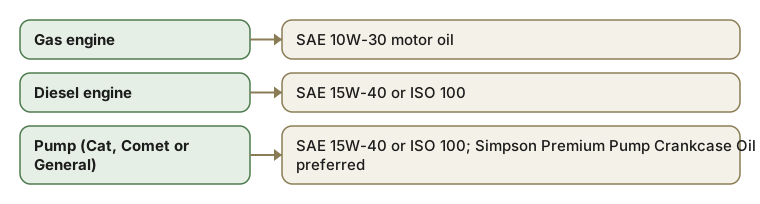
Two oils and a pump: the part most owners forget
A gas pressure washer has separate engine and pump instructions. A sealed maintenance-free pump is not serviced like a refillable crankcase. The engine has its own oil, exactly like a mower or generator.
A serviceable pump has its own crankcase oil and interval, and it is the one that is skipped. Simpson’s manual keeps the two apart, and it is clear that the pump oil is its own product, not engine oil.
| Component | Oil type | Capacity |
|---|---|---|
| Gas engine | SAE 10W-30 motor oil | 0.63 to 3 qt, depending on the engine |
| Diesel engine | SAE 15W-40 or ISO 100 | 1.7 to 3.3 qt |
| Pump (Cat, Comet or General) | SAE 15W-40 or ISO 100; Simpson Premium Pump Crankcase Oil preferred | 11 to 42 oz, depending on the pump |
The engine figure is a range because the manual covers many engines; your engine’s own capacity is on its page or in its manual, such as the Honda GCV160 and GCV190 or GX series that many washers carry. Axial pumps, Simpson says, come filled with synthetic oil that does not require changing.
The Pressure washer maintenance schedule
| Item | Interval |
|---|---|
| Engine oil, inspect | Daily |
| Engine oil, change | After the first 10 hours, then every 50 hours, especially in high ambient temperatures |
| Engine oil filter, if fitted | Every 100 hours |
| Air cleaner | Inspect every 25 hours; clean every 3 months |
| Pump oil, inspect | Daily; the level should reach the dot in the middle of the sight glass |
| Pump oil, change | After the first 25 hours, then every 3 months or 150 hours |
| Engine fuel filter and spark plug | Every 500 hours or 6 months |
| Fuel tank clean, fuel lines replace | Annually |
| Spray nozzle | Replace every 6 months |
| Quick connects and high-pressure hose | Replace annually, more often if required |
| Water screen or filter | Clean weekly |
| Belts, if fitted | Tighten every 6 months; inspect and replace annually |
One inconsistency inside the manual is worth knowing. The maintenance table says to change pump oil after the first 25 hours and then every 3 months or 150 hours. An earlier passage describing pump oil says after the first 50 hours and every 100 hours or 3 months.
The earlier passage sits among the descriptions of hot-water machines, and the booklet covers several types. The three-month limit appears in both, so for a homeowner who runs the washer a few hours a year, the calendar interval governs and the pump oil is changed every three months either way, or at the interval printed for your specific pump.
Parts to buy for the Pressure washer maintenance
| Part | Part number | Notes |
|---|---|---|
| Pump crankcase oil, 15W-40 | Simpson 80138 (also 7106737) | 16 oz bottle; the pump crankcase takes 11 to 42 oz depending on the pump. |
| Engine oil | SAE 10W-30 | First change at 10 hours, then every 50. |
10W-30
Gas engine oil
Change after the first 10 hours, then every 50.
15W-40
Pump oil
Or Simpson Premium Pump Crankcase Oil; 11 to 42 oz by pump.
40°F
The temperature to stay above
Freeze damage is excluded from the warranty.
For storage, drain the high-pressure hose, point the nozzle down and squeeze the trigger to drain the gun and wand, and store the machine upright. Follow the engine manual for the engine’s storage.
Pressure washer maintenance: questions
What oil goes in a pressure washer pump?
Simpson prefers its own Premium Pump Crankcase Oil, and says SAE 15W-40 or ISO 100 oil may be used if that is not available. The pump takes 11 to 42 ounces depending on the pump. It is not engine oil.
How often should I change pressure washer pump oil?
Simpson’s maintenance table says after the first 25 hours and then every 3 months or 150 hours. Another passage in the same manual says after the first 50 hours and every 100 hours or 3 months. The 3-month limit is common to both.
The identified maintenance-free axial pumps have no oil-change requirement; confirm the particular pump, rather than generalizing from its geometry.
What oil does the engine on a pressure washer use?
For a gas engine, SAE 10W-30 motor oil, in a capacity of 0.63 to 3 quarts depending on the engine. Change it after the first 10 hours and then every 50 hours, especially in high heat. Check the level before each use.
How do I check the pump oil level?
Look at the sight glass. Simpson says the oil level should come to the dot in the middle of the sight glass, and to check it daily before use.
How often should I replace a pressure washer nozzle?
Every 6 months, according to Simpson’s schedule. A worn nozzle widens its spray and lowers the pressure at the surface. The quick connects and the high-pressure hose are replaced annually, or sooner if damaged.
How often should I change the spark plug on a pressure washer?
Simpson lists spark plug maintenance and the engine fuel filter every 500 hours or 6 months. The engine maker’s manual can give a shorter interval, such as a yearly plug on the Honda engines, so use the tighter of the two.
Can I run a pressure washer in freezing weather?
No. Simpson says not to operate or store a pressure washer in temperatures below 40°F (4°C), and that freeze damage is not covered by the warranty. Water left in the pump can freeze and crack it.
How do I store a pressure washer?
Drain the high-pressure hose, point the nozzle down with the gun and wand vertical and squeeze the trigger to drain them, protect the chemical siphon hose, and store the unit upright. Follow the engine manual for the engine.
How often should I clean the water inlet screen?
Weekly, according to the schedule. A clogged inlet screen starves the pump and can damage it, and running without the screen installed may void the warranty.
How often should the air cleaner be serviced on a pressure washer?
Inspect it every 25 hours and clean it every 3 months, more often in dust. The engine manual gives the details for its filter type.
Should I replace the fuel lines on my pressure washer?
Simpson lists cleaning the fuel tank and replacing the fuel lines annually. Ethanol fuel hardens rubber over time, and a cracked line is a fire risk, so replace any that show cracks or stiffness.
Do all pressure washers use the same maintenance?
No. Simpson’s manual says not all items apply to all machines, since it covers gas, diesel, electric and hot-water washers.